
The Fire at Crumwold Hall and the Hidden Origins of Modern Charismatic Power
The Fire at Crumwold Hall and the Hidden Origins of Modern Charismatic Power
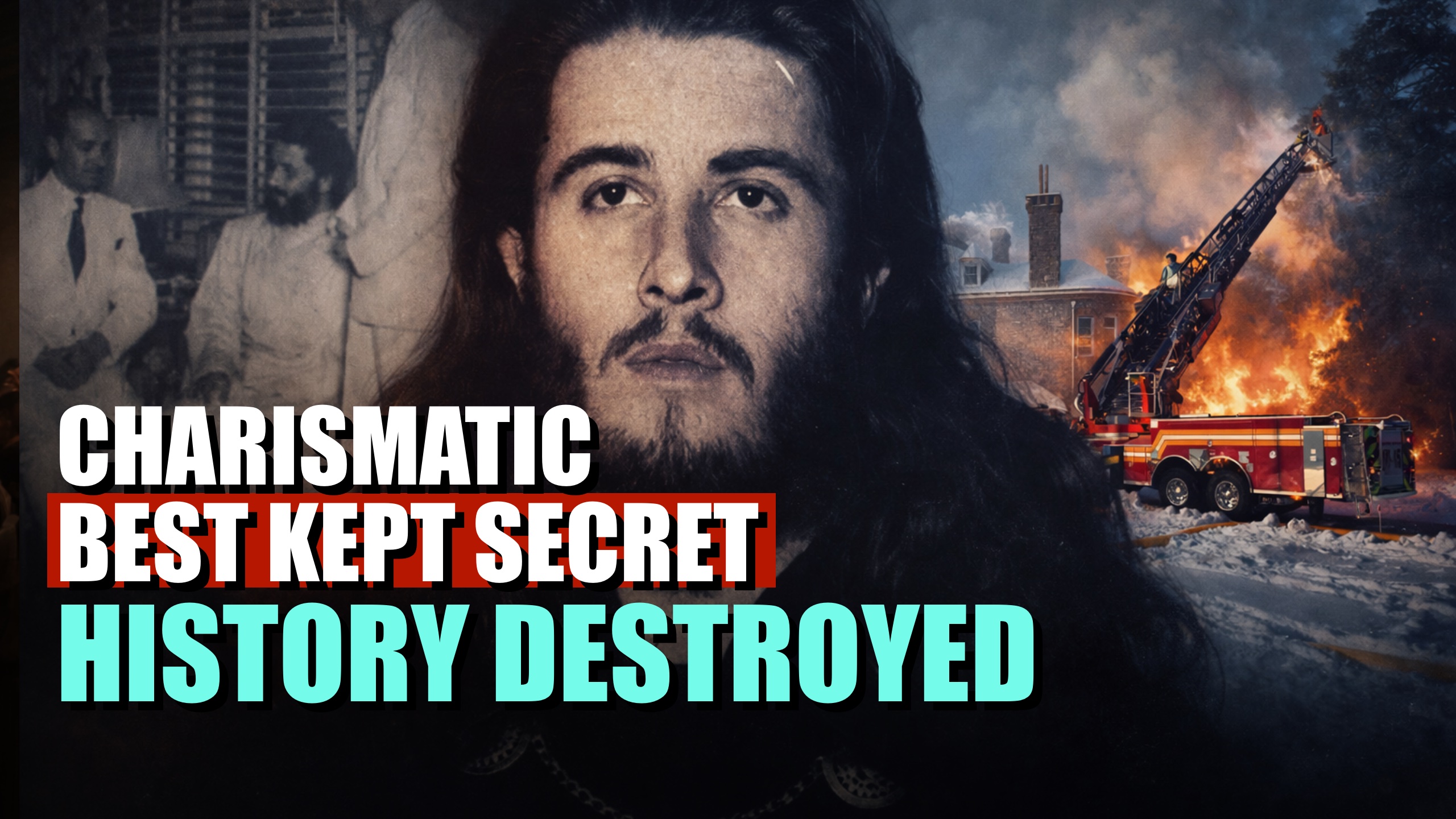
Unless you were actively watching local Hudson Valley news, you may have missed what happened on January 1, 2026.
Crumwold Hall, a historic estate in Hyde Park, New York, was engulfed in a massive fire that displaced its residents and likely rendered the structure beyond recovery. On the surface, the story appears to be a tragic but straightforward loss of a historic property. Beneath that surface lies a much deeper—and deliberately obscured—religious history.
For decades, Crumwold Hall has been operated by the Millennial Kingdom Family Church, a reclusive group with roots in one of the most consequential—and least examined—streams of twentieth-century faith-healing and revivalism. The fire did more than destroy a building. It erased a physical anchor point tied to the origins of Branhamism, the Latter Rain movement, the modern charismatic movement, and ultimately the New Apostolic Reformation.
Why Crumwold Hall Matters
The Millennial Kingdom Family Church traces its origins to the cultic following of Avak Hagopian, an Armenian faith healer whose arrival in the United States in the mid-1940s ignited a nationwide frenzy. When Hagopian arrived in Palm Springs to heal the crippled son of a wealthy vineyard owner, thousands of sick and desperate people flooded the city. Newspapers reported shortages of housing, impromptu food stands, and wealthy residents opening their homes to invalids who had come seeking miracles.
This was not a minor revival. It was a cultural moment that re-energized a Pentecostal movement widely regarded by historians as fading by the mid-1940s. Hagopian's popularity created the conditions for something new to emerge.
William Branham's Sudden Rise
Before 1947, William Branham was virtually unknown. Contemporary newspaper records show little to no coverage of his ministry prior to that year. Branham himself admitted to repeated failures in launching a healing ministry, including a period of retreat following the death of his first wife from tuberculosis—a devastating blow for someone claiming divine healing authority.
Everything changed after Hagopian's rise. As Hagopian's campaigns overwhelmed a single individual's capacity, sponsors began experimenting with parallel figures. Branham was one of them. From 1947 onward, Branham's name suddenly appears in newspapers nationwide, coinciding precisely with Hagopian's decline and eventual withdrawal from the public stage.
Money, Power, and Pentecostal Networks
Behind the scenes were wealthy Pentecostal patrons—most notably the Kardashian family—who were deeply involved in early Pentecostalism and Christian Identity circles. These networks overlapped with figures such as Gordon Lindsay, Branham's early campaign manager, and later extended into institutional engines like the Full Gospel Business Men's Fellowship International, co-founded by Demos Shakarian.
That organization became the financial and relational backbone of the charismatic movement. Ministries that later shaped American Christianity—including those connected to the Osteen family—were rescued, funded, and amplified through these networks. Remove Hagopian from the equation, and the entire cascade of events looks radically different.
From Faith Healer to Messianic Figure
After his public ministry faded, Hagopian's followers became increasingly isolated and destructive. Over time, the Millennial Kingdom movement came to believe Hagopian was not merely a healer, but the return of Christ himself—the sole mediator between God and humanity. Former members have reported that Hagopian's body was kept at Crumwold Hall, a claim consistent with patterns seen in other high-control religious groups.
This belief system echoes themes later popularized by Branham: a hidden angelic mediator, supernatural authority inaccessible to outsiders, and unquestionable leadership validated by mystical experience rather than evidence. Even Branham's shifting descriptions of his "angel"—changing in appearance over the years—bear striking resemblance to contemporary newspaper descriptions of Hagopian himself.
The Fire and the Silence
The January 2026 fire displaced eleven residents and consumed hundreds of thousands of gallons of water as firefighters battled the blaze for nearly twelve hours. Officials have indicated the structure will almost certainly be condemned, and the cause of the fire remains unknown. What is equally striking is what mainstream coverage does not address: the historical and theological significance of what was lost.
Crumwold Hall was not just a building. It was a linchpin—one of the last physical remnants of a movement that reshaped global Christianity while actively concealing its own origins. The destruction of that site removes a tangible link to a story few of these movements want told.
Modern charismatic and apostolic movements often present themselves as spontaneous revivals or purely spiritual awakenings. The history tied to Crumwold Hall tells a different story—one of failed healings, strategic sponsorship, media manipulation, and the recycling of authority from one figure to another.
From KKK to QAnon: Dr. Steven Hassan Interviews John Collins
Dr. Steven Hassan speaks with John Andrew Collins about the lasting impact of William Branham and the destructive offshoots of his ministry. Collins, a third-generation former Branham follower, describes how Branham's teachings laid the foundation for authoritarian groups, radicalized movements, and modern expressions of dominionist Christianity such as the New Apostolic Reformation. They trace how Branham's ideology, mixed with Christian Identity and extremist theology, continues to influence churches and individuals today—including in cases where followers have committed acts of violence. Collins highlights how militant language, misapplied biblical prophecy, and Branham's links to groups like the Ku Klux Klan created an environment ripe for radicalization
Dr. Steven Hassan speaks with John Andrew Collins about the lasting impact of William Branham and the destructive offshoots of his ministry. Collins, a third-generation former Branham follower, describes how Branham's teachings laid the foundation for authoritarian groups, radicalized movements, and modern expressions of dominionist Christianity such as the New Apostolic Reformation. They trace how Branham's ideology, mixed with Christian Identity and extremist theology, continues to influence churches and individuals today—including in cases where followers have committed acts of violence. Collins highlights how militant language, misapplied biblical prophecy, and Branham's links to groups like the Ku Klux Klan created an environment ripe for radicalization
Watch:
https://www.youtube.com/watch?v=RiaD0CTxQE4
https://podcasts.apple.com/us/podcast/cult-conversations-the-influence-continuum-with-dr/id1603773245?i=1000726874489
Branham Team Fights for Cult Leader - Jack Moore and Avak Hagopian
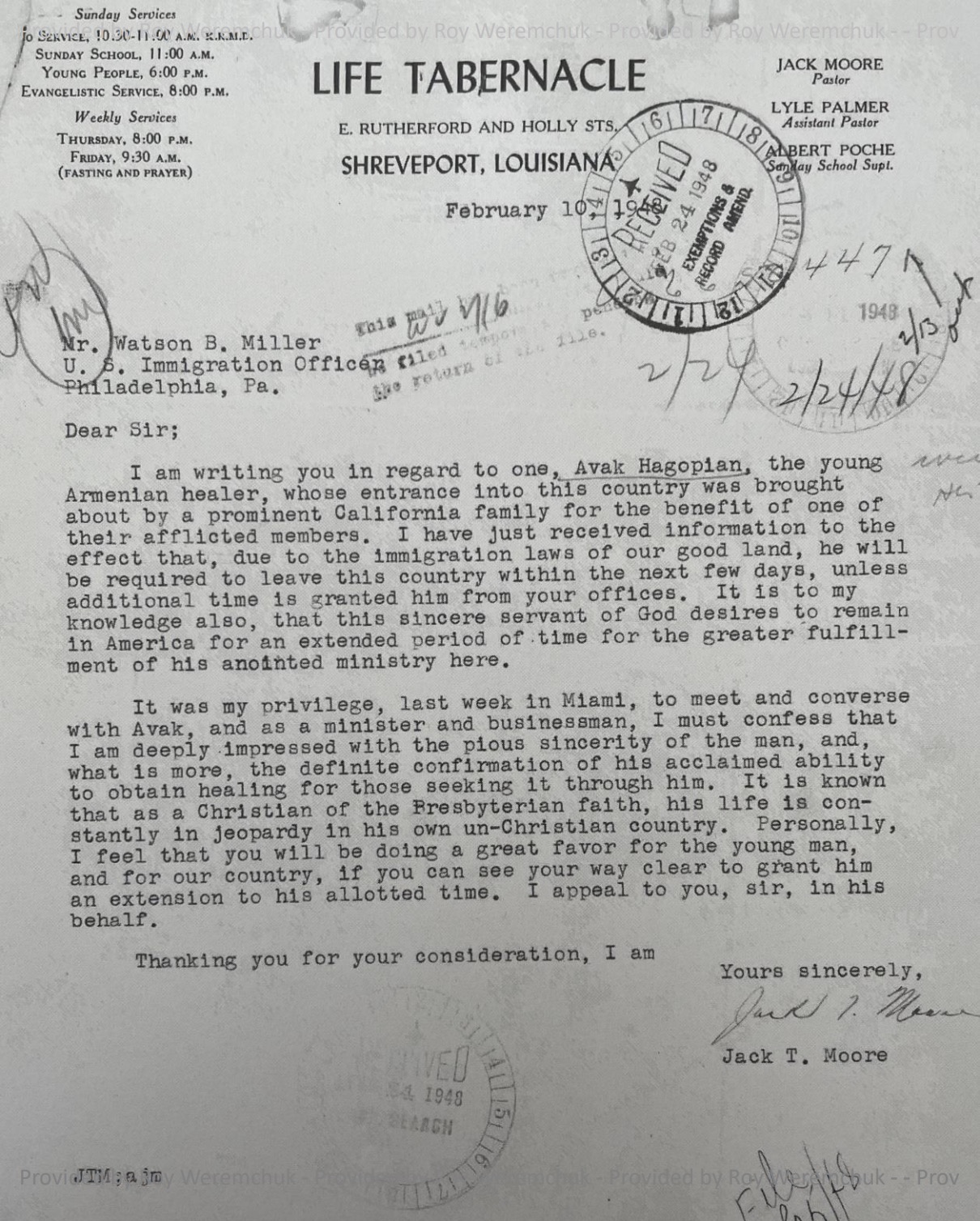
In a newly uncovered 1948 letter addressed to U.S. immigration officials, William Branham’s campaign manager, Jack Moore, advocates passionately on behalf of Avak Hagopian. Special thanks to author Roy Weremchuk for this incredible find.
In a newly uncovered 1948 letter addressed to U.S. immigration officials, William Branham’s campaign manager, Jack Moore, advocates passionately on behalf of Avak Hagopian. Special thanks to author Roy Weremchuk for this incredible find.
See Roy's research article:
https://www.researchgate.net/publication/394130693_When_Jack_T_Moore_supported_Avak_Hakobian?channel=doi&linkId=688b18ffc3cb2665f06285ff&showFulltext=true
The letter not only confirms that Moore personally met with Avak in Miami but also affirms his belief in the healer’s divine gift and ministry calling. Moore describes Avak as a “sincere servant of God” whose spiritual abilities had been “definitely confirmed” and whose continued presence in the United States was both a religious and moral imperative. This is significant for multiple reasons, including the date of the document. February 10, 1948, was during the height of the Latter Rain movement, when Jack Moore helped organize the Branham campaigns and shortly before helping to edit The Voice of Healing. It was almost a year after Moore had met with William Branham and Gordon Lindsay. Since Branham's and Avak's healing mission in Palm Springs was a complete failure, and Krikor Arakelian's son never recovered, it is a clear display of the precedent set by Moore and others for "healers" with a track record of failed "healings."
It is to my knowledge also, that this sincere servant of God desires to remain in America for an extended period of time for the greater fulfillment of his anointed ministry here. {...} I feel that you will be doing a great favor for the young man, and for our country.
— Jack Moore, Feb 10, 1948
This letter places Avak squarely within the orbit of Branham’s closest collaborators, offering new proof that the mystic’s rise was not only sponsored by Armenian-American businessmen but also endorsed by key figures in the Healing Revival's leadership structure.
The Miami Meeting
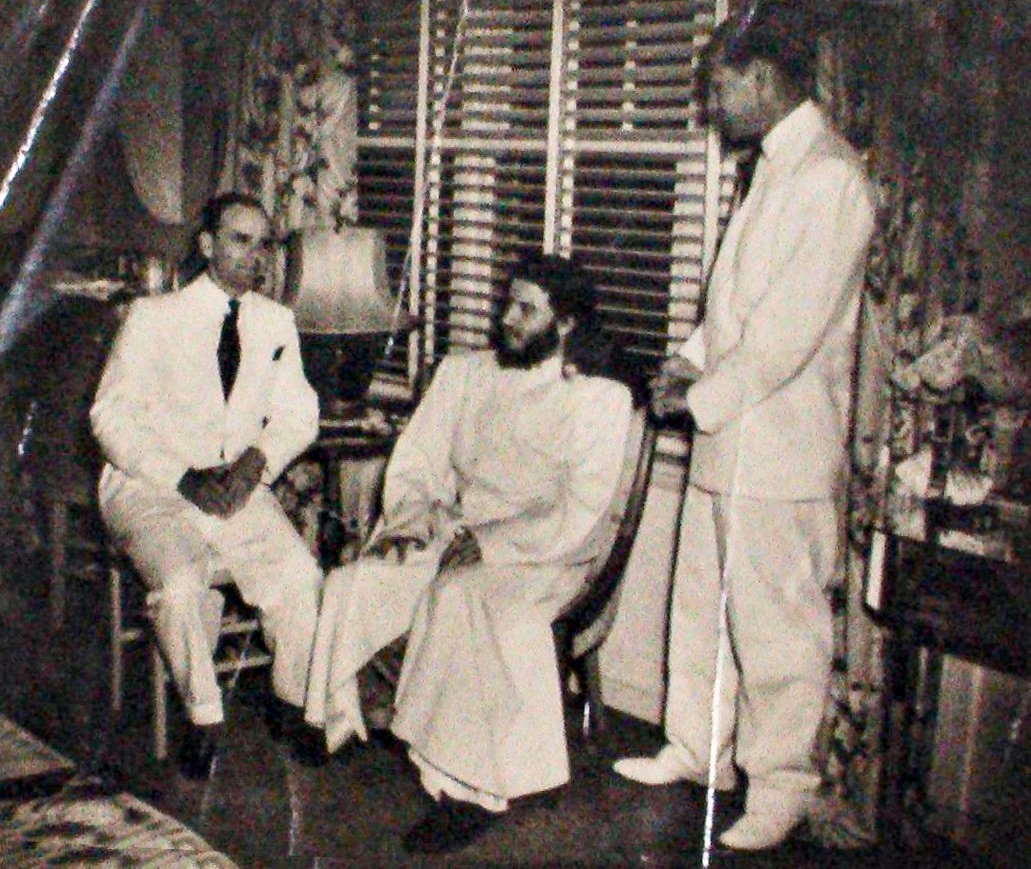
Jack Moore’s letter explicitly mentions his meeting with Avak Hagopian in Miami in early 1948, a detail that situates their encounter within a critical moment in the Healing Revival timeline. It helps properly date the photograph taken with Raymond Hoekstra, Avak Hagopian and William Branham — a photograph that has mysteriously disappeared from Branham cult archives. This period coincided with the North Battleford Latter Rain revival, a significant spiritual awakening that influenced many key figures in the Pentecostal and Healing Revival movements. The Miami meeting suggests that Avak’s intersection with Branham was not confined to California, where he is often primarily associated, but was part of a broader national campaign that extended into the southeastern United States. Placing Jack Moore at this revival is significant. Avak was actively engaging with revival leaders and networks across the country, positioning him as a more prominent figure in the movement than previously acknowledged.
Moore’s Role in the Revival Movement
Jack Moore’s endorsement carries substantial weight given his multifaceted role in the Healing Revival. As William Branham’s campaign manager, Moore was instrumental in organizing and promoting Branham’s healing campaigns, which were foundational to the revival’s growth. Additionally, Moore served as associate editor of The Voice of Healing, the principal publication disseminating news and testimonies from revival meetings, and was a leader within the Full Gospel Business Men’s Fellowship International (FGBMFI), an organization that mobilized laymen in support of charismatic ministries.
Moore’s public and private support of Avak Hagopian thus functions as a powerful credential, effectively integrating Avak into the established revival leadership. His testimony affirms that Avak was not an isolated or marginal figure but one whose ministry was recognized and validated by those at the movement’s helm.
Moore’s dual identity as a minister and businessman enhances the letter’s persuasive power. His familiarity with both spiritual matters and practical realities lends credibility to his assessment of Avak’s importance. The letter reflects a common pattern in revival-era immigration appeals, where spiritual leaders advocated on behalf of foreign-born ministers whose ministries were deemed vital to the American religious landscape.
This letter also deepens our understanding of the Armenian-American network that supported Avak Hagopian’s ministry. Previous research has identified sponsors such as Krikor Arakelian and Tatos Kardashian, prominent Armenian businessmen who facilitated Avak’s campaigns and helped secure his position in the United States. Moore’s involvement adds a new dimension to this network, indicating that collaboration extended beyond ethnic or business ties to include strategic alliances with Branham’s inner circle.
Historical Reframing
The discovery of Jack Moore’s 1948 letter necessitates a reevaluation of Avak Hagopian’s role in the early Healing Revival. Rather than a peripheral or fringe mystic, Avak emerges as a figure endorsed by Branham’s closest allies and integrated into the revival’s leadership network. His ministry contributed to the atmosphere of expectation, healing, and spectacle that characterized the movement’s formative years.
Recognizing Avak’s place within this constellation challenges prevailing narratives that marginalize his contributions and highlights the complex interplay of ethnicity, spirituality, and organizational strategy in the Healing Revival. Future scholarship must consider these dynamics to fully appreciate the revival’s multifaceted history and the diverse actors who shaped its trajectory.
Letter from Jack Moore to U.S. Immigration Office in Philadelphia, PA
CBC Interviews John Collins About Recent Hate Crimes in Canada
CBC Interviews John Collins to discuss "Message" cult preachers known for verbally harassing women in Ontario. They are now facing hate crime charges in relation to allegations they interfered with worshippers at two churches in B.C.'s Lower Mainland last fall.
CBC Interviews John Collins to discuss "Message" cult preachers known for verbally harassing women in Ontario. They are now facing hate crime charges in relation to allegations they interfered with worshippers at two churches in B.C.'s Lower Mainland last fall.
Read the full article:
https://www.cbc.ca/news/canada/british-columbia/street-preachers-hate-crime-1.7591134
From CBC: According to court documents obtained by CBC News, Steven Ravbar and Matthew Carapella are accused of mischief "motivated by bias, prejudice or hate based on sex, sexual orientation, gender identity or expression" for a pair of incidents dating back to a Sunday in November 2024.
Laura-Lynn Tyler Thompson Interviews John Collins About Branham's "Message" Cult
Canadian broadcaster Laura-Lynn Tyler Thompson sat down with cult survivor and researcher John Collins, founder of William Branham Historical Research, to discuss the far-reaching and often hidden influence of evangelist William Branham. Raised inside Branham's cult and the grandson of a pastor at Branham Tabernacle, Collins shared his personal journey of escaping the high-control religious movement and his decade-long effort to expose its abusive theology, authoritarian structure, and global impact.
Canadian broadcaster Laura-Lynn Tyler Thompson sat down with cult survivor and researcher John Collins, founder of William Branham Historical Research, to discuss the far-reaching and often hidden influence of evangelist William Branham. Raised inside Branham's cult and the grandson of a pastor at Branham Tabernacle, Collins shared his personal journey of escaping the high-control religious movement and his decade-long effort to expose its abusive theology, authoritarian structure, and global impact.
The conversation revealed shocking connections between Branham's teachings and many prominent movements in modern Pentecostal and Charismatic Christianity, including the New Apostolic Reformation (NAR), IHOP KC, and MorningStar Ministries. According to Collins, Branham's apocalyptic theology and hierarchical doctrines laid the groundwork for spiritual abuse, suppression of critical thinking, and widespread coverups of sexual misconduct—some involving communes and international compounds. He also detailed how Branham's influence continues through second-generation ministries, often unknowingly built on his teachings.
Watch the full video:
https://www.youtube.com/watch?v=zq2HLdCu7vI
Signs of a Healthy Church ... For Victims of High Control Groups
For people leaving high-control religious environments, joining a new church can be both hopeful and hazardous. Many survivors desire to remain Christian and continue fellowship—but doing so without caution can expose them to fresh harm. The risk of revictimization is real, especially when toxic dynamics are disguised by polite culture, theological orthodoxy, or modern branding.
Healing or Harm? The Risk of Revictimization After Leaving a High-Control Church
For people leaving high-control religious environments, joining a new church can be both hopeful and hazardous. Many survivors desire to remain Christian and continue fellowship—but doing so without caution can expose them to fresh harm. The risk of revictimization is real, especially when toxic dynamics are disguised by polite culture, theological orthodoxy, or modern branding.
Revictimization doesn’t just happen in fringe cults. It often occurs in mainstream, evangelical, and even “Bible-believing” churches where authoritarian leadership, spiritual gaslighting, and systemic control are normalized under the guise of discipleship, obedience, or unity. People who have already experienced manipulation may be especially vulnerable to trusting familiar-sounding patterns—mistaking structure for safety, or charisma for health.
Healing begins when survivors are empowered to slow down, ask hard questions, and trust their own discernment. They deserve churches that protect their agency, validate their journey, and prioritize people over performance. Discernment isn’t cynicism—it’s wisdom born from survival.
When “Good Advice” Turns Toxic: Discernment for the Wounded
Not all church advice is safe advice. Many well-meaning blog posts, ministry leaders, or discipleship resources offer “signs of a healthy church” without realizing how their language reinforces authoritarian dynamics. Others come directly from high-control movements or church growth consultants with little understanding of spiritual trauma.
For survivors of toxic religion, especially those from cultic or controlling environments, such advice can be harmful. It may sound biblical or practical on the surface—but beneath it lies a framework that emphasizes institutional loyalty, performance, and conformity over consent, healing, and justice. In many cases, these teachings retraumatize former members by echoing the same control tactics they fled.
Signs of dangerous or unhealthy church advice often include:
- Overemphasis on metrics: Measuring health by attendance, giving, volunteer ratios, or baptisms creates a performance-driven church culture where people are valued for output, not humanity.
- “Submission to leadership” without mutual accountability: Encouraging people to obey or “trust the vision” without safeguards or dissent channels fosters unchecked authority.
- Discipleship language rooted in hierarchy: Mentoring frameworks that resemble the Shepherding Movement often demand compliance rather than nurturing spiritual maturity.
- Blame-shifting or guilt-tripping: Warning readers that questioning church leaders is rebellion, or that leaving a toxic church is “forsaking the body,” can gaslight spiritual trauma survivors.
- Program-driven spirituality: Churches that equate discipleship with participation in events and roles—rather than transformation—often create burnout and shame cycles.
Healthy advice equips believers to discern for themselves, invites honest questions, and respects the time it takes to heal and recover. True church health centers the dignity and agency of every person, not the needs of the institution.
Abuse of Scripture – Signs of Unhealthy Advice
Scripture is often cited in discussions of church health, but in high-control environments, it’s frequently weaponized to enforce attendance, obedience, and conformity. This misuse strips verses from their original context—historical, cultural, and pastoral—and repurposes them to validate modern institutional structures that may not reflect the spirit of the early church. Below are common examples of how Scripture is abused in unhealthy church environments, especially when applied to manipulate or silence congregants.
- 1 Timothy 4:13 – “Devote yourself to the public reading of Scripture…”
Often used to pressure members into attending weekly services, this verse originally addressed Timothy’s role in a largely illiterate society where public reading was a necessity. It’s a directive for pastoral care—not a requirement for physical church attendance today. In today's world, most Christians can read for themselves. Cultural and historical context is critical. - Hebrews 10:25 – “Not neglecting to meet together…”
Frequently used to shame those who leave or question the church, this verse was meant to encourage mutual support during persecution—not demand compliance with weekly services. The emphasis is on mutual encouragement, not attendance quotas. Scriptural advice should always consider the context of not only the chapter, but also the book from which a verse is taken. - Acts 2:42 – “They devoted themselves to the apostles’ teaching…”
This is often misused to validate rigid church programming or mandatory group participation. In reality, early Christian gatherings were fluid, home-based, and organically relational—not institutional or performance-driven. - Ephesians 4:11–13 – “He gave some to be pastors and teachers…”
Used to elevate clergy as untouchable authorities, this passage actually outlines gifts meant to equip all believers. It supports empowerment and mutual edification, not hierarchical control. Jesus said, "Whoever wants to be great among you must be your servant." (Mark 10:43) - Malachi 3:10 – “Bring the whole tithe into the storehouse…”
This verse is regularly used to demand tithes under threat of divine disfavor. In context, it referred to the temple system and support for priests and the poor—not mandatory institutional funding in the New Testament church. Context of the Covenants — and the group(s) of people under those Covenants — is key.
When churches use Scripture to demand loyalty, suppress dissent, or obligate participation without consent, they misuse the Bible as a tool of control rather than a source of liberation. Healthy church teachings honor Scripture’s spirit, not just its words.
What a Healthy Church Looks Like for Survivors of Spiritual Abuse
A truly healthy church, especially for those recovering from high-control environments, looks nothing like a stage-driven production or a personality cult. Instead, it fosters spiritual safety, empowerment, and a deep sense of belonging. These signs are not about institutional performance—they are about relational integrity, consent, and spiritual freedom. Below are key marks of a church where former members of controlling or abusive groups can begin to heal and thrive:
- Mutuality, Not Hierarchy: The church emphasizes shared spiritual responsibility, not top-down authority. Leaders facilitate rather than dominate, and congregants are encouraged to discern together rather than defer blindly to a single voice.
- Consent-Based Discipleship: Participation in groups, mentoring, or service is voluntary and safe to pause or leave. Discipleship is seen as a mutual journey, not a submission to personal oversight or spiritual ranking.
- Diversity Without Assimilation: The church affirms diversity in race, age, neurodiversity, appearance, theology, and identity. Belonging isn’t conditioned on becoming culturally or doctrinally uniform.
- No Guilt for Distance or Rest: Members can step back, grieve, question, or take time off without guilt. Healing is honored over hustle, and no one is pushed into service or performance.
- Transparency in Leadership and Finances: Leadership structures are open, questions are welcomed, and financial practices are visible. Accountability is practiced, not just preached.
- Empowered Congregants: People are encouraged to grow in spiritual confidence and autonomy. Thoughtful questioning, independent study, and personal discernment are all welcomed.
- Safe Space for Wounded Faith: Trauma survivors and deconstructing believers are treated with gentleness and respect. There is space for processing faith, not pressure to conform quickly.
- Preaching That Liberates, Not Controls: Sermons inform and uplift without coercion. Guilt and fear are not used as motivators. Teaching leaves space for nuance and disagreement.
- Lament, Not Just Celebration: There is room for grief, doubt, and honest emotional expression. Worship includes the full range of human experience, not just triumphalism.
- Jesus-Centered, Not Pastor-Centered: The focus remains on the message of Jesus—love, justice, mercy—not on the charisma or authority of a leader. The church does not rise or fall on a single personality.
Branham Cult Pastor Sentenced to 20 Years - "Message" Cult Abuse
Pastor Pierre Kasambakana, head of the Early Church in the Democratic Republic of Congo (DRC), has been sentenced to 20 years in prison. The charges include sexual harassment, forced marriage, and abuse of morals. The sentence was issued by the public prosecutor and adjudicated at the Tribunal de Grande Instance in Gombe. The formal reading of the judgment is scheduled for June 7, 2024.
Pastor Pierre Kasambakana, head of the Early Church in the Democratic Republic of Congo (DRC), has been sentenced to 20 years in prison. The charges include sexual harassment, forced marriage, and abuse of morals. The sentence was issued by the public prosecutor and adjudicated at the Tribunal de Grande Instance in Gombe. The formal reading of the judgment is scheduled for June 7, 2024.
Read Full Article (in French):
https://kt.cd/2024/05/28/le-chef-de-leglise-primitive-le-pasteur-pierre-kasambakana-condamne-a-une-peine-de-20-ans-de-prison/
Kasambakana was arrested in Kinshasa on January 8, 2024, following his twelfth marriage, which took place in Moanda, Kongo Central province. The father of the alleged victim, Mabiala Nzuzi, was also arrested. Both were transferred to Makala central prison.
Pastor Pierre Kasambakana, head of the early'church in the DRC, was sentenced Monday to 20 years in prison by the public prosecutor, for sexual harassment, forced marriage and abuse of morals. The' case has been adjudicated at the Tribunal de Grande Instance in Gombe, and the judgment is scheduled for June 7, 2024.
- Kinshasa Times
The case gained public attention after a video circulated on social media showing a priest in Moanda officiating a marriage allegedly involving a minor. The footage led to widespread reaction on social networks, including from women's rights advocates calling for legal action.
Golden Dawn Tabernacle: Cultish Interviews John Collins
Cultish interviews John to discuss the destructive Golden Dawn Tabernacle sect of William Branham's "Message" cult of personality. They discuss Golden Dawn, as well as Leo Mercier's "The Park," Paul Mackenzie's starvation cult and more.
Cultish interviews John to discuss the destructive Golden Dawn Tabernacle sect of William Branham's "Message" cult of personality. They discuss Golden Dawn, as well as Leo Mercier's "The Park," Paul Mackenzie's starvation cult and more.
No blog posts found.