
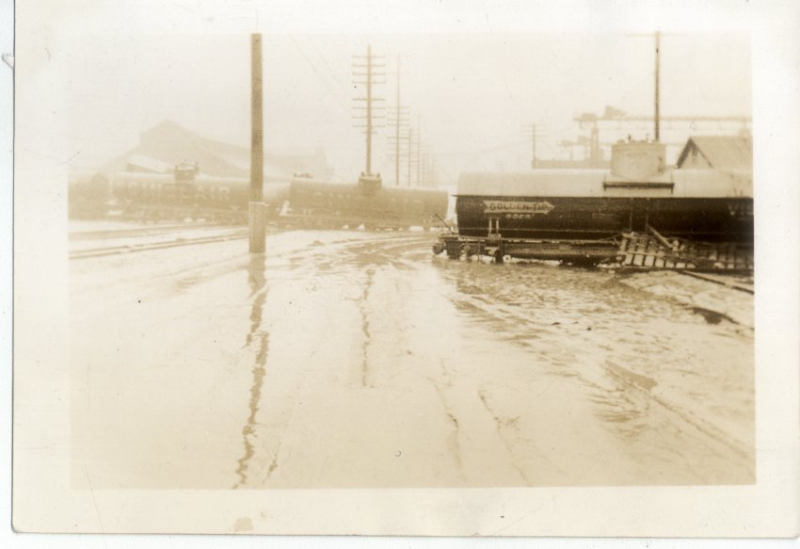
1937 Flood: The Myth of Branham's Pentecostal Conversion
The catastrophic Ohio River flood of January 1937 later became a centerpiece of William Branham’s “Life Story,” in which he claimed that God punished him for resisting Pentecostalism by taking the lives of his wife Hope and daughter Sharon during the disaster. However, historical records show that Branham had already been ordained into Pentecostal ministry and founded a Pentecostal church before the flood, and that Hope’s death from tuberculosis occurred months after the waters receded—exposing serious contradictions in his popular conversion narrative.
In January 1937, the Ohio River flooded in what would become one of the most devastating floods in American history. Torrential rains, sleet, and freezing rain filled the Ohio River from January 9 to January 23, raising the water to its highest recorded level at Louisville, KY. The water crested at 51.1 feet and eventually reached 57.15 feet above flood stage on the upper gauge. Central and Western Louisville, KY, Jeffersonville and New Albany, IN were almost completely destroyed. Sixty percent of Louisville flooded, and two-thirds of the city's population was forced to be evacuated.
As early as 1950,[1] William Branham began claiming that he was a Baptist minister [2] who converted to the Pentecostal faith after a series of events during the 1937 flood resulted in the deaths of his wife, Hope Branham, and daughter, Sharon Rose Branham. According to William Branham's "Life Story" speeches and publications, he had avoided Pentecostalism at the request of his mother-in-law, [3] and for that reason, he claimed that God punished him by killing those he loved most. According to Branham, several family members died within a few days. [4]
This tragic event became an integral part of multiple versions of William Branham's stage persona. During the height of the Latter Rain Revival, many churches in the Latter Rain sect of Pentecostalism would invite William Branham to speak about his "Life Story". [5] The supernatural claims associated with the Great Flood of 1937 were received as confirmation of the movement's focus upon a last and final wave of Pentecostalism before the destruction of world systems.
While many fundamental parts of Branham's "Life Story" accounts are based on actual events, many details change and often conflict between versions of William Branham's stage persona. The association of the 1937 flood to Branham's transition to Pentecostalism disagrees with the historical timeline; While claiming that God punished him by claiming the lives of his wife and daughter for remaining Baptist and avoiding the "Pentecostal Call", Branham was ordained by Roy E. Davis into Pentecostalism[6] as early as 1933 [7] - six years before the 1947 flood. After Davis was extradited to Arkansas on charges of Grand Theft and his congregation transitioned to Branham's leadership, William Branham established the "Billie Branham Pentecostal Tabernacle". The deed for Branham's Pentecostal church was signed November 9, 1936 - several weeks before the 1937 flood. [8]
In some versions of William Branham's stage persona, Branham associated the death of his first wife and daughter with the 1937 flood, describing his journey through raging flood waters by boat and arriving at the hospital shortly before their deaths. According to Hope Branham's death certificate, however, she suffered from tuberculosis starting January 1936, and died in late July long after the flood waters subsided. [9]