
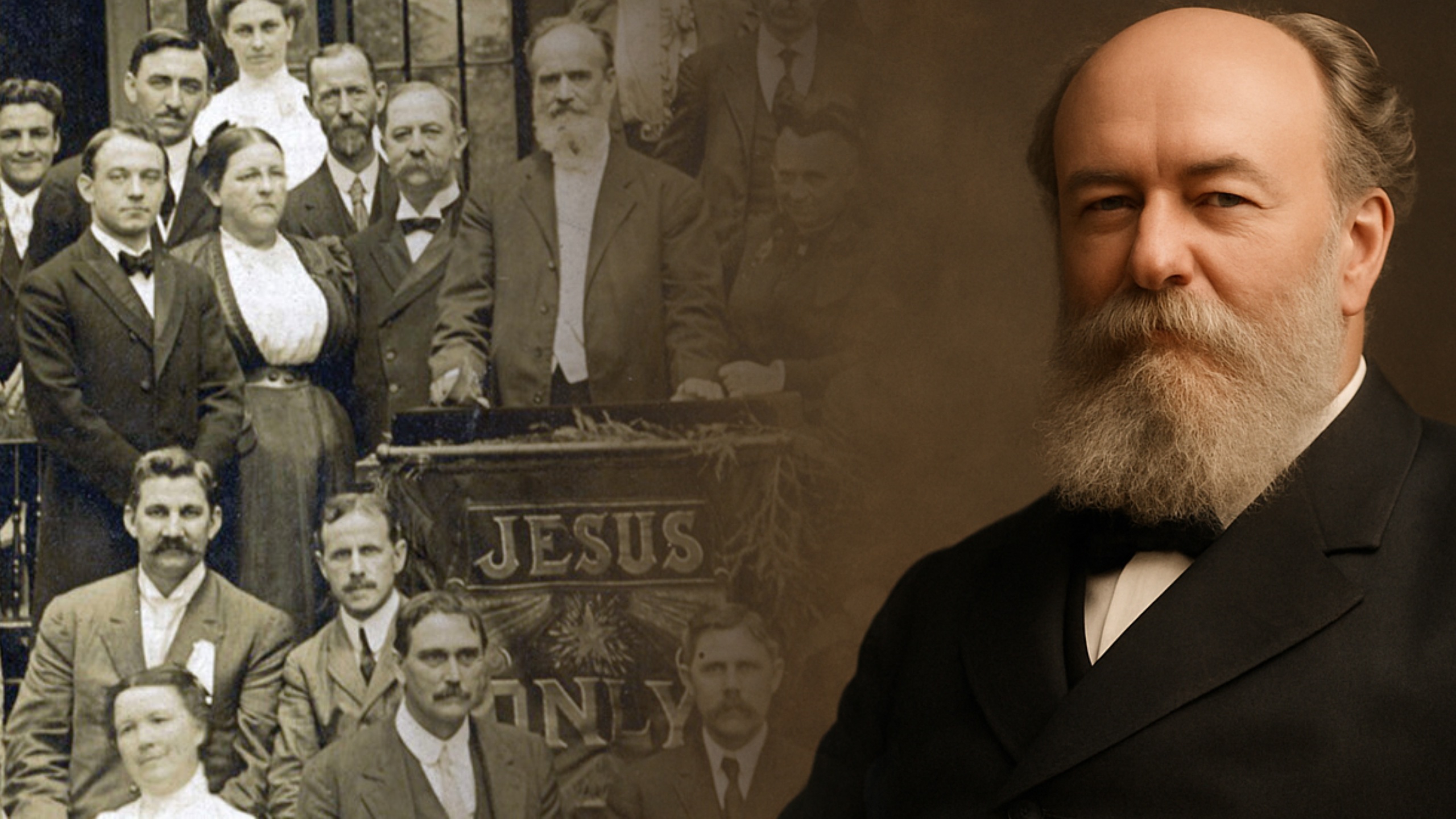
A. B. Simpson: From Million Dollar Revivals to Doomsday Prophecy
A. B. Simpson, founder of the Christian and Missionary Alliance, promoted Keswick-style “Higher Life” teachings, sensational revival practices, and apocalyptic fundraising that critics linked to manipulation and misuse of donated funds. His influence—directly and through figures like the Raders, Bosworth, and Frank Sandford—helped spread Second-Blessing theology and shaped later healing-revival movements, even as many of his doctrines and failed predictions drew significant theological and ethical criticism.
Albert Benjamin Simpson was a faith healer and the founder of the Christian and Missionary Alliance (C&MA).[1] Simpson popularized the "holy laughter," a state of spiritual euphoria causing uncontrollable laughing.[2] He also popularized the notion of severing the Body of Christ by declaring certain Christians as "carnal" as opposed to those who are "spiritual." Bible scholars are quick to point out that "There is no biblical basis for the distinction between 'carnal' and 'spiritual' Christians."[3]
The Christian and Missionary Alliance organization was largely responsible for spreading Keswikian theology. Keswikian, or "Higher Life" theology, was the basis for the "second blessing" or "filling with the Holy Spirit" to achieve "entire sanctification" within evangelical Christianity.[4] According to the doctrinal teachings of the C&MA, humans must fully surrender to achieve perfection. Those who were unable were "carnal Christians." Paul Rader, Ralph Rader, and F. F. Bosworth were leaders in the C&MA. Gerald Burton Winrod worked closely with the C&MA when touring with Paul Rader during the time Rader was the president of the organization, and spoke at C&MA Conventions.[5] Through these and other key figures in the C&MA, Keswikian theology quickly spread around the globe.
Simpson's lectures on the subject were extremely popular and very profitable. Meetings frequently brought in offerings ranging from $27,000[6] to $100,000.[7] (between $884,000 and $3.2 million in today's money[8] ) It was suspected that Simpson was using hypnotism to convince the masses to offer such large sums of money as early as 1896.[9] Participants in Simpson's meetings freely gave away cash, jewelry, money, real estate, and more. Some donors wished to recover their donations once they broke from Simpson's spell, but Simpson responded that "a gift once made to the Lord could not be returned." During the revivals, Simpson stressed the urgency of the donations by claiming that the end of the world was at hand, and that the Second Coming of Christ would be brought on by special missionary efforts. Simpson also stressed the urgency of the donations by issuing apocalyptic predictions. When those predictions failed, Simpson pushed the prediction forward,[10] keeping his cult of personality held captive by fear. It was later learned that a large portion of the funds donated were deposited in his wife’s personal bank account, and that missionaries were only receiving a small percentage for their travel expenses.[11]
Rev. A. B. Simpson, of New York, drew from an audience of 6,000 personas a collection of $40,000 for foreign missions. The collection was made in cash, jewelry, pledges of money, and real and personal estate. Preceding the collection the Rev. Mr. Simpson preached a stirring missionary sermon, in which he declared that the end of the world is near and that the second coming of Christ can be hastened by an evangelization of the world through special missionary effort. He said too much money is wasted on beautiful church edifices.[12]
Several key figures in the Post WWII Healing Revival history were either working with, influenced by, or connected directly to A. B. Simpson. Frank Sandford, whose cult imploded after he was arrested for manslaughter when many members of his cult of personality starved on a foreign mission, modeled his Shiloh cult after Simpson. Sandford met Simpson in 1887 at an event to organize a C&MA branch in Maine. It was at this conference that Sandford married Helen Kinney, a missionary to Japan under the direction of Simpson.[13] In 1896, Sandford copied Simpson's strategy by seeking to have his converts fund a $1,000,000,000 boat to carry evangelists around the globe and hasten the return of Christ.[14] In the early 1900s, Branham's religious mentor F. F. Bosworth was affiliated with the C&MA in Dallas. As Simpson was reaching end-of-life, Bosworth joined the Christian and Missionary Alliance. Interestingly, in the late 1800s, Simpson pastored a Presbyterian Church in Louisville,[15][16] across the river from Branham's hometown of Jeffersonville, Indiana.
For a brief period of time, Simpson entertained the doctrine of "evangelistic earthly tongues" created by Pentecostal Founder Charles Fox Parham. According to Parham's theology, God would magically give his missionaries the ability to speak in foreign tongues when sent as missionaries.[17] When missionaries were unable to perform this supernatural ability after being sent, however, both Simpson and Parham abandoned the doctrine.