
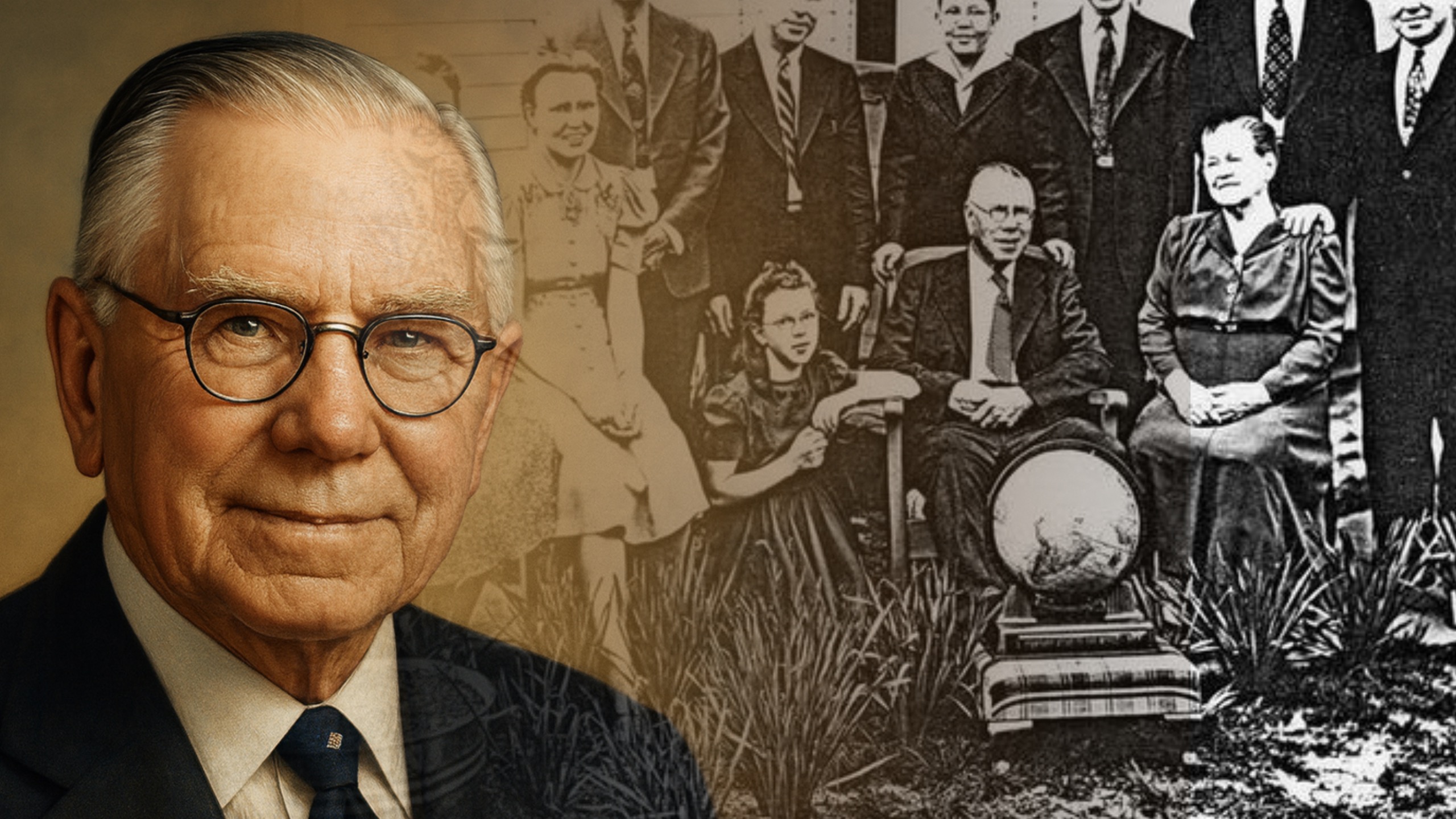
A. J. Tomlinson: Architect of a Theocratic Pentecostal Empire
Here is a clear, tight two-sentence summary of the entire passage: A. J. Tomlinson, a former Quaker turned Pentecostal leader, transformed the Church of God (Cleveland, TN) into a major Pentecostal denomination, but his authoritarian governance and financial controversies led to his 1923 removal and a lasting schism that reshaped the movement. The fallout opened the door for white supremacist influence through figures like Roy E. Davis, while Tomlinson’s son Homer later extended his father’s theocratic ambitions into politics—founding the Theocratic Party, declaring himself “King of the World,” and blending Pentecostalism with British Israelism and dominionist aspirations.
A. J. Tomlinson and the Formation of Theocratic Governance
Rev. Ambrose Jessup Tomlinson (1865-1943) became one of the most influential early Pentecostal leaders through his role as the first General Overseer of the Church of God headquartered in Cleveland, Tennessee.[1] Under his leadership, the movement developed a centralized form of church government and expanded from a small Holiness fellowship into a structured denomination with coordinated assemblies, publications, and missions.
Tomlinson’s background placed him at the crossroads of late nineteenth-century evangelical currents. He was connected with the Religious Society of Friends (Quakers) and later served as an agent for the American Bible Society before identifying with the holiness people who became the Church of God.[2] His restorationist outlook emphasized recovering the New Testament pattern of church life, not only in doctrine but also in governance.
As Pentecostal teaching spread, Tomlinson and the Church of God adopted the doctrine of Spirit baptism commonly described as an additional work beyond sanctification, with glossolalia treated as initial evidence in many early Pentecostal circles.[3] Tomlinson’s theocratic vision located authority in what he understood to be divinely ordered leadership and Spirit-guided assemblies, a model that promoted cohesion and rapid growth while also embedding structural tensions that would later surface in the movement’s internal conflicts.
The 1906-1923 Period: Consolidation, Expansion, and Structural Tension
Between 1906 and 1923, the Church of God experienced significant consolidation under Tomlinson’s leadership. The International General Assembly functioned as the central deliberative body of the movement, reinforcing a shared doctrinal identity and a unified administrative structure.[4] This framework strengthened denominational cohesion and provided an organized mechanism for expansion.
The movement’s growth extended beyond the American South. Missionary efforts were launched in the Bahamas in 1909, marking the beginning of formal international outreach.[5] The establishment of the Church of God Evangel in 1910 created a consistent channel for doctrinal instruction and denominational communication, while educational initiatives begun in 1918 sought to prepare ministers and members within an increasingly structured ecclesiastical system.[6]
These developments demonstrate how centralized governance facilitated rapid institutional growth and doctrinal alignment. At the same time, the concentration of authority within the General Overseer’s office and the Assembly limited alternative mechanisms for internal dissent or constitutional negotiation. As the denomination expanded in size, financial scope, and geographic reach, the same structural centralization that had promoted unity also created conditions in which disagreements over authority and administration would carry heightened institutional consequences.
The 1923 Schism: Constitutional Crisis and Competing Visions of Authority
By 1923, the Church of God entered a crisis shaped by competing visions of authority, including disputes over constitutional governance and the administration of church funds. Contemporary newspaper reporting stated that Tomlinson was ousted after it was found that he had appropriated about $14,000 of church funds, and that afterward he established a separate church and sought to draw members and contributions by claiming the Cleveland body had departed from the original faith.[7] Whatever the underlying causes and internal arguments, this reporting demonstrates how the conflict was publicly framed and why it rapidly became a defining rupture.
After Tomlinson’s removal, the dispute expanded beyond internal discipline into a struggle over legitimacy, identity, and control. Tomlinson’s supporters presented themselves as a remnant committed to continuing what they described as the original theocratic process, while the Cleveland leadership represented the continuing organization headquartered in Tennessee.[8] The conflict escalated into legal proceedings that reached the Tennessee Supreme Court, where the Tomlinson faction was reported as having been bested but still seeking the possibility of a rehearing.[9]
The resulting schism created enduring structural consequences. Competing ecclesiologies emerged not only in theology but in governance, with the Tomlinson remnant emphasizing continuity with a theocratic model and the Cleveland body claiming institutional legitimacy through its constitutional order. The controversy therefore cannot be reduced to personal rivalry alone; it illustrates how centralized authority can generate high-stakes conflict when institutional mechanisms for disagreement are limited, especially when property, publications, and denominational identity are tied to control of a single center.
Race and Ecclesiology: Theology of "One Blood" Versus Structural Reality
Evaluate Tomlinson’s rhetoric of racial unity alongside segregated seating, the formation of the "Colored Work," and paternalistic structures. Engage Kinder, Ramsey, and other scholarship to distinguish theological inclusion from institutional equality.
Early Church of God rhetoric frequently appealed to biblical themes of unity, including the idea that humanity was created of “one blood,” language common in Pentecostal preaching that emphasized spiritual equality before God. Within this theological framework, interracial fellowship was presented as evidence of Spirit-filled Christianity and restorationist authenticity. Such claims, however, must be evaluated alongside the institutional realities that developed within the denomination.
Scholarly examination of the period demonstrates that theological inclusion did not necessarily translate into structural equality. Christopher W. Kinder argues that while Tomlinson articulated a vision of interracial fellowship, the administrative arrangements of the Church of God developed in ways that preserved racial separation and white oversight.[10] Likewise, Bradley Ramsey’s analysis of racial ecclesiology within the movement shows how the creation of a distinct “Colored Work” functioned within a centralized system that maintained financial and ministerial control at the denominational center.[11]
By the 1920s, Black ministers within the Church of God publicly voiced concerns regarding their constrained position within the denomination’s structure. In a 1927 address to the General Assembly, representatives expressed their frustration in measured but direct terms:
We feel... somewhat embarrassed and handicapped to the extent we cannot make much progress that we really desire, and we are asking you brethren, with the consent of all our brethren present at this Assembly, if there can be a way formulated by which we can arrange better to take care of our affairs among the colour work.[11]
This appeal illustrates the distinction between theological affirmation and institutional autonomy. While interracial worship and fellowship were defended in principle, segregated seating practices, separate administrative channels, and paternalistic oversight mechanisms limited Black leadership authority. The resulting arrangement cannot be described simply as exclusion, nor can it be described as equality; rather, it reflects a managed inclusion shaped by both regional racial norms and a centralized ecclesiology that vested final authority in white-controlled structures.
The "Colored Work": Autonomy, Paternalism, and Centralized Control
The development of the “Colored Work” within the Church of God reflected an attempt to reconcile interracial theological claims with the racial realities of the American South. Rather than complete segregation into a separate denomination, Black congregations were organized within a distinct administrative stream that remained connected to the central leadership structure. This arrangement allowed for a measure of internal organization while preserving oversight from the predominantly white governing body.[12]
In practice, the structure created a layered form of authority. Black ministers could conduct services, organize congregations, and participate in denominational life, yet financial accountability, credentialing, and major administrative decisions remained tied to the centralized leadership. As Ramsey notes, the language of separation was often framed as pragmatic and pastoral, but the system operated within a broader ecclesiology that vested ultimate authority in the General Assembly and its officers.[13]
The 1927 petition by Black ministers illustrates the tension inherent in the arrangement. Their request was not for doctrinal separation but for greater capacity to “take care of our affairs” within the existing denominational framework. This language suggests that what developed was neither full autonomy nor simple exclusion, but a managed inclusion shaped by paternalistic assumptions and structural hierarchy.
Kinder’s analysis further demonstrates that Tomlinson’s rhetoric of unity coexisted with practices that limited Black advancement into the highest levels of leadership.[12] The result was a denomination that could affirm spiritual equality while maintaining differentiated administrative pathways. Separation functioned simultaneously as a response to racial pressures, a concession to internal advocacy, and a mechanism of centralized control.
Post-Schism Instability and the Religious Marketplace of the Late 1920s
The fragmentation that followed the 1923 schism produced more than two rival administrative centers; it created a competitive religious marketplace in which legitimacy, naming rights, property claims, and ministerial credentials were simultaneously contested. When parallel bodies each claimed to be the continuing “Church of God,” authority was no longer secured merely by memory of origins but by control of pulpits, assemblies, publications, and public perception. The resulting environment blurred denominational boundaries, especially in regions where revival culture functioned through personal networks rather than formal corporate channels.
This instability was visible in the press. In November 1927, while litigation over control of the Church of God remained a recent memory, The Knoxville Journal reported that “Tomlinson Faction, Bested in High Court, Still Hopeful,” underscoring that civil adjudication had not resolved reputational competition.[14] The same year, newspapers openly described the financial accusations that had accompanied Tomlinson’s removal, reporting that he had appropriated approximately $14,000 of church funds before establishing a rival body.[15] Whether framed as constitutional reform or financial misconduct, such public reporting shaped how congregants and observers interpreted legitimacy.
Within this climate of ambiguity, revival networks became porous points of entry. The Knoxville Journal announced in November 1927 that a revival at the Church of God Tabernacle in Cleveland featured Rev. Roy E. Davis, identifying him as a “widely known evangelist” who had lectured for the Ku Klux Klan and associated with fundamentalist leaders.[16] The fact that such notoriety could coexist with access to a denominational pulpit illustrates how fluid credentialing could become when institutional lines were unsettled. In a fragmented structure, local invitations and personal endorsements sometimes operated independently of centralized gatekeeping.
Fragmentation thus intensified both consolidation and vulnerability. Competing headquarters sought legal clarity and administrative stabilization, yet the revivalist ethos that fueled Pentecostal growth continued to rely on itinerant preachers, public advertising, and emotionally charged services. Where multiple bodies claimed continuity with the same denominational identity, reputational boundaries blurred. Authority became negotiated rather than assumed, and the question of “which Church of God” often depended less on formal documentation than on relational trust and public narrative.
The late 1920s therefore reveal a structural tension within Pentecostal governance. Centralized theocratic models could enforce cohesion under unified leadership, but once divided, the same centralized claims multiplied into competing centers. In such a marketplace, publicity, litigation, and revival access became instruments of authority. The conditions created by schism did not merely reflect disagreement; they reshaped the denominational ecosystem into one where reputation, credentials, and institutional identity were continuously renegotiated.
Roy E. Davis: From Klan Leadership to Pentecostal Networks
Roy E. Davis emerged in the public record during the height of the Second Ku Klux Klan’s expansion in the 1910s and 1920s. Newspapers identified him as closely associated with Colonel William Joseph Simmons and described him as an official representative and ambassador for the revived Klan organization.[17] His name also appeared in connection with internal factional disputes, including the formation of the more militant Knights of the Flaming Sword, a splinter body organized amid struggles for authority within the Klan’s leadership structure.[18]
After the banishment papers had been made out against Col. Simmons by the imperial kloncilium and signed by Dr. H. W. Evans, imperial wizard of the klan, Col. Simmons continuing to confer the second degree of the klan. Believing I was entitled to the honor of the second degree I went to the colonel's home and while visiting with him was raised to the second degree and that day made his personal representative. Immediately thereafter I became quite active in conferring this second degree
- 1925, January, 19. Knights Flaming Sword Asked to Lay Down Arms. Chattanooga Daily Times. "Chattanooga Daily Times."
Davis later boasted of his proximity to the movement’s highest levels. In a 1961 interview, he claimed that he had received all degrees of the Klan and had assisted in drafting its constitution, by-laws, and ritual during its 1915 revival.[19] Such retrospective assertions align with earlier press accounts that situated him near the center of Klan organizing activity in Tennessee and Georgia. These public claims underscore that his white supremacist involvement was neither peripheral nor obscure; it was a matter of documented record.
By the mid-1920s, however, Davis began repositioning himself within Protestant revival networks. Although his name remained linked in the press to Klan lecturing and fundamentalist associations, he increasingly appeared in Pentecostal and holiness contexts, including Church of God revivals in Tennessee.[20] This transition did not represent a clean break from his past affiliations; rather, it reflected a strategic relocation of influence. Revival culture, with its emphasis on itinerant preaching and public advertising, offered opportunities for visibility and institutional footholds.
Davis’ later ministerial ventures reveal continued fluidity in denominational identity. In the 1930s and 1940s, he was associated with Pentecostal Baptist organizations and other hybrid sectarian efforts, moving between revival campaigns and oversight roles.[21] At various points, his name surfaced in connection with criminal allegations and federal charges, further complicating his public reputation.[22] Yet despite these controversies, he maintained access to religious platforms, demonstrating how porous revival networks could absorb and recast controversial figures.
The trajectory from Klan leadership to Pentecostal evangelism illustrates a broader structural reality of the interwar religious marketplace. Charismatic authority, publicity, and institutional ambiguity could allow an individual with a widely documented extremist background to reposition himself within emerging Pentecostal networks. Davis’ movement across these spheres does not merely reflect personal opportunism; it exposes the permeability of denominational boundaries during a period of fragmentation and revival expansion.</p
Roy E. Davis and "Church of God" Access: Cleveland and Knoxville as Case Studies
Contemporaneous newspaper coverage shows that Roy E. Davis gained access to Church of God platforms in Cleveland and Knoxville during 1927, even while his reputation as a Klan lecturer was openly noted in the press. In November 1927, The Knoxville Journal reported that a revival service at the Church of God Tabernacle in Cleveland featured Davis as the preacher and explicitly identified him as a lecturer for the Ku Klux Klan.[20] The same notice connected him to prominent fundamentalist circles, signaling that his public identity was not merely that of a generic evangelist but of a figure already marked by political-religious controversy.[20]
“Rev. Davis has been ... a lecturer for the Ku Klux Klan.”[20]
Within months of that Cleveland revival notice, Davis was also operating in Knoxville under circumstances that suggest organizational opportunity created by denominational instability. In September 1927, Knoxville newspapers reported that Davis was holding evangelistic meetings in the city while also promoting institutional plans tied to the Original Church of God stream, including the possible relocation of the Davis-McPherson Institute to Knoxville and the involvement of the school’s executive committee in surveying potential sites.[23][24] These reports portray Davis not only as a visiting preacher but as a networked operator leveraging revival meetings, denominational conferences, and institutional projects to establish influence.
Taken together, these Cleveland and Knoxville cases illustrate how credentialing and gatekeeping could become porous in a fragmented Pentecostal marketplace. The question is not whether leaders had access to information about Davis’ background; the Cleveland notice itself demonstrates that such information circulated publicly.[20] Rather, the evidence suggests that the practical mechanics of revival culture — local invitations, publicity incentives, and the portability of ministerial identity across loosely policed networks — could override reputational caution. When denominational boundaries were unsettled, access to pulpits could function as a form of credential in itself, granting legitimacy through visibility.
This pattern reveals an institutional vulnerability. Centralized governance could, in theory, establish standards for recognition, yet schism and competition weakened clarity over who held final authority and how reputations should be weighed. In that environment, controversial actors could exploit ambiguity: a well-advertised revival at a prominent tabernacle created the appearance of endorsement, while simultaneous activity in another city broadened influence through overlapping conferences, schools, and campaigns.[20][23][24] The press coverage therefore does not merely record events; it documents how public reputation, revival access, and denominational fragmentation interacted to make gatekeeping uneven and credibility negotiable.
The Original Church of God, Dahlonega, and the Davis-McPherson Institute
Newspaper reporting in 1927 places Roy E. Davis within the institutional life of the Original Church of God stream in a manner that exceeds the role of a transient revival preacher. In September 1927, The Knoxville Journal reported that the Davis-McPherson Institute, described as a school maintained by the Original Church of God at Dahlonega, Georgia, might be relocated to Knoxville by action of the denomination’s general conference meeting in October at Chattanooga. The report framed this prospective move through Davis’ own statements, identifying him as the source of the information while he was simultaneously conducting an evangelistic meeting in Knoxville.
Additional coverage reinforced the institutional scope of the proposal. The Nashville Banner reported that the executive committee of the Davis McPherson college would visit Knoxville in October to survey possible sites for removing the school from Dahlonega, explicitly identifying Davis as the school’s president at the time. The combination of these claims — a denominational school bearing his name, maintained by a specific Church of God stream, and overseen by an executive committee — indicates that Davis occupied a recognized leadership position within that institutional framework rather than functioning solely as an invited speaker.
The naming itself is significant. A school titled the Davis-McPherson Institute suggests commemorative honor and organizational investment, and the presence of an executive committee implies structured governance and denominational resources. If the reports are accurate, Davis’ presidency positioned him to influence not only revival meetings but also educational infrastructure, conference agendas, and potentially the credentialing pipeline that often flowed through denominational schools. In this light, the proposed relocation is best interpreted as a strategic effort to expand institutional presence into a new regional base rather than as a marginal administrative detail.
These developments also clarify how influence could be consolidated through overlapping roles. Davis appears in Knoxville simultaneously as an evangelist conducting meetings and as a denominational operator involved in a planned institutional move. Such overlap would have strengthened his standing among supporters, increased his access to denominational decision-makers, and broadened his reach beyond single-event revivals. The Dahlonega-to-Knoxville relocation proposal therefore provides evidence that Davis’ activities were embedded within organizational strategy and infrastructure, suggesting deeper institutional leverage within the Original Church of God stream during the late 1920s.
How Extremist-Adjacent Actors Exploited Revival Networks
The late 1920s created an environment in which controversial figures could translate notoriety into opportunity. Revival culture rewarded visibility, mobility, and the ability to draw crowds, while denominational fragmentation reduced clarity about who held final authority to grant access, recognize credentials, or enforce reputational boundaries. In such a marketplace, public identity could be reshaped through religious publicity: an evangelist did not need unanimous institutional approval to gain legitimacy, only recurring invitations, favorable advertising, and the appearance of ministerial success.
Press coverage demonstrates how this worked in practice. In November 1927, The Knoxville Journal announced a revival at the Church of God Tabernacle in Cleveland with Roy E. Davis preaching, and the notice explicitly described him as a lecturer for the Ku Klux Klan.[20] The significance of such a notice is that it did not conceal his political associations; it normalized them as biographical color attached to an evangelist presented as welcome in a prominent Pentecostal pulpit. Where pulpits were treated as proof of legitimacy, repeated access functioned as a credential that could outweigh reputational warning signs.
Fragmentation also created institutional openings. While Davis appeared in Cleveland as a revival preacher, newspapers in Knoxville and Nashville reported him operating simultaneously within denominational planning tied to the Original Church of God stream and its school infrastructure. Reports stated that the Davis-McPherson Institute at Dahlonega, Georgia, might be relocated to Knoxville by action of a denominational conference, and identified Davis as the school’s president while an executive committee planned to survey sites for relocation.[25][26] These overlapping roles — evangelist, institutional promoter, denominational officer — demonstrate how revival platforms could be leveraged into organizational influence.
Publicity incentives intensified the problem. Revival announcements, newspaper notices, and denominational advertising aimed to attract attention, and controversial associations could increase public interest rather than reduce it. When organizations prioritized momentum, crowd appeal, and expansion, the reputational calculus could shift: scandal and extremism became manageable liabilities if they also functioned as engines of publicity and recruitment. In this sense, the logic of revival culture could invert normal safeguards, treating notoriety as a form of market value.
These dynamics reveal a structural vulnerability within fragmented Pentecostal networks. Centralization could stabilize identity when unity existed, but schism multiplied centers of recognition and left wide spaces where local leaders made discretionary decisions about whom to invite and endorse. In that environment, extremist-adjacent actors could exploit porous credentialing, public advertising, and institutional ambiguity to gain both pulpits and footholds. The issue was not merely individual moral failure; it was the interaction of revival culture, publicity markets, and denominational instability that made reputational boundaries negotiable and gatekeeping uneven.
Homer Tomlinson and the Theocratic Imagination in American Pentecostalism
Homer A. Tomlinson’s public career cannot be understood apart from his direct relationship to his father, A. J. Tomlinson. Raised within the Church of God movement during its formative years, Homer inherited not merely a denominational office but a theological framework that treated governance as divinely ordered rather than procedurally negotiated. A. J. Tomlinson had framed the General Overseer’s authority as part of a restored New Testament theocracy, where assemblies discerned divine will and leadership operated under sacred mandate rather than democratic preference. That conceptual architecture shaped the younger Tomlinson’s understanding of authority.
After the 1923 schism and the formation of the Tomlinson-led continuation body, Homer’s leadership developed within a structure already defined by the language of restoration, divine government, and centralized oversight. The elder Tomlinson’s emphasis on rejecting “man-made” constitutional constraints in favor of Spirit-guided governance created a theological environment in which authority was understood as descending from divine revelation rather than ascending from institutional consent. Homer did not invent this paradigm; he extended it.
Where A. J. Tomlinson applied theocratic language primarily to denominational governance, Homer gradually expanded its scope into overt political theology. By the mid-twentieth century, he had founded the Theocratic Party and framed civil government itself as an arena for restoring biblical rule.[28] His campaigns were not conventional political efforts but symbolic acts rooted in prophetic interpretation. The language of divine mandate that had once structured ecclesiastical administration was redirected toward national and eventually global claims.
This escalation culminated in Homer Tomlinson’s declaration that he would crown himself “King of the World” in Jerusalem, grounding the act in scriptural expectations concerning the restoration of David’s throne and divine sovereignty over nations. The shift is significant. A. J. Tomlinson had insisted upon centralized spiritual authority within a church body; Homer personalized that authority and universalized its jurisdiction. The move from General Overseer to self-proclaimed global monarch marks a transformation in scale and symbolism, even while retaining the underlying conviction that divine government should manifest visibly in institutional form.
It would be overly simplistic to argue that Homer’s actions were an inevitable outcome of A. J.’s theology. The father’s theocratic framework emerged within early Pentecostal restorationism and denominational crisis, whereas the son’s political coronations unfolded within mid-century American media culture and apocalyptic spectacle. Yet the continuity of vocabulary—restoration, divine order, sacred mandate—and the inherited structure of centralized spiritual authority created conditions in which theological governance could be reframed as territorial sovereignty. Homer’s trajectory therefore represents not direct duplication but intensification: a personalized expansion of theocratic imagination from ecclesial restoration to global dominion rhetoric.