
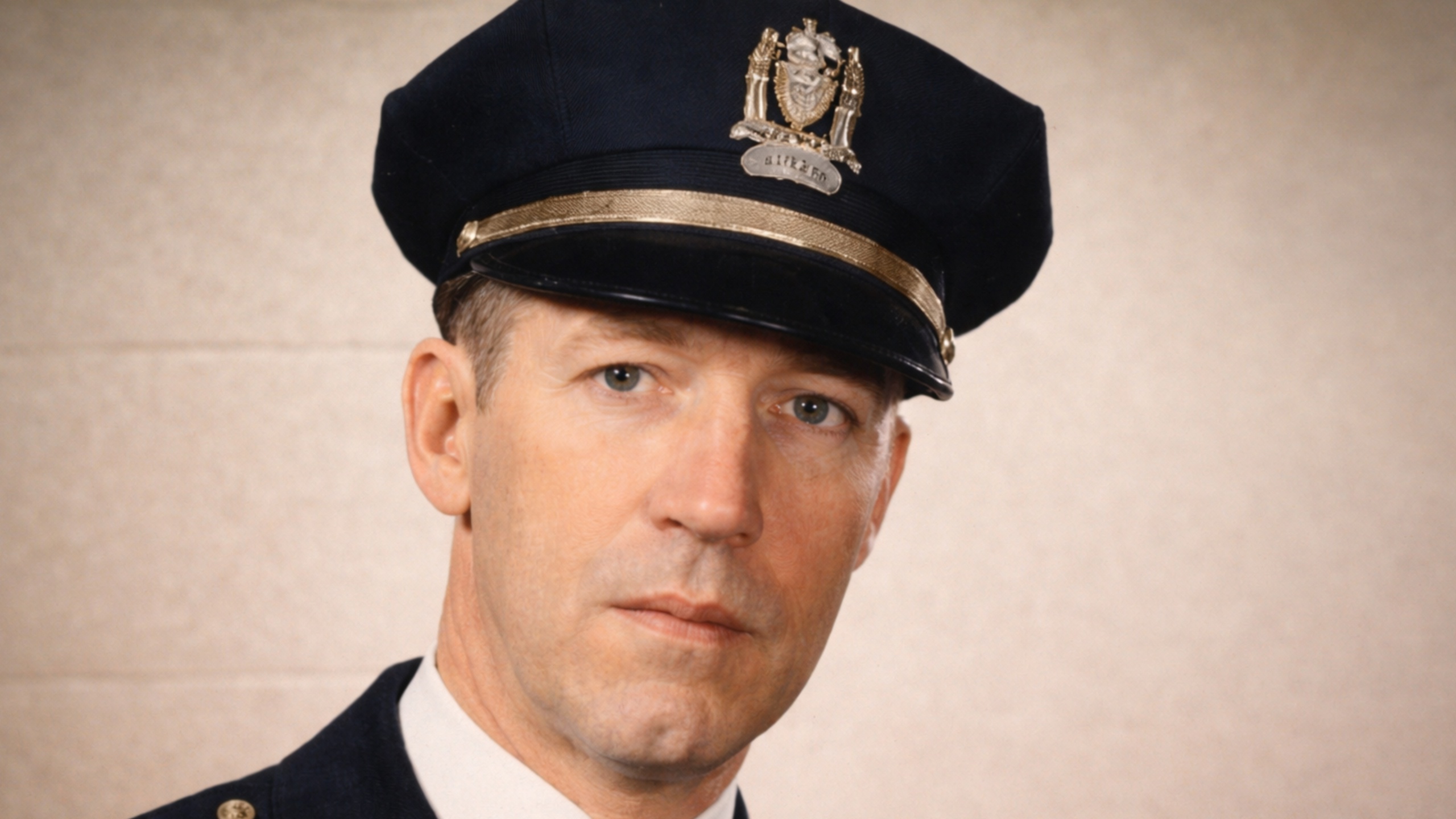
Albert E. Farrar: Policeman to Pentecostal
Albert E. Farrar, a long-serving police captain in Tacoma, Washington[1], emerged as an unexpected yet influential figure in mid-century Pentecostal evangelism[2]. His religious conversion, though not precisely dated, was widely publicized in revivalist circles throughout the 1940s and 1950s[3]. Known to many in the Pacific Northwest as a no-nonsense lawman[4], Farrar became a staple testimonial figure in Pentecostal publications and advertisements[5], often introduced as the “Converted Tacoma Policeman”[6]. His appearances at revival meetings—such as those held by W. J. Ern Baxter at the Evangelistic Tabernacle[7]—were framed to signal divine transformation, presenting Farrar as a man of both worldly authority and spiritual renewal[8]. The narrative surrounding his faith journey reinforced the idea that even the most hardened public servants could experience radical salvation and become vessels for moral leadership.
Conversion and Evangelistic Ministry of Al Farrar
Albert E. Farrar, a long-serving police captain in Tacoma, Washington [1], emerged as an unexpected yet influential figure in mid-century Pentecostal evangelism [2]. His religious conversion, though not precisely dated, was widely publicized in revivalist circles throughout the 1940s and 1950s [3]. Known to many in the Pacific Northwest as a no-nonsense lawman [4], Farrar became a staple testimonial figure in Pentecostal publications and advertisements [5], often introduced as the “Converted Tacoma Policeman” [6]. His appearances at revival meetings—such as those held by W. J. Ern Baxter at the Evangelistic Tabernacle [7]—were framed to signal divine transformation, presenting Farrar as a man of both worldly authority and spiritual renewal [8]. The narrative surrounding his faith journey reinforced the idea that even the most hardened public servants could experience radical salvation and become vessels for moral leadership.
I said, 'All right, FBI, I am on the platform in the Name of the Lord Jesus Christ; come to the platform now and expose me.' I said, 'If I'm doing anything outside of God Almighty's Bible, come here and expose me.' I said, 'Where you at?' Thousands sitting there and everybody was crying. I said, 'I'm waiting for the FBI. According to your paper here, you was going to expose me tonight.' Just then I waited a few minutes, and I felt that spirit coming out. I said, 'It wasn't the FBI. I'm no criminal.' I said, 'Every time an FBI agent come in my meeting, they got—they got saved. Their chief got saved in my meeting, Captain Al Farrar.' I said, and, oh, I said, 'No FBI does anything like that.' [9]
- William Branham
Farrar’s evangelistic role was further amplified by William Branham [10], who repeatedly cited him in sermons as an example of supernatural transformation [11]. In various accounts, Branham claimed Farrar had been converted at one of his healing campaigns, in a jail cell, or even in a shooting gallery [12]. These stories were inconsistent, but their intent was clear: to present Branham’s ministry as so powerful that even hardened officers were brought to salvation [13]. The conflicting accounts strongly suggest fabrication, yet Farrar's name was nevertheless absorbed into revivalist lore as if the stories were true [14], serving as both a narrative device and a public symbol [15]. His dual identity as a police captain and Pentecostal believer was leveraged to connect themes of authority, redemption, and masculinity—key components in the messaging of postwar American revivalism [16].
Youth Guidance and Juvenile Reform in Tacoma
During the late 1940s [17], Al Farrar emerged as a central figure in youth outreach within the city of Tacoma [18]. His appointment as head of the Youth Guidance Division in 1948 [19] coincided with a national postwar concern about juvenile delinquency, especially in urban and industrial regions. Farrar’s strategy extended beyond punitive methods. He emphasized preventive engagement and community mentorship, believing that troubled youth required direction, structure, and moral foundation more than incarceration. His dual identity as a police officer and a man of faith allowed him to engage both secular and religious institutions in addressing these concerns. Churches, civic organizations, and local schools frequently partnered with Farrar in hosting educational forums, workshops, and outreach events for at-risk teens [20]. This further confirms the inaccuracy of Branham's claim—Farrar was already a committed Christian by the time he assumed leadership of the Youth Guidance Division, making any narrative of conversion through Branham's ministry chronologically impossible. His public faith and church involvement were already well established before Branham's revival circuit reached prominence.
One of the defining moments of his youth advocacy came in 1949, when Farrar toured several European cities to study juvenile justice systems and youth ministries abroad [21]. Sponsored in part by local religious institutions, this journey revealed his commitment to cross-cultural learning and innovation. Upon returning, he applied insights from the tour—such as restorative practices and community integration—to local programs in Tacoma. His work prefigured many later developments in community policing and youth diversion programs. Farrar became widely respected not only as a disciplinarian but as a reformer who saw youth as worth investing in. His initiatives laid groundwork that influenced both his later political platform and broader youth rehabilitation efforts across Washington state.
Political Career and Legislative Influence
Al Farrar’s political ascent was a natural extension of his civic work in Tacoma [22], particularly his leadership in the Youth Guidance Division [23]. After more than two decades in law enforcement [24], he transitioned into public office by running for a seat in the Washington State Legislature representing the 27th District . His campaign emphasized integrity, law and order, and practical solutions to social issues—values he had cultivated throughout his police career. Voters responded positively to his reputation as a disciplined, morally grounded figure who understood the complexities of youth delinquency and public safety . He was elected as a Republican state representative in the 1952 election and served from 1953 to 1957 .
During his time in the legislature, Farrar advocated for reforms that aligned with his professional background, particularly around youth services, policing standards, and community development. He also gained attention at the national level, being invited to the White House Conference on Children and Youth—an honor reflecting his credibility on matters of juvenile welfare [25]. Farrar's legislative approach was methodical and cooperative rather than confrontational. He avoided partisan theatrics in favor of incremental policy shifts, earning him quiet respect across party lines. His experience navigating both street-level law enforcement and high-level political negotiation gave him a unique perspective among his peers. Though he eventually returned to local politics, Farrar’s years in the statehouse left a legacy of service rooted in grounded leadership and public trust.
Public Service and Utility Board Contributions
Following his legislative career [26], Al Farrar continued to serve the city of Tacoma through his involvement in public utilities [27]. He was appointed to the Tacoma Utility Board , where his reputation for integrity and community-minded governance followed him. During his tenure, Farrar became an advocate for improved transparency in municipal utility operations and emphasized the need to balance economic development with responsible infrastructure management. He believed that public utilities were not merely technical enterprises but deeply entwined with civic trust and public accountability. Colleagues praised him for his diligence and his ability to synthesize technical briefings into actionable policy, especially in the realm of utility budgeting and service equity.
In 1961, Farrar resigned from the Utility Board to take ownership of a motel near Olympia, marking a shift from public to private service . Yet even in his departure, the Board issued a formal resolution commending him for his contributions and lauding the inspiration he had provided to other civic-minded citizens . The language used—highlighting “intense devotion to civic responsibility”—reflected the esteem in which he was held. His post-board involvement in public commentary and private enterprise demonstrated that Farrar viewed service not as a phase, but as a lifelong calling. His work helped shape Tacoma’s modern public service expectations and created precedents for balancing utility governance with moral leadership.
Libel Lawsuit and Political Repercussions
One of the most publicized and consequential moments in Al Farrar’s political life occurred during his 1956 campaign for Washington State Senate . In the final days before the election, a controversial advertisement appeared in a local newspaper, the Tacoma News Tribune, suggesting unethical conduct on Farrar’s part. Farrar maintained that the advertisement, placed by supporters of his opponent George Kupka, was both false and defamatory. After losing the election, Farrar filed a libel lawsuit against the Tribune Publishing Company, arguing that the ad had damaged his personal reputation and political viability [28]. The case became a flashpoint in local debates over press responsibility and political ethics.
In 1958, a jury awarded Farrar $23,000 in damages—a substantial sum at the time, and a rare legal victory against a major newspaper . The outcome served not only as personal vindication for Farrar but also as a warning to political operatives and media organizations that smear tactics could carry real consequences. The lawsuit was widely reported across Washington State and helped to reframe Farrar’s public image. No longer just a lawman or legislator, he was now also a figure who had challenged institutional power and won. The case is still cited in regional media history as an example of how libel law can intersect with electoral politics, and it added a defining chapter to Farrar’s public service legacy.
Connections to the Branham Healing Revival
Al Farrar's name is perhaps most unexpectedly remembered not through political or civic records, but through the sermons of William Branham, a leading figure in the postwar healing revival . Branham repeatedly invoked Farrar’s name as a narrative tool during his evangelistic campaigns, describing him variously as an FBI agent, a jailhouse convert, or a hardened officer transformed by divine power . In one version, Branham claimed Farrar was saved in a shooting gallery; in another, he suggested that Farrar gave his life to Christ in a jail cell after witnessing Branham’s miracles . These inconsistent accounts do not match the timeline or public record of Farrar’s conversion, which occurred years earlier and within Pentecostal circles independent of Branham’s ministry .
The use of Farrar’s identity served a broader rhetorical strategy common in Branham’s sermons: the conversion of authority figures was presented as validation of the supernatural. By presenting a respected police captain as one who yielded to the power of God under Branham’s influence, the evangelist enhanced his own credibility. This manipulation, however, raises ethical and theological questions. Not only did Branham misrepresent Farrar’s position—falsely calling him an FBI chief—but he also constructed conflicting salvation narratives that appear to exploit Farrar’s reputation. These fabrications complicate Branham’s legacy and highlight the degree to which revivalist storytelling often blurred fact and myth to amplify spiritual authority.
Veteran Policeman and Community Engagement
Al Farrar’s legacy as a veteran law enforcement officer in Tacoma was deeply rooted in his long service with the city’s police department, where he joined the force in 1927 and rose to the rank of captain . He became known not only for his discipline and commitment to order, but for his innovative approaches to community interaction. In the early 1940s, he was already engaging with civic and religious groups, delivering talks to young people about responsibility, morality, and the challenges of post-Depression America . His work bridged the gap between the badge and the community, particularly through his involvement with local churches like Faith Temple and youth-focused outreach programs. These efforts laid the foundation for his later leadership of the Youth Guidance Division and showed his belief in early intervention over punishment.
Farrar’s presence extended well beyond uniformed duty. He was active in civic life as a speaker, youth mentor, and participant in initiatives aimed at reducing crime through positive influence rather than fear or force. His career was marked by a consistent philosophy: that enforcement without compassion leads to resentment, but justice rooted in community relationships builds lasting safety. This belief made him a respected figure not just in law enforcement circles, but also in neighborhoods across Tacoma. Even after retirement, Farrar remained involved in public discourse, occasionally speaking at events and maintaining ties with institutions he had served. His work helped shape the evolving philosophy of American policing in the mid-twentieth century, offering a model of authority grounded in accessibility, mentorship, and trust.
Port Commission Campaigns and Economic Vision
In the years following his legislative and utility board service , Al Farrar remained active in local governance through multiple campaigns for Port Commissioner in Tacoma [29]. His platform consistently emphasized economic revitalization, job creation, and stronger partnerships between public utilities and the Port of Tacoma [30]. At a time when the region faced post-industrial uncertainty and unemployment concerns, Farrar framed the port as the engine of future prosperity [31]. His proposals focused on attracting new industries, expanding port services, and promoting Tacoma as a competitive destination for maritime and logistical operations. Public statements and campaign ads reflected his belief that economic strength began with infrastructure and that low-cost industrial sites paired with aggressive outreach could help bring new payrolls to the city .
What distinguished Farrar’s vision was its grounding in both moral conviction and practical governance. He frequently spoke about the human cost of joblessness—its toll on families, communities, and civic morale . His message resonated across political lines, drawing support from working-class voters and small business owners alike. Farrar was not content with abstract economic theories; he pushed for tangible solutions, including better port marketing strategies and transparency in port operations. Though not all of his campaigns resulted in electoral victory, his advocacy influenced local policy discussions and helped reshape how Tacoma’s port was perceived—not just as a shipping hub, but as a cornerstone of economic justice and municipal identity.