
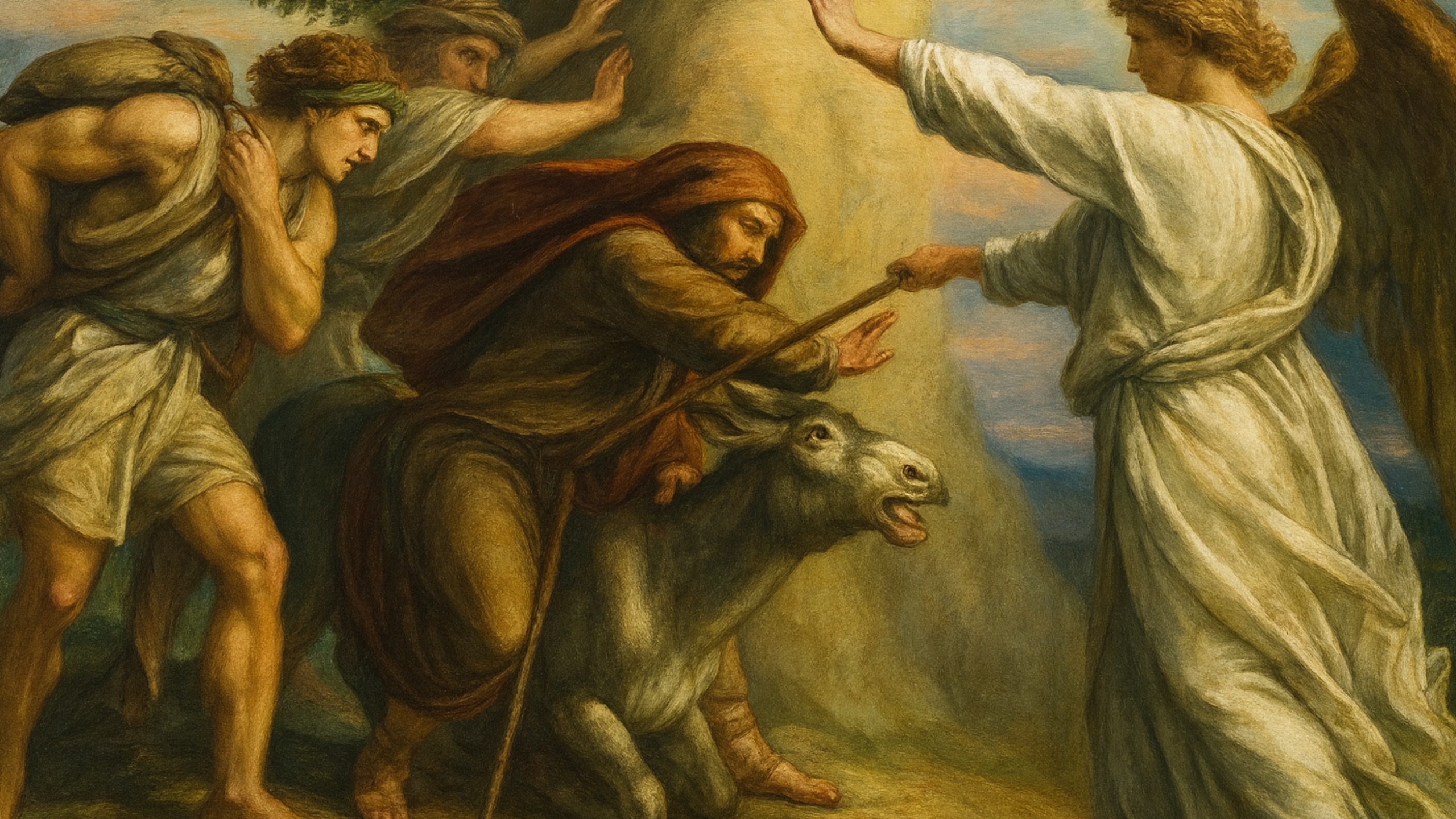
From Balaam to the New Apostolic Reformation: The Normalization of Prophetic Error
William Branham repeatedly used Balaam as a theological model to argue that genuine prophetic anointing and supernatural accuracy can coexist with doctrinal error, moral compromise, and destructive teaching, a framework he applied to the Latter Rain, the postwar Healing Revival, and later Charismatic and NAR movements. While this Balaam typology allowed Branham to critique revival excesses without denying supernatural experience, it also reshaped the biblical narrative in ways that insulated prophetic authority from accountability and helped normalize permissive theology under the language of unity, gifting, and success.
Within the biblical canon, Balaam occupies a paradoxical role as a prophet who genuinely receives revelation from God while simultaneously acting in ways that undermine God's purposes. The Book of Numbers portrays Balaam as a figure who hears the word of the Lord, blesses Israel against his own intentions, and acknowledges divine sovereignty, yet later becomes responsible for counseling actions that lead Israel into sin. Later biblical texts interpret Balaam not primarily through his prophetic utterances but through the consequences of his teaching. Revelation identifies "the doctrine of Balaam" as instruction that entices God's people toward compromise, idolatry, and immorality, reframing Balaam as a warning about corruption from within rather than opposition from without.
Second Temple and early Christian interpretation sharpened this distinction between prophetic gift and moral fidelity. Balaam becomes a typological example of a gifted religious figure whose authority and experiences are genuine but whose motivations and counsel produce destruction. The emphasis consistently falls not on Balaam's accuracy when compelled to speak, but on his willingness to reshape obedience into accommodation. This interpretive trajectory establishes Balaam as a template for understanding how divine gifting can coexist with theological error, a framework later exploited in modern revivalist preaching.
William Branham repeatedly appealed to this traditional distinction, stressing that Balaam's prophecies were correct while his teaching proved fatal. Branham explicitly argued that Balaam was a true prophet, Spirit-anointed, and capable of speaking only what God placed in his mouth, yet still became the agent through whom Israel was corrupted by false unity and moral compromise [1]. By foregrounding Balaam as a prophet who operated under God's permissive will rather than His perfect will, Branham positioned the Balaam narrative as a diagnostic tool for evaluating modern religious movements that claimed spiritual power while departing from what he defined as the revealed Word [2].
William Branham's Use of Balaam in Early Sermons
From the earliest years of his public ministry, William Branham repeatedly returned to the figure of Balaam to explain how a divinely gifted individual could nevertheless become a source of spiritual corruption. In Branham's sermons, Balaam is never reduced to a pagan diviner or outsider; instead, he is consistently identified as a genuine prophet who heard God, spoke under divine inspiration, and operated under authentic anointing. This framing allowed Branham to insist that spiritual experiences, prophetic accuracy, and visible anointing were not, by themselves, safeguards against error.
Balaam, anointed with the same Spirit that was upon Moses. What was the difference? The teaching of Moses was perfect.
- William Branham, The Anointed Ones At The End Time (65-0725M)
Branham emphasized that Balaam's initial conduct was correct. He highlighted that Balaam sought God, received a clear command not to curse Israel, and accurately proclaimed blessings when compelled to speak. According to Branham, the tragedy of Balaam was not ignorance of God's will but persistence in seeking an alternative outcome after God had already spoken. Balaam's repeated attempts to revisit the divine decision were presented as the critical turning point, marking a shift from obedience to what Branham described as God's permissive will rather than His perfect will [3].
In these early sermons, Branham used Balaam to illustrate how ambition, desire for influence, and attraction to recognition could distort prophetic ministry. Balaam's willingness to entertain Balak's offers and to negotiate divine instruction became, in Branham's telling, a cautionary tale for ministers who knew the truth yet sought opportunity, prominence, or institutional security. Balaam thus functioned as a mirror through which Branham warned his audiences about the dangers of religious success divorced from strict submission to God's spoken Word [4].
Branham also drew attention to Balaam's role as a teacher rather than merely a prophet. While Balaam could not curse Israel through prophecy, Branham stressed that he succeeded through counsel, advising a strategy that brought Israel into moral and covenantal compromise. This distinction allowed Branham to argue that doctrinal teaching, rather than prophetic utterance, was the primary means by which spiritual devastation entered the camp. In this way, Balaam became an archetype for religious leaders whose public ministries appeared blessed while their teachings quietly undermined obedience and separation [5].
Balaam as a Model of the Anointed but Erring Prophet
Branham developed the figure of Balaam into a central model for explaining how authentic spiritual anointing could coexist with doctrinal error and moral failure. In Branham's framework, Balaam was not an impostor pretending to hear God but a prophet genuinely anointed by the Holy Spirit, capable of receiving revelation and speaking accurately under divine compulsion. This insistence allowed Branham to challenge the assumption that supernatural gifts or visible success necessarily indicated divine approval.
Branham repeatedly stressed that Balaam and Moses operated under the same Spirit, built the same altars, offered the same sacrifices, and addressed the same God. From a fundamental standpoint, Branham argued, Balaam's religion appeared indistinguishable from that of Israel. The decisive difference lay not in form, sincerity, or anointing, but in alignment with the revealed Word for the moment. Balaam's error was not theological ignorance but refusal to submit fully to what God had already spoken, choosing instead to reinterpret obedience through compromise [6].
This distinction allowed Branham to argue that error often enters religious movements through leaders who are spiritually gifted yet unwilling to accept the limits imposed by divine revelation. Balaam became, in Branham's sermons, the prototype of the "anointed one" who speaks truth at times but introduces corruption through teaching that softens separation, minimizes obedience, or redefines faithfulness. By framing Balaam this way, Branham reinforced the idea that deception is most dangerous when it comes clothed in spiritual legitimacy [7].
Branham further emphasized that Balaam's failure was instructional rather than prophetic. While Balaam could not curse what God had blessed, he succeeded by persuading Israel to cross boundaries God had established. This emphasis on teaching over prophecy enabled Branham to warn his audiences that doctrinal instruction, not prophetic utterance, was the primary channel through which compromise spreads. Balaam thus functioned as a warning against trusting spiritual manifestations without rigorous submission to the Word, a theme that would later shape Branham's critique of postwar revival movements [8].
Permissive Will versus Perfect Will in Branham's Balaam Doctrine
A recurring element in William Branham's treatment of Balaam is the distinction he drew between God's perfect will and God's permissive will. Branham used Balaam's narrative to argue that divine permission should never be confused with divine approval. According to this framework, Balaam received a clear and unambiguous command from God not to go with Balak's messengers. The problem arose when Balaam continued to seek an alternative answer after God had already spoken, revealing a heart inclined toward opportunity and reward rather than obedience.
Branham emphasized that God's eventual permission for Balaam to go did not represent a change in divine intent but an accommodation to Balaam's persistent desire. This accommodation, Branham argued, exposed Balaam's motives rather than vindicating them. Balaam's experience thus became a template for understanding how religious leaders can operate under divine blessing while functioning outside God's original intention. For Branham, blessing, success, and even prophetic accuracy were insufficient indicators of alignment with God's will [9].
This distinction allowed Branham to warn that religious success achieved under permissive will could still result in long-term spiritual devastation. Balaam prospered, spoke accurately, and gained recognition, yet ultimately polluted Israel's camp. Branham repeatedly applied this pattern to modern ministry, insisting that growth, influence, and supernatural manifestations could coexist with disobedience. Balaam's story therefore functioned as a corrective to triumphalist readings of revival, redirecting attention from outcomes to obedience [10].
By framing Balaam as a prophet who knowingly stepped outside God's perfect will, Branham reinforced a theology of discernment grounded not in results but in fidelity to what he described as the revealed Word for the age. In this way, the Balaam narrative became a theological instrument for evaluating both individual ministers and entire movements, especially those that justified compromise by appealing to blessing or effectiveness rather than submission [11].
Balaam, Sexual Morality, and Boundary Crossing
Branham consistently connected the doctrine of Balaam with sexual morality and the crossing of divinely established boundaries. In his sermons, Balaam's ultimate success against Israel did not come through prophecy but through counsel that enticed the people into illicit relationships and covenantal compromise. Branham emphasized that Balaam's strategy targeted desire, attraction, and assimilation, weakening Israel from within rather than confronting them directly. Sexual immorality, in this framework, was not an isolated moral failure but a symptom of deeper theological compromise.
When they got up there, why, these Israelite people begin to see these pretty, sexy-dressed Moabite women...And Balaam knowed if God wouldn't curse them, he'd take them over on this denominational side.
- William Branham, 1960, January, 12. The Pergamean Church Age.
Branham portrayed Balaam's teaching as an appeal to normalcy and sameness. By encouraging Israel to intermarry and participate in Moabite social and religious life, Balaam reframed disobedience as unity and integration. Branham repeatedly warned that this pattern was particularly effective because it appeared reasonable, compassionate, and inclusive. The call to "be all the same" functioned, in Branham's interpretation, as a direct assault on separation, which he viewed as essential to covenant faithfulness [12].
This emphasis allowed Branham to extend the Balaam narrative beyond ancient Israel to modern religious contexts. He argued that moral laxity within the church often followed doctrinal accommodation, especially when leaders minimized distinctions between holiness and worldliness. Sexual boundaries became a visible marker of spiritual erosion, signaling that the original Word had been displaced by permissive teaching. In this sense, Balaam's counsel represented a comprehensive strategy of corruption, blending moral compromise with theological justification [13].
Branham also insisted that the consequences of Balaam's teaching were irreversible. He frequently cited the biblical claim that Israel's sin at Peor was never forgiven, using this to underscore the seriousness of moral compromise introduced under religious authority. By presenting sexual immorality as the endpoint of Balaam's doctrine, Branham reinforced his broader warning that deviation from revealed truth inevitably produces ethical collapse, even when cloaked in spiritual language and prophetic legitimacy [14].
The Doctrine of Balaam and Anti-Denominational Polemics
Branham frequently invoked Balaam as a polemical device in his critique of denominationalism. In his sermons, Balaam functioned as a symbol of institutional religion that retained correct forms while abandoning revelatory obedience. Branham argued that Balaam's religion was fundamentally orthodox in appearance: the same God, the same sacrifices, the same altars, and the same language of faith. What distinguished Balaam's position from Moses, in Branham's telling, was not creed but submission to the Word as freshly revealed.
Branham used this contrast to frame denominations as modern expressions of Balaam's doctrine. He insisted that denominational structures, creeds, and councils encouraged compromise by prioritizing unity, stability, and institutional survival over fidelity to divine revelation. In this framework, Balaam's counsel to Israel to join with Moab prefigured the modern call for interdenominational unity, ecumenism, and organizational conformity. What appeared as cooperation and peace was, according to Branham, a repetition of Balaam's fatal advice to blur divinely established boundaries [15].
Central to this argument was Branham's claim that Balaam succeeded where prophecy failed. Unable to curse Israel directly, Balaam redirected his influence through teaching that normalized association with a rival religious system. Branham equated this maneuver with denominational efforts to absorb revival movements by reshaping them into manageable institutions. The danger, he warned, was not overt opposition to truth but subtle redefinition of obedience under the banner of fellowship and shared belief [16].
By aligning denominationalism with the doctrine of Balaam, Branham framed organizational religion as a threat to authentic faith rather than its guardian. He argued that just as Israel's downfall followed Balaam's teaching, modern believers risked spiritual collapse by accepting unity that was not grounded in revealed truth. In this way, Balaam became a rhetorical lens through which Branham opposed denominational authority and justified separation as a theological necessity rather than sectarian excess [17].
Balaam, False Unity, and "We Are All the Same"
A central feature of William Branham's interpretation of Balaam was the slogan he repeatedly placed in Balaam's mouth: "We are all the same." Branham treated this phrase as the theological essence of Balaam's doctrine, arguing that it reframed disobedience as unity and compromise as charity. In his telling, Balaam's counsel did not deny Israel's God or reject Israel's experiences; instead, it affirmed sameness while quietly erasing the boundaries God had established. This move, Branham insisted, was far more dangerous than open opposition because it preserved religious language while hollowing out obedience.
Balaam taught the church the same thing. "Let us unite; we're all the same." It was the last trick.
- Branham, William. 1965, January, 8. The God Of This Evil Age.
Branham repeatedly emphasized that Balaam's appeal to unity was persuasive precisely because it rested on shared fundamentals. Moab worshiped the same God, offered the same sacrifices, and spoke in the same religious vocabulary as Israel. According to Branham, this fundamental similarity made Balaam's teaching plausible and attractive, especially to people who valued peace, cooperation, and religious respectability. The problem, he argued, was that unity built on anything other than revealed truth inevitably functioned as deception, regardless of how sincere or inclusive it appeared [18].
This framework allowed Branham to reinterpret biblical warnings about Balaam as warnings against false unity in every age. He argued that Israel's willingness to accept Balaam's message stemmed from a failure to discern the difference between fundamental agreement and revealed obedience. By minimizing separation, Balaam's doctrine converted theological distinctiveness into pride and resistance into intolerance. Branham applied this pattern directly to modern religious movements that equated unity with spiritual maturity while dismissing doctrinal boundaries as divisive [19].
Branham also insisted that the consequences of false unity were catastrophic and irreversible. He frequently returned to the claim that Israel's acceptance of Balaam's teaching resulted in judgment that was never forgiven, using this to underscore the seriousness of doctrinal compromise. In his sermons, false unity was not a secondary error but a decisive act of rebellion against God's order. Balaam's legacy, in this sense, was the normalization of compromise through religious language, a legacy Branham believed was being reenacted in contemporary revival culture [20].
From Balaam to the Latter Rain: Doctrinal Transmission
Branham did not treat Balaam merely as a historical or biblical cautionary figure but as a recurring pattern that reemerged whenever spiritual movements drifted from revealed obedience toward accommodation and unity. In Branham's interpretation, the doctrine of Balaam was not confined to ancient Israel but represented a transferable logic that could surface wherever prophetic authority, supernatural gifting, and institutional pressure converged. This made Balaam an ideal bridge for explaining how postwar revival movements, particularly those connected to the Latter Rain, could begin with genuine spiritual fervor yet end in doctrinal distortion.
Branham argued that the Latter Rain movement repeated Balaam's essential error by prioritizing unity, manifestation, and prophetic experience over submission to what he defined as the revealed Word. Just as Balaam appealed to shared belief and spiritual legitimacy to persuade Israel, Branham warned that Latter Rain teachers emphasized spiritual gifts, prophetic insight, and restored offices while downplaying doctrinal boundaries and accountability. In this framework, the movement's emphasis on apostles, prophets, and impartation functioned as a modern analogue to Balaam's authoritative counsel [21].
A key feature of this doctrinal transmission was the normalization of permissive theology. Branham contended that Latter Rain teaching encouraged believers to interpret blessing, growth, and supernatural activity as evidence of divine approval, even when teachings departed from biblical precedent or historic Christian doctrine. This mirrored Balaam's success in persuading Israel that divine favor could coexist with compromise. By framing deviation as progress and resistance as legalism, Branham believed the movement perpetuated the same logic that had corrupted Israel [22].
By tracing Balaam's influence into the Latter Rain, Branham provided a theological explanation for what he viewed as the long-term consequences of postwar revivalism. Movements that began with sincere hunger for God gradually absorbed institutional ambitions, prophetic elitism, and ecumenical impulses that weakened doctrinal clarity. Balaam thus served as both a historical archetype and a contemporary diagnosis, enabling Branham to connect ancient biblical warnings with modern charismatic developments that would later shape the Charismatic movement and the New Apostolic Reformation [23].
Balaam Typology in the Post-World War II Healing Revival
William Branham extended the Balaam typology beyond the Latter Rain movement to interpret the broader Post-World War II Healing Revival. In his preaching, the healing revival represented a moment of genuine divine visitation marked by restored gifts, signs, and widespread spiritual hunger. At the same time, Branham warned that this revival environment created conditions similar to those surrounding Balaam: widespread anointing combined with increasing pressure for organization, recognition, and unity across diverse ministries.
Branham argued that many healing evangelists operated under authentic spiritual gifting while simultaneously drifting into patterns of compromise. As with Balaam, the danger did not lie in false prophecy alone but in teaching that accommodated ambition, popularity, and institutional survival. Branham frequently warned that financial success, large crowds, and supernatural manifestations could mask deviation from divine instruction. In this framework, the healing revival's rapid growth made it especially vulnerable to Balaam-like influence, as leaders sought cooperation, platforms, and legitimacy rather than separation and obedience [24].
Central to this critique was Branham's insistence that revelation, not results, was the measure of faithfulness. He contended that healing evangelists who aligned themselves with denominational sponsors, cooperative councils, or ecumenical ventures repeated Balaam's error by exchanging obedience for opportunity. Just as Balaam sought reward from Balak while retaining prophetic credibility, revival leaders could, in Branham's view, maintain spiritual language while reshaping their message to fit institutional expectations [25].
By framing the healing revival through the lens of Balaam, Branham offered an internal critique rather than an external dismissal. He acknowledged the reality of healings and spiritual experiences while attributing later doctrinal instability to Balaam-like teaching rather than to deception alone. This interpretive move allowed Branham to affirm the revival's beginnings while condemning its trajectory, positioning Balaam as the explanatory key for understanding how a movement marked by divine activity could nonetheless produce long-term theological fragmentation [26].
Balaam's Legacy in Charismatic and NAR Teaching
William Branham's interpretation of Balaam did not end with his critique of the Healing Revival but extended, by implication and influence, into later Charismatic and New Apostolic Reformation streams. In Branham's framework, Balaam represented a recurring pattern in which prophetic authority and supernatural gifting were used to legitimate teaching that weakened doctrinal boundaries. As Charismatic movements expanded beyond their original revival contexts, Branham's Balaam typology offered an explanation for how movements marked by spiritual experience could drift toward theological accommodation.
Branham argued that the same dynamics present in Balaam's counsel--appeals to unity, emphasis on gifting, and tolerance for doctrinal variation--reappeared in Charismatic environments that prioritized experience over discernment. Prophetic words, healings, and manifestations became measures of legitimacy, while questions of doctrine were reframed as secondary or divisive. In this sense, Balaam's legacy persisted wherever spiritual authority was detached from accountability to revealed truth [27].
Within the New Apostolic Reformation, these tendencies intensified through the elevation of modern apostles and prophets. Branham's Balaam framework helps explain how hierarchical prophetic authority could normalize innovation while insulating leaders from critique. Just as Balaam's prophetic accuracy obscured the danger of his teaching, contemporary prophetic figures could claim divine endorsement while introducing doctrines that departed from historic Christian theology. Balaam thus functioned as a prototype for understanding how revelation claims can override scriptural restraint [28].
By tracing Balaam's influence into Charismatic and NAR contexts, Branham's teaching provided a critical lens for evaluating modern revival culture. The enduring warning was not against spiritual gifts themselves but against the redefinition of obedience through experience, unity, and success. Balaam's legacy, as Branham presented it, was the transformation of compromise into virtue through religious language--a pattern he believed continued to shape Charismatic and apostolic movements long after the close of the Healing Revival [29].
Theological and Historical Assessment of Branham's Balaam Framework
William Branham's use of Balaam represents one of the most internally coherent yet historically problematic elements of his theological system. On one hand, Branham's insistence that spiritual gifting and prophetic accuracy are not reliable indicators of doctrinal faithfulness aligns with longstanding biblical warnings found in both Testaments. By emphasizing teaching over manifestation, Branham echoed earlier Christian concerns about deception arising from within the community rather than from external opposition. Balaam, in this respect, functioned as a powerful heuristic for critiquing revival culture's tendency to equate success with divine approval.
At the same time, Branham's framework selectively reconfigured the biblical Balaam narrative to support his broader polemical goals. Scripture consistently presents Balaam as morally compromised from the outset, motivated by reward, and practicing divination condemned elsewhere in the law. Branham's repeated insistence that Balaam was "anointed with the same Spirit as Moses" went beyond the biblical text and introduced a theological equivalence that served to legitimize his own claims about anointed but erring prophets. This move allowed Branham to acknowledge failure and corruption within revival movements while preserving the authority of prophetic anointing as a category immune from falsification [30].
Historically, Branham's Balaam typology functioned less as neutral exegesis and more as a boundary-setting mechanism. It enabled him to affirm early phases of the Healing Revival and Charismatic renewal while condemning later developments without indicting the supernatural experiences themselves. This approach proved rhetorically effective, but it also blurred critical distinctions between biblical prophecy, charismatic experience, and Branham's own revelatory claims. By framing deviation as "permissive will," Branham created a theological buffer that insulated prophetic authority from accountability [31].
The enduring impact of Branham's Balaam doctrine can be seen in its adoption, modification, and amplification within later Charismatic and NAR teaching. Appeals to unity, experience, and prophetic authority continue to override doctrinal scrutiny in many contemporary contexts, often accompanied by warnings against "religious" or "denominational" resistance. In this sense, Branham's Balaam framework remains influential not only as a critique of revival culture but as a contributor to the very dynamics it sought to expose, perpetuating a system in which authority is preserved even as error is acknowledged [32].