
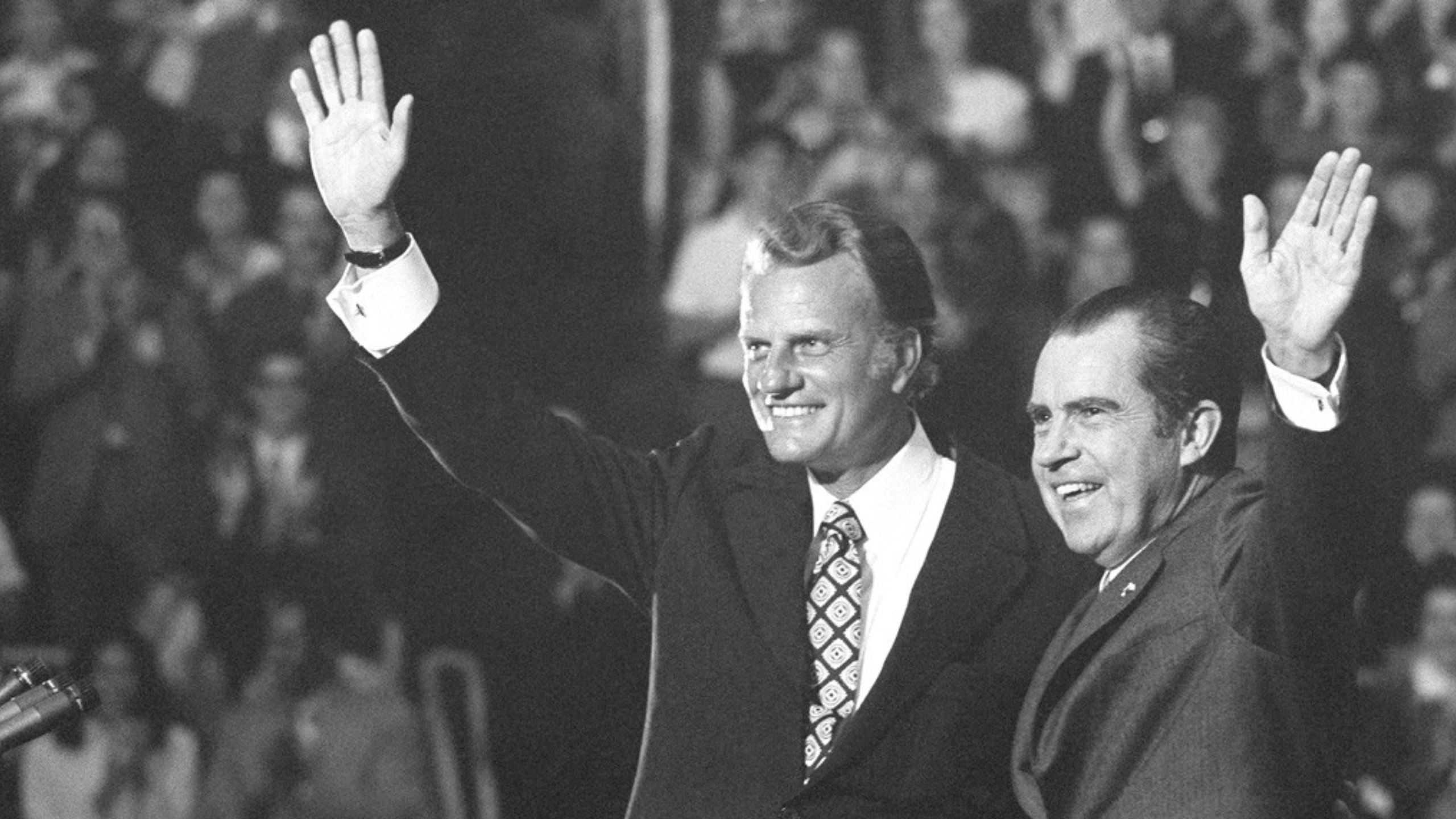
Billy Graham: From Youth for Christ to National Power
Billy Graham’s city-wide crusade model—built on interdenominational cooperation, centralized planning, and campaign-style evangelism—helped normalize a scalable parachurch ecosystem while also becoming a symbolic benchmark that adjacent revival networks (including figures like Branham and environments like Peoples Temple promotions) could invoke for legitimacy. Your excerpt then traces Graham’s visible proximity to Cold War political power through declassified references and public civic spectacle, and concludes by contrasting his public reputation on race with later-documented private antisemitic remarks and their fallout.
Billy Graham emerged as a defining figure in twentieth-century American evangelicalism through mass evangelistic "crusades" that were designed as city-wide events rather than strictly local church meetings. One contemporary summary of his methods notes that, "In his crusades, he worked closely with a broad range of churches in each city. He was far more willing to cross denominational lines than most evangelicals." [1] This basic organizational approach—interdenominational cooperation, centralized planning, and a public-facing campaign structure—became a hallmark of the Graham crusade model and helps explain both his reach and the controversies attached to his role as a unifying symbol.
A key part of Graham's early platform-building also occurred within the postwar youth-evangelism environment associated with Youth for Christ. A May 4, 1947 item (as preserved in the current source set) describes his early campaign-style work this way: "Mr. Graham and two other American Leaders toured the country, holding city-wide campaigns." [2] Even at this early stage, the language emphasizes coordinated, multi-city efforts—an approach that aligns with the later crusade form and suggests continuity between youth-oriented mobilization strategies and the broader crusade movement. Graham's "city-wide campaign" model and his practice of crossing denominational boundaries helped normalize a style of evangelical cooperation that fits naturally within the later expansion of parachurch ministry ecosystems.
Billy Graham, Jim Jones, and William Branham: A Minister Sent to Modern Sodom
The points of intersection between William Branham and Billy Graham tell a story. In Branham's own preaching, Graham often functions as a symbol of the new postwar evangelical celebrity and the scale of modern mass evangelism. In a 1952 sermon, Branham told his audience that "Mattsson-Boze today is up there taking my book to Billy Graham, on an interview," and that "they're wanting me to follow him...in that big auditorium," before presenting the matter as a question of divine guidance rather than professional opportunity.[3] Regardless of whether the report can be corroborated from outside sources, the statement is historically significant because it shows Branham positioning himself rhetorically within the orbit of Graham's public prominence, treating Graham's meetings as the kind of platform that could confer legitimacy on those who came after.
Remember, this is the last thing that He'll do before His Coming. You remember what He said? 'As it was in the days of Sodom and in Gomorrah, so will it be in the Coming of the Son of man.' What was the message? 234 There was three Angels went down. Two of them, a Billy Graham and a Jack Shuler went down into Sodom, and preached just the message of Gospel deliverance, to the people. But one Angel stayed behind with the elected, Abraham and his group.
- William Branham, December 21, 1958, Where Is He, King Of The Jews?
Promotional materials further complicate the picture, because the name "Billy Graham" could be invoked for attention in environments far removed from Graham's established crusade apparatus. One advertisement excerpt announces an event featuring "Billy Graham of Full Gospel" alongside Winston Nunes at Peoples Temple with the infamous Jim Jones.[4] While Graham is not historically identified with the Latter Rain or Deliverance movements, his being advertised at a Peoples Temple event after Branham and Joseph Mattsson-Boze approached him might suggest Graham's involvement with Branhamism. At the time, Mattsson-Boze was working directly with Branham and Jones to rebuild Branham's ministry after an incident with Gordon Lindsay and the Voice of Healing revivalists. Regardless of the history, Branham invoked Graham to frame his own ministry ambitions, and others could invoke the Graham name to confer credibility on local meetings, whether accurately or opportunistically.
Youth for Christ and the Healing Revival Networks
The postwar revival environment that produced both the Youth for Christ circuit and the mass crusade phenomenon was defined by mobility, media visibility, and a widening ecology of interdenominational cooperation. Graham's early prominence was cultivated in a setting where evangelistic labor was already being organized on a scale larger than any one congregation. A 1947 notice describing his work observes that "Mr. Graham and two other American Leaders toured the country, holding city-wide campaigns." [5] The phrasing is important: it signals a campaign logic—strategic cities, coordinated teams, and repeated formats—that could be replicated across contexts. In time, the crusade model refined this into a well-known pattern of large public meetings supported by broad local church coalitions; one interpretive summary notes that, in these campaigns, "he worked closely with a broad range of churches in each city," and that he was "far more willing to cross denominational lines than most evangelicals." [6]
That same ecosystem helped shape the postwar healing revival networks, which often depended on the circulation of reputations across overlapping audiences. Figures who did not share Graham's institutional standing nonetheless benefited from the symbolic capital created by Graham's visibility. Branham's preaching illustrates how Graham could function as a point of reference that signaled scale and legitimacy. In 1952, Branham told his listeners that "Mattsson-Boze today is up there taking my book to Billy Graham, on an interview," and that "they're wanting me to follow him...in that big auditorium," before framing the decision in terms of divine direction. [7] Whether the claim can be corroborated externally, it reveals how the postwar revival economy encouraged comparative positioning: to place one's ministry in relation to Graham was to claim adjacency to the most recognizable form of evangelical success.
The same dynamic appears in promotional rhetoric. A mid-1950s advertisement excerpt presents an event featuring "Billy Graham of Full Gospel," paired with Winston Nunes. [8] The value of such a reference is not merely biographical but sociological: it demonstrates how the Graham name could be used to confer credibility and attract attention, even in contexts that diverge from Graham's established crusade machinery. In this way, the postwar revival ecosystem produced a kind of reputational spillover. Campaign-style evangelism created widely recognized symbols of legitimacy, and those symbols could be invoked—accurately or otherwise—by adjacent movements and personalities operating within the same competitive religious marketplace.
Billy Graham and the U.S. National Security Council: Declassified
Public memory often treats Billy Graham's proximity to American power as either proof of covert collaboration or, at the other extreme, as a harmless byproduct of celebrity. The declassified record supports neither simplification. Instead, it depicts Graham as a religious figure whose name appears naturally within Cold War governance: sometimes as a public symbol attached to national events, sometimes as a person discussed in practical bureaucratic terms, and sometimes as a presence in elite political conversations.
One of the clearest examples of Graham's name moving through official channels appears in a CIA deputies' meeting record dated 17 August 1955. The note is procedural rather than conspiratorial: "Noted it is possible that Billy Graham might receive an invitation to visit the USSR and CIA might be called upon to furnish an interpreter. The Director remarked that Mr. Graham is amenable to either refusing or accepting this invitation as the State Department might direct." [9] Whatever conclusions are drawn later about Graham's politics, this passage reads as a normal intersection between diplomacy and a prominent evangelist: the State Department's posture matters, and CIA support is framed as logistical.
Graham's closeness to political power is also visible indirectly, through references that treat him as an eyewitness to sensitive discussions rather than as an operative. A memorandum of telephone conversation dated 24 January 1961 records that, during a discussion involving the new President, "He mentioned that Billy Graham had been a witness when he was talking to the new President about this matter." [10] The wording does not establish an intelligence role; it does, however, show Graham present in conversations close enough to policy concerns that participants could cite him as a confirming observer.
A related dynamic appears in Senate-to-CIA correspondence from March 1957. In the course of reporting a paragraph relayed from a private letter, the senator's text notes: "Billy Graham has already been removed because of a remark he made recently against Russian behavior." [11] The line is important less for its factual precision about the underlying incident than for what it implies about the environment in which Graham operated: his public remarks were understood as having consequences in international or quasi-diplomatic settings, and those consequences were noteworthy enough to appear in communications forwarded to the CIA.
Finally, a 1970 "Situation Information Report" demonstrates how Graham's name could function as an establishment signifier in the political theater of the era. Under a July 4 Washington, D.C. entry, the report states: "Plans for the Bob Hope-Billy Graham originated Honor America Day being produced by Walt Disney Productions are progressing." [12] Here, the issue is not clandestine work but public alignment—Graham's name appears as part of a national spectacle described in terms of production, promotion, and high-profile endorsement.
Political Entanglements: Elite Access, Public Events, and Establishment Framing
By the 1960s and 1970s, Billy Graham's role in American public life could not be reduced to "politics" in the narrow sense of partisan endorsement. His position was that of a nationally recognized religious counselor whose presence was routinely adjacent to high-level decision-making and national spectacle. A revealing glimpse appears in a memorandum of a telephone conversation dated 24 January 1961, where one participant notes that "Billy Graham had been a witness when he was talking to the new President about this matter." [13] The line is brief, but its implication is substantial: Graham's access placed him close enough to consequential conversations that he could be cited as an eyewitness to discussions involving presidential leadership.
The 1970s also show Graham's name operating as a public symbol within civic and patriotic production. A situation report dated 18 June 1970 records that "Plans for the Bob Hope-Billy Graham originated Honor America Day being produced by Walt Disney Productions are progressing." [14] Whatever one makes of the event's politics, the description indicates that Graham's public identity was being deployed as part of a nationally choreographed performance of American unity—an "originated" stamp that linked him to a patriotic campaign produced with entertainment-industry professionalism.
At the same time, Graham's stature meant that his judgments and public comments were monitored and contested within establishment debates about international posture. A Washington Star report on the appointment of Leo Cherne to a board supervising intelligence agencies recounts that Cherne "chided the Rev. Billy Graham...for having praised the Russians for 'high morality.'" [15] The episode illustrates a recurring tension in Graham's public career: his reputation as a moral voice granted him unusual access and influence, but it also made his statements about global rivals politically legible and therefore vulnerable to scrutiny by other elite actors. In this period, Graham's proximity to power was not hidden; it was structural, visible in his appearance in national events, his access to presidents, and the way his speech could become an object of establishment concern.
Graham, Branham, Race, and Antisemitism: Public Personas and Private Rhetoric
After Jones and hundreds of other ministers broke with Branham over Branham's promotion of the "Serpent's Seed" doctrine—an idea he presented as a distinctively "Christian" teaching with clear affinities to Christian Identity frameworks—Branham publicly praised Billy Graham for a sermon that used the "wise man's filter" motif in connection with a Viceroy cigarette advertisement. Branham later claimed that the "Holy Spirit" drew his attention to the advertisement while he was hunting,[16] and he then repackaged the same motif in his own preaching under the title "A Thinking Man's Filter."
When Branham described Graham as having "went down into Sodom," the expression must be read against Branham's established racial outlook and the way he coded social change as moral collapse. Graham, by contrast, cultivated a public reputation as an evangelist willing to challenge segregationist norms, including later retellings that credit him with removing segregation ropes at his 1952 Jackson, Mississippi meetings.[17] Branham defended segregation and denounced civil-rights leaders—most notably Martin Luther King Jr.—as agents of political subversion rather than moral reform.[18]
I am a segregationalist. Because, I don't care how much they argue, you cannot be a Christian and be an integrationist. That's exactly right. God even separates His nations. He separates His people. 'Come out from among them!' He's a...He is a segregationalist. 'Don't even...Touch not their unclean things!' He pulled Israel, that Jewish race, out of every, all the races in the world. He is a segregationalist.[19]
William Branham
Graham's public persona of racial moderation and reconciliation, however, does not remove the need to examine other strands of his formation and his private rhetoric. Graham's conversion is commonly linked to the preaching ministry of Mordecai Ham, a fundamentalist revivalist whose public career included openly antisemitic themes. In the early 1970s, Graham privately echoed President Richard Nixon's antisemitic framing, saying that Jewish people "swarm around me and are friendly to me," but adding, "They don't know how I really feel about what they're doing to this country."[20] When the remarks became widely known after the release of White House tapes, Graham initially claimed not to remember the exchange; later, he issued a written apology.[21] Commentators have questioned how voluntary that apology was, noting that Graham continued to insist that he could not recall the conversation.
When I broke the story in 2002, Graham said through a spokesman that he could not respond regarding the transcript because he didn't remember it. He would later issue a written apology and meet with Jewish leaders. But he forever maintained that he could not recall the conversation."What Graham said that day is inexcusable. Did it ever occur to him that he should have countered the president?" Martin Marty, a religious historian at the University of Chicago, has told me. Marty noted the distinction some conservative evangelicals and Pentecostals have made between supporting Israel but not American Jews.[22]