
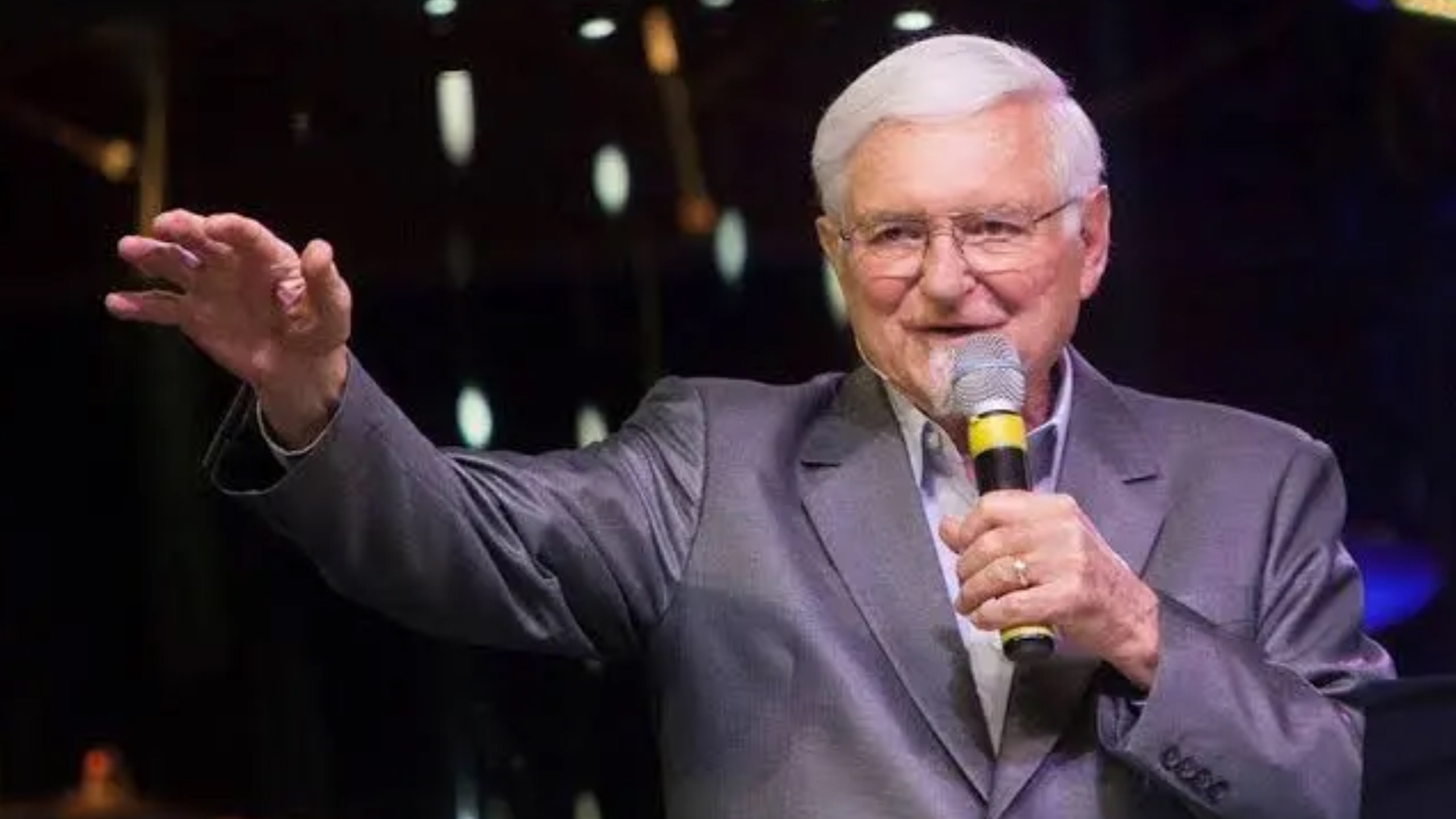
C. Peter Wagner, Fuller Seminary, and the Roots of the New Apostolic Reformation
C. Peter Wagner was a central figure in the Church Growth Movement at Fuller Theological Seminary, where he worked alongside John Wimber and helped shape theological currents that later became known as the New Apostolic Reformation. His legacy is marked not only by influence over modern charismatic networks, but also by deeply controversial positions on race, church authority, and social integration that continue to draw criticism from scholars and apologists.
Charles Peter Wagner was a Quaker[1] theologian, missiologist, missionary, writer, teacher, and "church growth specialist" who founded Global Harvest Ministries and co-founded the World Prayer Center. From 1971 to 2001, Wagner served as the Professor of Church Growth at Fuller Theological Seminary's School of World Missions.[2]
Fuller Theological Seminary was founded by Charles E. Fuller, Baptist minister who held revivals with William Branham.[3][4][5] Branham helped promote Fuller's "Old Fashion Revival Hour" radio program.[6] Wagner was enrolled in Fuller Theological Seminary during the years in which Charles held revivals with Branham.[7]
Wagner was among the first (or the first) to use the term "New Apostolic Reformation" and wrote books on the subject.[8] The New Apostolic Reformation is a movement that seeks to reform Christianity and restore the offices of church government, such as the office of a prophet and an apostle. Through the years, it has received a great deal of skepticism from cult experts and Christian apologists for its cultish attributes. So much so that Wagner published "The New Apostolic Reformation Is Not a Cult" in Charisma News.[9]
After Wagner graduated from Princeton Theological Seminary, Fuller Theological Seminary, and Rutgers University in 1952, Wagner worked as a missionary in Bolivia.[10] Upon his return to the United States, Wagner spoke at a series of conferences on his missionary work in South America [11] and published several books about the "Defeat of the Bird God" in Latin America.[12] Soon after, Wagner was named as a director at Fuller Theological Seminary and associate professor of Latin American Studies.[13]
While working at Fuller, Wagner joined the Church Growth Movement and was soon recognized as a leading authority.[14] He pushed for Christian ministers to grow their churches and compared ministers with small churches to "being overweight". Wagner worked closely with Church Growth Movement founder Donald McGavran and organized seminars on church growth, church renewal, and pastoral care.[15]
Thousands of Churches are not growing because they really don't want to grow. Growth can be a threat to insecure Christian leaders who feel they already have all they can handle. Some Christians admit that they prefer small churches and would therefore feel uncomfortable if their church started getting bigger. Some say they want to grow, but are unwilling to pay the price, exactly like an overweight person who is always going to ... go on a diet but never seems to ...[16]
- C. Peter Wagner.
In 1973, Wagner published his book, Look out! The Pentecostals are Coming, and held meetings on the subject at well-recognized Pentecostal Churches such as Angelus Temple.[17] Joining John Wimber, the Founding Director of the Department of Church Growth at Fuller, Wagner held Church Growth clinics for multiple denominations.[18][19]
In 1979, Wagner began to push for racial segregation of churches. Upon publishing his book Our Kind of People, Wagner received immediate criticism for attempting to undo the work leaders in Civil Rights had accomplished. According to Wagner, "The local congregation should be only as integrated as are the families and other primary social groups in the community, while intercongregational activities and relationships should be as integrated as are the secondary social groups in the community or society as a whole".[20] Ministers promoting racial equality pointed to Galatians 2:28 recited, "Neither Jew nor Greek, there is neither slave nor free, there is neither male nor female, for you are all one in Christ Jesus", but Wagner disagreed. According to Wagner, "whenever the Apostle Paul spoke of Christian believers being 'all one in Christ', he is 'referring not to a normative pattern for local congregations, but rather to the supracongregational relationship of believers in the total Christian body over which Christ himself is the head". Wagner began to apply his opinions formed as he witnessed the indigenization of natives in South America to that of people with black skin during the Civil Rights Movement in the United States.
The civil rights movement caused a distinct change in the attitude of American blacks toward their own cultural values in general and toward their churches in particular. What happened to black churches during the sixties was not unlike the process of indigenization that has occurred in scores of cultures around the world where Christianity has been introduced.
- Wagner, C. Peter. Our Kind of People
Wagner's Our Kind of People is a strong argument against racial integration of churches to segregate black culture, essentially sub-dividing (or segregating) American culture. Though Wagner's call to arms was unsuccessful, there was a solid attempt to establish a secondary Church Growth Movement among the Black communities in the South, proclaiming that an "age of black liberation has now begun in America." Worse, Wagner quoted others of like mind who labeled white ministers in favor of racial integration "culturally arrogant".[21]
The age of black liberation has now begun in America. Black Christian leaders are joining their voices in a chorus of protest against the impotent models of integration and assimilation preferred a decade or two ago. Henry Mitchell, in my estimation, leads the chorus. Although he admits to being 'among those once guilty of the pervasive and erroneous assumption of the erasure of the substance of traditional African faith ...', he is 'now convinced that the slavocracy failed to erase African culture, but slowly succeeded in getting Blacks to be ashamed of it.' Mitchell's keen perception of the cultural differences between black and white America is unmatched in the literature.
- Wagner, C. Peter. Our Kind of People
Our Kind of People argues that "Integration Has Failed", and Wagner titled a book subsection with that phrase.[22] He admitted that McGavran and others never dreamed of Church Growth in an interracial method; McGavran did not apply his principles for Church Growth to the Civil Rights movement because he was not in favor of people who "prefer the assimilationist or integrationist models for understanding society."[23] Integrating the church would, according to Wagner, seriously curtail the evangelist potential of the church. Discrediting the many examples of churches that allow people of all races, Wagner claimed that their growth was the result of "transfer of membership rather than individual conversions", and that "American churches that mix blacks and whites in their membership can do reasonably well as long as the blacks remain a numerical minority".[24]
As the examples given earlier have shown, the evangelistic potential of the church will be seriously curtailed. The few truly interracial churches that have flourished have grown largely through transfer of membership rather than individual conversions. Although some undoubtedly will, few non-Christians from outside the congregation are likely to be attracted to such a heterogeneous community.
- Wagner, C. Peter. Our Kind of People
Many people have observed, for example, that American churches that mix blacks and whites in their membership can do reasonably well as long as the blacks remain a numerical minority. In such cases, the burden for altering the system of relevance has fallen on the black membership. This relationship is acceptable, particularly to those blacks who have assimilated into the Anglo-American culture or who are moving in that direction. THe whites are glad to have them as long as they 'do it our way.' In some cases, a particularly charismatic black pastor may be able to preside over such a situation for some time and keep morale at a high level. When and if black members become a majority, however,r white membership usually begins to fall off rapidly, in spite of frequent sermons and exhortation on Christians being "one in Christ." This situation is often such an embarrassment that the reasons for it are never realistically faced. But obviously, typical American whites, accustomed to their dominant position in society as a whole, are less willing than blacks to go through the difficult and uncomfortable process of altering their system of relevances. In most cases, those who leave the mixed church will join another church of their own homogenous unit.
- Wagner, C. Peter. Our Kind of People