
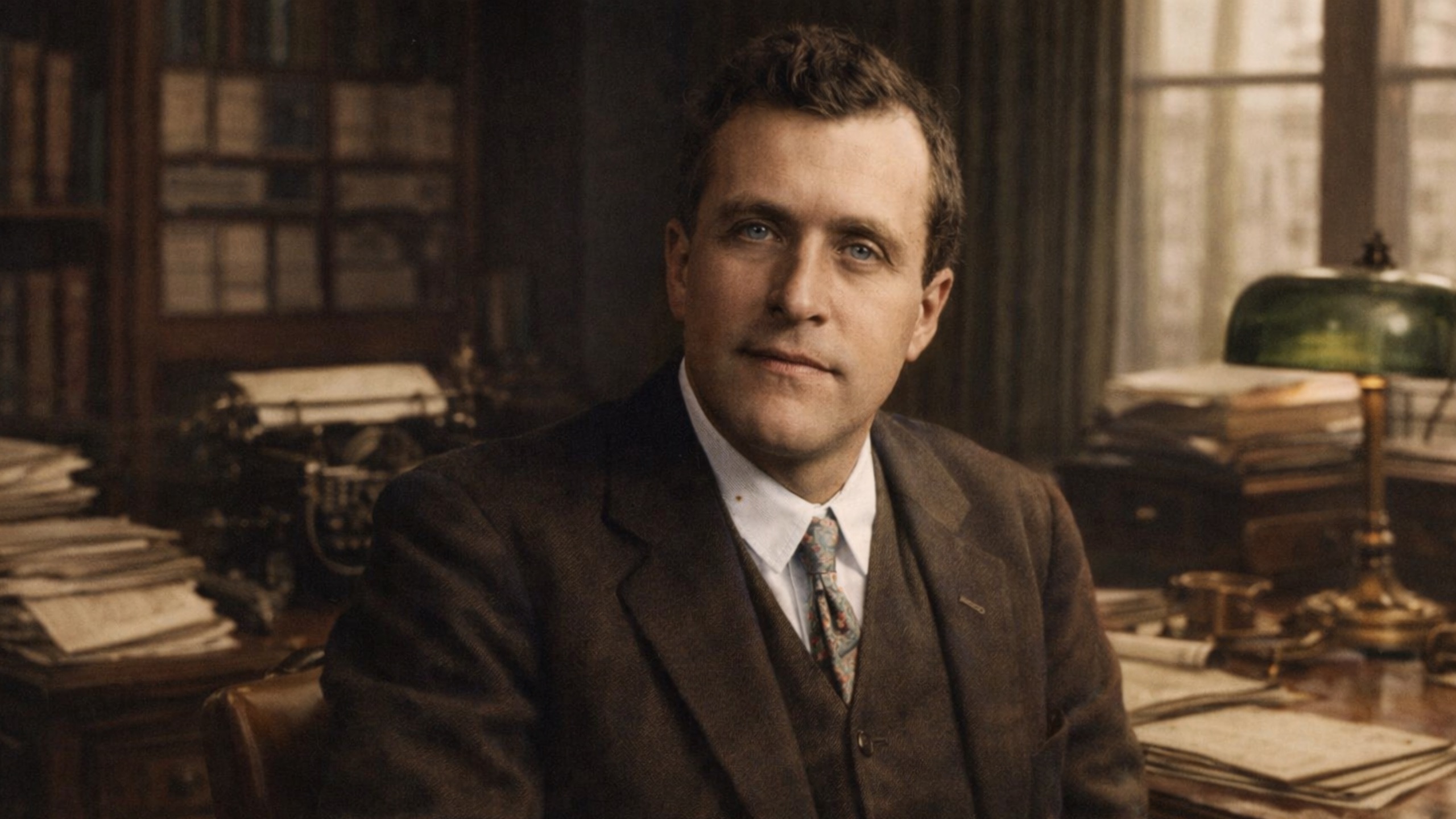
Caleb A. Ridley: The Klan Chaplain Linked to William Branham and Roy E. Davis
Caleb A. Ridley, an Imperial Kludd of the 1915 Ku Klux Klan, played a significant role in early twentieth-century religious and political networks that intersected with Roy E. Davis and William Branham. His participation in revivals, prohibition activism, and Klan organizing sheds new light on the racial and ideological context surrounding the formative years of Branham’s ministry.
Dr. Caleb A. Ridley was the Imperial Kludd,[1] the highest-ranking chaplain, of the 1915 Ku Klux Klan under William Joseph Simmons. Ridley was also involved with the Supreme Kingdom white supremacy group created by Edward Young Clarke.[2] He was directly connected to William Branham and served as the featured speaker at a church rally organized by Roy E. Davis to promote the Pentecostal Baptist Church of God sect in Nashville.[3] Ridley was allegedly a member of the original Stamps Quartet, singing four-part harmony with Roy E. Davis, William D. Upshaw, and William Jennings Bryan.[4] Ridley helped organize the Jeffersonville, Indiana branch of the Ku Klux Klan, connecting Jeffersonville to the Hiram Evans sect of the Klan when Indiana separated to form the Indiana Klan.
Organizers for the Ku Klux Klan late today announced that the proposed attempt to hold a meeting in Louisville tonight bad been abandoned and that activities of the organization had been transferred to Jeffersonville, Ind., opposite Louisville, on the Ohio river. The armory in that city. the state-ent said, had been obtained for an address by Rev. Caleb A. Ridley of Atlanta, preparatory to forming a branch of the order.
- Wichita Falls Record News
Prohibition Activism and Public Scandal
Ridley was involved with the Western Carolina Bible Conference alongside William D. Upshaw,[5] and he played a leadership role in the prohibition movement headed by Upshaw. At the Baptist General Convention of Texas in 1908, Ridley announced the publication of lectures on prohibition, prompting a rush of attendees eager to obtain copies. To restore order, Rev. A. E. Baten, the convention secretary, and William D. Upshaw began singing "Yankee Doodle".[6] Despite his public advocacy, Ridley was later exposed as a drunkard after being arrested for drunk driving.[7]
Ku Klux Klan Activity in Jeffersonville
In 1921, Ridley planted the Jeffersonville chapter of the Ku Klux Klan after efforts to hold meetings in Louisville were abandoned. Meetings were held at the Armory,[8] a location later used by Roy E. Davis and Ralph Rader for revival services. The Klan headquarters was later moved to the Speith Building, where William Branham's father-in-law, Charles Brumbach, was appointed custodian of the entrance key.[9]
Nashville Revival and Roy E. Davis
In 1929, prior to relocating the headquarters of the Pentecostal Baptist Church of God sect to Jeffersonville, Indiana, Roy E. Davis organized a large church rally to raise interest in a new building intended to replace the church located at Spring and Meridian in Nashville, Tennessee.[10] Caleb A. Ridley was the featured speaker.
The pastor, Dr. R. E. Davis will preach the evening sermon. And special music has been prepared by a string orchestra. The speaker for the evening will be Dr. Caleb A. Ridley, former pastor of the Central Baptist Church of Atlanta who was connected with the late William Jennings Bryan of the circuit of the Radcliffe Chautauqua.[11]
William Branham’s Recollection of the Revival
William Branham later mentioned this revival in his sermons, though he reportedly could not recall the exact location. When describing the event with Roy E. Davis, Branham referred to an art gallery inside the Nashville Parthenon. The Pentecostal Baptist Church on Spring and Meridian was located only a short distance from the Parthenon. According to Branham, he was present with Davis during the revival.
I was with Brother Davis and was having a—a revival. It might have been Memphis. And we was, went to a coliseum, and they had in there, not a coliseum, it was kind of an art gallery, and they had the—the great statues that they had got from different parts of the earth, of different, Hercules and so forth, and great artists had painted. And then they had the analysis of a man that weighed a hundred and fifty pounds. You know what, how much he's worth? Eighty-four cents. That's all he is. Eighty-four cents is all—all the chemicals you can get out of him. He's just got enough whitewash to sprinkle a hen's nest, and he's got enough, just a little bit of calcium, little potash. It would all sell for eighty-four cents. But we just take care of that eighty-four cents and baby it around.[12]
Implications for Branham’s Early Ministry Timeline
This revival not only connects William Branham directly to Dr. Caleb A. Ridley, but it also significantly alters the commonly accepted timeline of Branham’s early ministry. In 1959, Branham stated that he had been converted into Roy E. Davis’ Pentecostal sect thirty-one years earlier, placing the event in 1928.[13] Many historians incorrectly date Branham’s ordination to the early 1930s, after Roy E. Davis migrated to Indiana.
Later Associations with Roy E. Davis and William D. Upshaw
In the early 1940s, as William D. Upshaw[14] and Roy E. Davis[15] were soliciting funds from wealthy individuals in San Bernardino and Los Angeles to support the Third Wave of the Ku Klux Klan through the Ussher-Davis Children’s Orphanage, Caleb Ridley also appears to have been involved. Both Upshaw and Ridley were listed among Roy E. Davis’ credentials at the 1943 state convention of the California Singers and Musicians Association led by Davis.[16]