
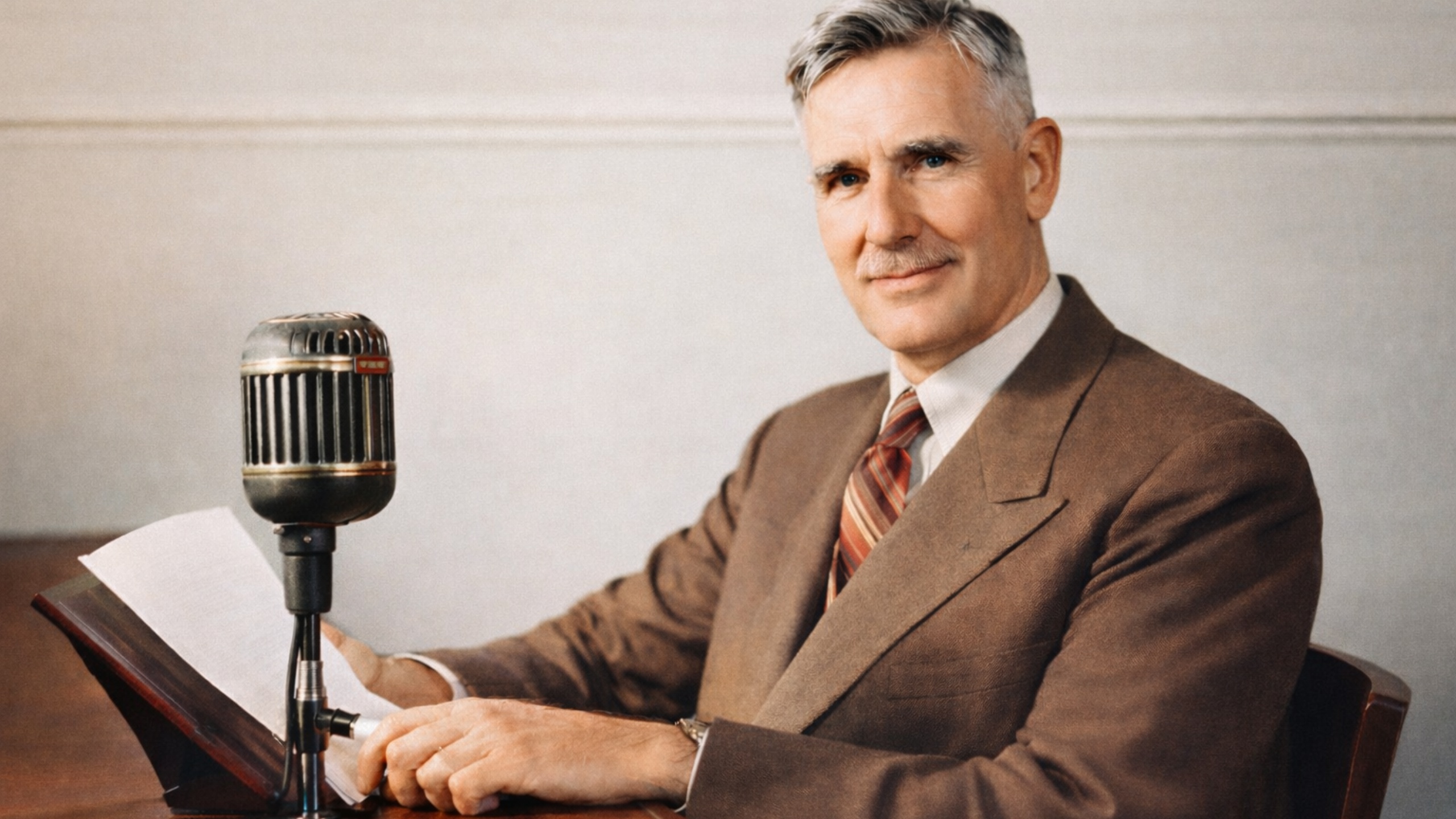
Charles Fuller and the Political Foundations of Modern Evangelical Media
Charles Fuller emerged as a powerful radio evangelist whose ministry blended revivalism, political activism, and prophetic rhetoric during a period of intense religious and cultural upheaval in the United States. His associations with figures such as Gerald B. Winrod, Paul Rader, and William Branham, along with the founding of Fuller Theological Seminary, positioned him as a key transitional figure linking early fundamentalism to later charismatic and Third Wave movements.
Charles E. Fuller was a minister and radio evangelist who founded Fuller Theological Seminary in Pasadena, California. He was converted by Paul Rader in 1917 at the Church of the Open Door in Los Angeles and almost immediately began holding revivals throughout the western United States.[1]
Before entering full-time ministry, Fuller worked in the fruit-packing business and later attended the Bible Institute of Los Angeles, where he gained a reputation as a capable Bible teacher within the local community.[2] He also achieved notable success in radio, launching his broadcast ministry in 1925. By 1926, Fuller had earned sufficient income to purchase a twenty-acre orange grove outside Placentia, California, for $82,375,[3] an amount equivalent to approximately $1.4 million today.[4] He also owned the “Baby Gar Black Beauty,” a speedboat regarded as one of the finest in Southern California and noted for reaching speeds of up to fifty miles per hour.[5]
Fuller regularly used his religious platforms to advance political positions, including commentary on party affiliation and contemporary political issues, which drew skepticism from local newspapers. In 1928, he was particularly outspoken against presidential candidate Alfred Emmanuel Smith during Smith’s race against Herbert Hoover.[6] Smith was the first Roman Catholic nominated for president by a major political party, a fact that intensified divisions between Catholic and anti-Catholic voters.[7] Fuller aligned himself with the anti-Catholic side of this controversy and was active in Gerald Burton Winrod’s organization, Defenders of the Christian Faith.[8] Winrod, commonly referred to as the “Kansas Hitler”[9] and “Jayhawk Nazi,”[10] was widely known for blending religion with political activism. Winrod was connected to William Branham through F. F. Bosworth, Paul Rader, and Roy E. Davis. Branham promoted Charles Fuller’s “Old-Fashioned Revival Hour” radio program[11] and also held revival meetings with Fuller.[12]
Charles Fuller. How many ever heard The Old-Fashioned Revival Hour? Great man, he said, not long ago, he said, “We have the speaking in tongues, interpretation, right here.” Right there in Long Beach. And that’s true. I’ve preached right there with him, many time. So they have the interpretation, and make everybody sit quiet.[13]
- William Branham
As a frequent speaker at Defenders of the Christian Faith conventions, Fuller’s theology overlapped with early versions of Branham’s stage persona. Branham likewise preached a fusion of religion and politics similar to that promoted by Paul Rader and Gerald Winrod within Defenders circles. Fuller delivered lectures on British Israelism,[14] along with topics that included faith healing,[15] prophecy,[16] Russia,[17] eschatology,[18] and prophecy related to “Mussolini and the Vatican.”[19] Winrod was also outspoken against Benito Mussolini prior to his arrest as a conspirator in the Great Sedition Trial of 1944, and Branham later claimed that he narrowly avoided arrest for similar rhetoric.
People, we’re living in the end time. How many of you people has heard years ago down here when they was going to have me arrested down here for preaching on that “mark of the beast”? When I said that Mussolini, when he first come in power twenty-some-odd years ago, I said, “If Mussolini ever goes towards Ethiopia, mark this down, there will never be peace till Jesus Christ comes.”[20]
- William Branham
Fuller served as a leader within Fundamentalists of the World, an organization whose directors included Roy E. Davis[21] and Gerald Burton Winrod.[22] The thirteenth annual convention of the group was held at the Church of the Open Door at the Bible Institute of Los Angeles, where Fuller served as director.[23] Fuller also oversaw the fourteenth annual convention in Philadelphia in 1931.[24] In addition, he was active within Christian and Missionary Alliance circles, where he organized and participated in conclaves hosted by C&MA churches.[25]
In the months preceding the Great Sedition Trial of 1944, Fuller purchased the Franklin School grounds for $90,000 and announced plans to construct a Bible school for training evangelists.[26] Whether due to his associations with figures named in the Sedition Trial or for other reasons, the project was suspended. Following William Branham’s March 1947 revival meetings in Santa Rosa, California,[27] the Fuller Foundation submitted a $145,000 bid for the estate of John S. Cravens[28] and began preparations for what would become Fuller Theological Seminary. Around this period, or shortly before, Branham met with Fuller.[29] According to Branham, their discussion included various religious groups active in the region, including Father Divine. Notably, a portion of the recording and transcript of Branham’s account was later edited.
Brother Charles Fuller was speaking to me when we was down at Long Beach, and he told me, said, “Brother Branham,” said, “the reason,” said, “this West Coast here has everything under the name of Divine healing.” Said, “They have Blue Flame worshippers, Father Divine worship and all, everything under the name of Divine healing.” Said, “It’s such a stumbling block.” Well, that…That may be so, friends; I do not know; but that does not counteract God’s power to heal. [Blank spot on tape. End of record—Ed.]…and the Healer Divine. And now, no man can do a miracle in His Name that can speak light of Him. That’s what He said.[30]
- William Branham
By June of that year, the leadership of Fuller Theological Seminary was announced, with classes scheduled to begin in October.[31] Dr. Harold John Ockenga, Ph.D., was named president, joined by Rev. Harold Lindsell, Ph.D., Rev. Everett F. Harrison, Ph.D., Rev. Carl F. H. Henry, Ph.D., and Wilbur M. Smith, D.D.[32]
Over subsequent decades, Fuller Theological Seminary produced ministries that were supportive of, affiliated with, or influenced by various expressions of William Branham’s stage persona. A number of leaders associated with the Third Wave of Pentecostalism maintained close ties to the seminary.
According to Branham, Fuller initially rejected the postwar healing revival and later came to accept it. C. Peter Wagner, who later coined the term “New Apostolic Reformation” to describe movements linked to Branham and to Second and Third Wave Pentecostalism, served as a director at Fuller.[33] John Wimber later joined Wagner in teaching a course on healing at the seminary, a development that generated controversy over “signs and wonders in Christian ministry.”[34]
Charles Fuller, as much as he fussed and carried on to me about that when I was out there, he’s accepting it now. And they’re doing it on Long Beach. Yes, sir! Right on shore, right in the auditorium, having the blessings of God, speaking in tongues, interpretation of tongues, and praying for the sick.[35]
- William Branham