
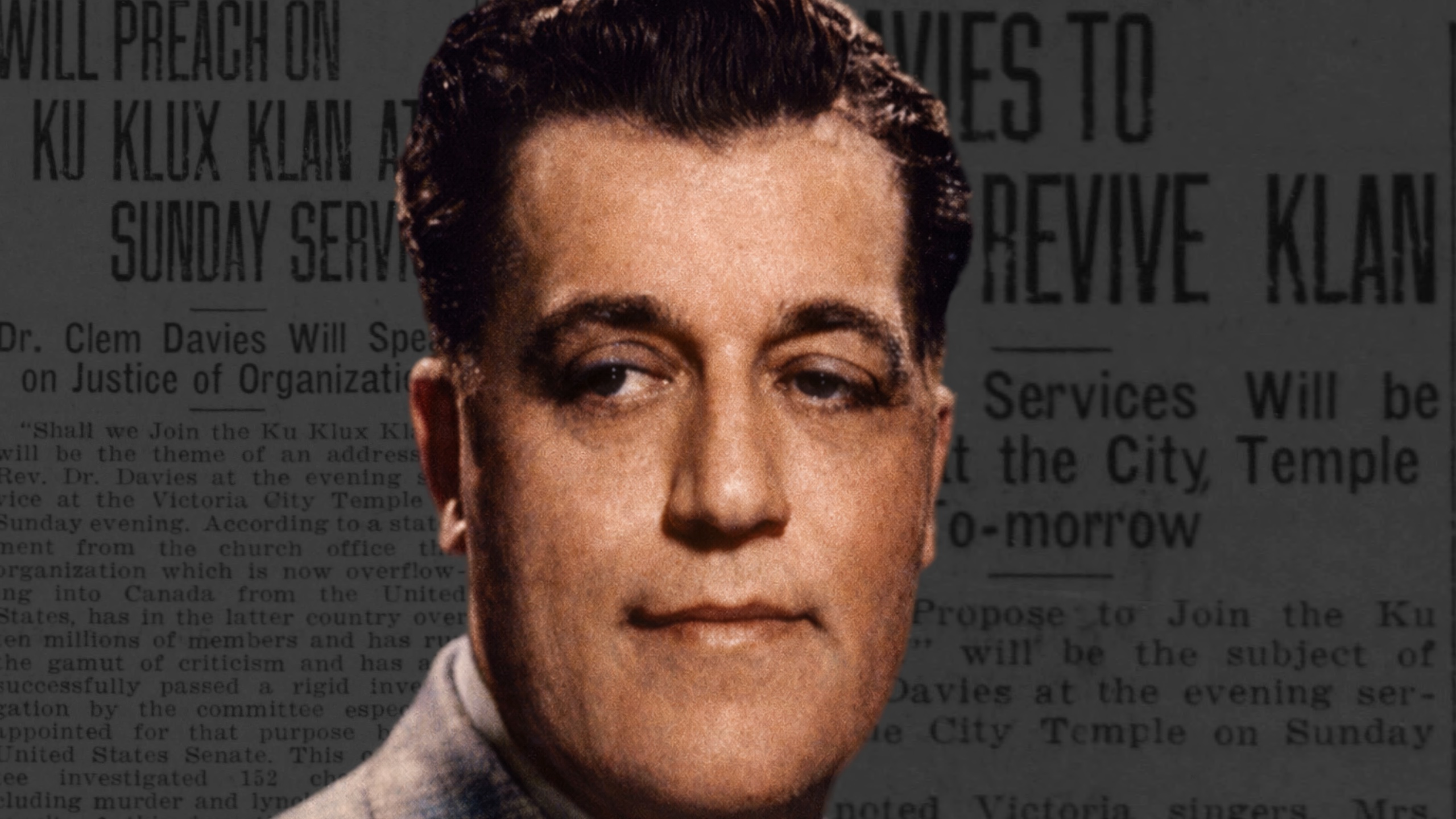
Clem Davies: The White Supremacist Preacher Behind Revivalist Networks
Clem Davies was a transnational revivalist figure whose ministry fused white supremacy, British-Israelism, and apocalyptic prophecy with mass revival techniques decades before the rise of postwar healing movements. His networks, teachings, and organizational methods formed an ideological and structural pipeline that carried racialized theology into later Pentecostal, Latter Rain, and charismatic revival contexts.
Clem Davies first emerged as a public religious figure in Victoria, British Columbia, during the early 1920s, where he rapidly gained attention as an unconventional and provocative preacher. Originally associated with Methodist circles, Davies distinguished himself by rejecting conventional sermon styles and ecclesiastical restraint, drawing large crowds through lectures that blended religion, social critique, and sensational subject matter [6]. His popularity quickly exceeded the capacity of traditional church venues, prompting the establishment of the Victoria City Temple as an independent platform for his ministry.
From its inception, Victoria City Temple functioned less as a conventional church and more as a hybrid religious auditorium and lecture hall. Contemporary newspaper coverage documents Davies’s deliberate departure from standard religious discourse, with sermons and lectures addressing topics such as sex, heredity, race, and social degeneration—subjects largely absent from mainstream Protestant pulpits of the period [7]. These presentations were explicitly marketed as controversial and, at times, restricted to mature audiences, signaling Davies’s willingness to court notoriety as a means of expanding influence.
Davies’s early ministry at the Temple also reflected a growing hostility toward established religious institutions. He framed organized churches as compromised by tradition and moral weakness, positioning himself instead as a prophetic voice offering scientific, racial, and spiritual “truths” to a disillusioned public [8]. This anti-institutional posture would later align closely with British-Israelism and Christian Identity frameworks, but its roots are already visible in his Victoria period.
The Victoria City Temple thus became the incubator for Davies’s later ideological synthesis. It provided him with a loyal following, financial independence, and a public stage from which he could normalize extremist ideas under the guise of religious inquiry. These early years laid the structural and rhetorical foundation for Davies’s subsequent advocacy of eugenics, racial hierarchy, and militant social movements that would define his later career [9].
Eugenics, Birth Control, and Racial Ideology in Davies’s Early Teaching
By the mid-1920s, Clem Davies had moved beyond unconventional preaching into the open promotion of eugenics, racial hierarchy, and social engineering framed as religious and scientific truth. At Victoria City Temple, Davies hosted and personally delivered lectures addressing birth control, heredity, and “race betterment,” explicitly marketing some of these presentations as suitable for mature audiences only [10]. Contemporary advertisements confirm that these themes were not peripheral but central to his public ministry, signaling a deliberate effort to fuse religious authority with emerging pseudoscientific racial theories.
Davies’s engagement with eugenics reflected a broader ideological shift occurring within certain strands of Anglo-Protestant extremism during the interwar period. Rather than emphasizing individual repentance or spiritual renewal, Davies increasingly framed social problems as biological and racial in origin. His lectures treated marriage, reproduction, and heredity as matters requiring expert regulation, positioning himself as both moral instructor and social engineer [11]. This approach aligned closely with transatlantic eugenics discourse and provided theological cover for racial exclusion and hierarchy.
These teachings also introduced core elements later identifiable in Christian Identity theology. By emphasizing bloodlines, inherited traits, and racial destiny, Davies laid conceptual groundwork for doctrines that reinterpreted biblical narratives through racialized frameworks [12]. Scholarly analysis identifies this period as formative in Davies’s transition from sensational preacher to ideological architect, where theology became a vehicle for racial determinism rather than spiritual transformation.
The significance of this phase lies not only in its content but in its method. Davies normalized extremist racial ideology by embedding it within church programming and public lectures, thereby lowering the barrier between religious instruction and political radicalization. This fusion of eugenics, religion, and authority would become a defining feature of his later advocacy for the Ku Klux Klan and British-Israelism, and it prefigured patterns later visible in postwar revivalist movements [13].
Public Advocacy for the Ku Klux Klan in Canada
By 1925, Clem Davies had moved from implicit racial theorizing to explicit public advocacy for the Ku Klux Klan, using his pulpit at Victoria City Temple as a platform to defend and promote the organization. Contemporary newspaper reports document Davies announcing sermons explicitly devoted to the question of Klan membership, framing the Ku Klux Klan as a legitimate and necessary response to perceived moral, political, and racial decline [14]. These announcements were not defensive reactions to accusations but proactive invitations to consider Klan ideology within a religious framework.
Davies’s sermons went beyond abstract discussion. Notices in the local press record him preaching on topics such as whether Christians should join the Ku Klux Klan and, shortly thereafter, why he personally proposed to do so [15]. This progression indicates a deliberate effort to normalize Klan affiliation among his congregation and to present membership as a morally justified Christian duty. By integrating Klan rhetoric into worship services, Davies blurred the boundary between religious conviction and extremist political allegiance.
The public nature of Davies’s Klan advocacy distinguishes him from many contemporaries who sympathized privately with exclusionary movements but avoided overt endorsement. His willingness to associate his church publicly with the Klan suggests confidence in both his audience and the broader social climate of interwar British Columbia, where anti-Catholic, anti-Jewish, and white supremacist sentiments had found organized expression [16]. Scholarly analysis identifies Davies as one of the most visible religious figures in Canada to legitimize the Klan from the pulpit during this period.
This phase of Davies’s ministry marked a critical escalation. The Klan provided an organizational and ideological framework that aligned seamlessly with his earlier eugenic teaching and racial determinism. It also reinforced his conception of religion as an instrument of social discipline and racial preservation rather than spiritual reconciliation. These commitments would later resurface in his British-Israel teaching and influence the racialized theology that migrated into Christian Identity and postwar revivalist networks [17].
Political Organization and Mobilization from the Pulpit
Clem Davies did not limit his activism to rhetoric or ideological instruction; he moved deliberately into direct political organization, using his pulpit as a recruitment and mobilization platform. In early 1925, newspaper coverage reported that Davies announced the formation of a new political organization during a church service, openly criticizing provincial government policy on unemployment and liquor regulation while soliciting names of supporters from his congregation [18]. This episode illustrates the extent to which Davies viewed religious gatherings as instruments for coordinated political action.
Davies’s approach collapsed the distinction between church and political movement. Rather than urging congregants to influence society indirectly through moral reform, he framed political participation as an extension of religious duty. His sermons increasingly presented social and economic issues as evidence of moral decay requiring decisive, organized response, a posture consistent with authoritarian and nationalist movements of the period [19]. The church thus became a staging ground for civic agitation rather than a forum for spiritual formation.
This pattern of mobilization aligned seamlessly with Davies’s earlier advocacy for the Ku Klux Klan and his promotion of eugenics and racial hierarchy. Political organization offered a practical mechanism through which racial and exclusionary ideology could be enacted rather than merely discussed. Scholars note that such movements often relied on charismatic religious leaders to legitimize political extremism by framing it as divinely sanctioned or scientifically inevitable [20].
Davies’s willingness to openly organize politically from the pulpit further distinguishes him within Canadian religious history. It demonstrates that his extremism was not an incidental byproduct of theological eccentricity but a coherent program aimed at reshaping society through coordinated religious, racial, and political action. This strategy would later reappear in his American ministry, where revival networks and prophecy conferences provided similarly effective platforms for ideological dissemination [21].
Anti-Asian Agitation and Exclusionist Campaigns
Clem Davies’s racial ideology found one of its most explicit public expressions in his leadership of anti-Asian agitation in British Columbia during the mid-1920s. Contemporary reporting and later historical analysis identify Davies as a founder and first president of the Victoria branch of an Oriental Exclusion Association, an organization dedicated to opposing Asian immigration and economic participation in the province [22]. His activism positioned him at the center of a broader exclusionist movement that blended economic anxiety, racial fear, and militant nationalism.
Davies’s rhetoric framed Asian immigration not merely as a labor or policy issue but as an existential threat to white society. In a widely publicized 1924 sermon titled “British or Oriental Columbia—which?”, he warned that failure to act decisively would provoke violent consequences, explicitly invoking the Ku Klux Klan as a force prepared to “take the law into its own hands” if legislators did not intervene [23]. This sermon was attended by thousands and broadcast over the radio, dramatically amplifying its reach and normalizing extremist rhetoric within mainstream public discourse.
The significance of Davies’s exclusionist campaigns lies in their fusion of religion, politics, and intimidation. By presenting racial exclusion as a moral and spiritual imperative, he endowed secular discrimination with divine urgency. Historians note that such sermons functioned as rallying points for organized racism, translating abstract prejudice into coordinated social pressure and political action [24]. Davies’s leadership role further demonstrates that his extremism was not rhetorical excess but structured activism.
These campaigns also reveal continuity with Davies’s earlier advocacy of eugenics and the Ku Klux Klan. Anti-Asian exclusion provided a practical arena in which racial hierarchy, social engineering, and militant enforcement converged. This synthesis would later reappear in his British-Israel teaching and prophetic frameworks, where racial destiny and national survival were similarly intertwined. In this sense, Davies’s exclusionist agitation represents a critical bridge between local political extremism and the racialized theology that later circulated through Christian Identity and postwar revivalist networks [25].
British-Israelism and the Foundations of Christian Identity
Clem Davies’s turn toward British-Israelism marked a decisive ideological consolidation in which his earlier commitments to racial hierarchy, exclusion, and authoritarian social control were given an explicit theological framework. British-Israelism—the belief that Anglo-Saxon peoples were the literal descendants of the biblical Israelites—provided Davies with a religious rationale for white supremacy that claimed divine mandate rather than mere cultural preference [26]. Through lectures, sermons, and published writings, he reframed race as sacred lineage and history as prophetic destiny.
Davies emerged as a prominent lecturer and advocate of British-Israelism, attracting audiences beyond his earlier local base. Scholarly analysis identifies him as part of a transnational network of British-Israel teachers who blended prophecy interpretation, racial theory, and political alarmism [27]. This movement supplied Davies with a coherent narrative that connected his anti-Asian agitation, eugenic thinking, and Klan advocacy into a unified worldview: white Anglo-Saxon peoples were chosen, threatened, and obligated to defend their inheritance.
Within this framework, biblical texts were reinterpreted to support doctrines of blood purity, racial separation, and inherited spiritual status. Davies’s emphasis on lineage and “racial streams” anticipated core claims later formalized within Christian Identity theology, including pre-Adamic race theory and the demonization of Jews as non-Israelites [28]. His 1946 publication Racial Streams of Mankind exemplifies this synthesis, presenting racial history as divinely ordered and immutable.
The significance of Davies’s British-Israel teaching lies in its function as an ideological bridge. It translated secular racism and political extremism into theological certainty, allowing followers to view exclusion and domination as acts of obedience rather than prejudice. Scholars have identified figures like Davies as critical intermediaries who carried British-Israelism into explicitly extremist religious movements in the mid-twentieth century [29]. This theological turn would later echo through Christian Identity networks and influence postwar revivalist environments in which racialized prophecy and lineage-based doctrine found renewed expression.
Migration to the United States and Expansion of Influence
Clem Davies’s relocation to the United States marked a significant expansion of his influence, both geographically and ideologically. By the early 1940s, Davies had moved from Canada to southern California, a region that had become a nexus for British-Israelism, prophetic speculation, and emerging extremist religious networks [30]. This move placed him within a dense ecosystem of revivalism, political radicalism, and racialized theology that amplified the reach of his ideas beyond their earlier regional confines.
In the American context, Davies adapted his message to resonate with postwar anxieties, emphasizing prophecy, geopolitical collapse, and racial destiny. Newspaper coverage and scholarly analysis document his public lectures on topics such as Russian encirclement, economic catastrophe, and “Oriental factors” in prophecy, themes that mirrored Cold War fears and reinforced his earlier exclusionist worldview [31]. These subjects allowed Davies to frame contemporary events as fulfillment of divine prophecy, lending urgency and inevitability to his racial and political claims.
Davies’s American ministry also benefited from established networks that connected British-Israelism with Pentecostal and healing revival circles. Scholars note that figures associated with prophecy conferences and revival campaigns often shared platforms and audiences, facilitating the cross-pollination of ideas [32]. Within this environment, Davies’s emphasis on lineage, prophecy, and divine election found receptive audiences already primed for apocalyptic interpretation and charismatic authority.
This period represents a critical transition in Davies’s career. His migration did not moderate his views but instead enabled their integration into broader revivalist and prophetic movements that were gaining national and international visibility. By embedding his racialized theology within popular revival formats, Davies helped ensure that themes developed in his Canadian ministry would persist and evolve within American religious extremism, setting the stage for his later involvement with Armenian faith-healing networks and figures linked to postwar charismatic revivalism [33].
Armenian Faith Healing Networks and the Kardashian Connection
Clem Davies’s American ministry intersected directly with Armenian faith-healing networks that played a significant role in the postwar revival environment. By the mid- to late 1940s, Davies was closely associated with Armenian healer Avak Hagopian, whose highly publicized healing campaigns attracted national attention and substantial financial backing [34]. Contemporary newspaper accounts identify Davies as a central organizer and associate in these campaigns, confirming his role was not peripheral but administrative and promotional.
Multiple reports document that Hagopian’s tours were sponsored by Armenian-American businessmen, including members of the Kardashian family, and that Davies worked alongside these sponsors to coordinate logistics, publicity, and venues [35]. One article notes that Davies chartered a special Southern Pacific train to facilitate Hagopian’s nationwide tour, underscoring the scale and organization of the operation [36]. These efforts demonstrate Davies’s continued ability to translate ideological influence into practical mobilization through revival-style enterprises.
The Kardashian connection is particularly significant because it situates Davies within a network that bridged ethnic religious communities, healing revival culture, and financial patronage. Later biographical research confirms that Tatos Kardashian, the family patriarch, partnered with Davies as a financial backer of Hagopian and was involved in plans to construct a temple in Los Angeles for the healer [37]. This collaboration places Davies at the intersection of race-based theology and multicultural revival networks, complicating simplistic narratives of segregation while reinforcing the instrumental nature of these alliances.
Davies’s involvement in Armenian healing campaigns also created points of contact with figures central to the postwar healing revival, including William Branham. Branham’s own sermons explicitly reference the same sponsors who supported Hagopian, stating that those who sent for Hagopian also arranged Branham’s appearances [38]. This overlap confirms that Davies operated within the same sponsorship and revival circuits that facilitated Branham’s early campaigns, providing a concrete pathway through which Davies’s ideas and networks could exert indirect influence on emerging charismatic movements.
This phase of Davies’s career illustrates the adaptability of his extremism. While his racial theology remained intact, he demonstrated pragmatic flexibility in forming alliances that expanded his reach and relevance. The Armenian faith-healing network thus served as a vehicle through which Davies’s organizational skills, prophetic framing, and revivalist strategy continued to shape the postwar religious landscape [39].
Avak Hagopian, Sponsored Healing Campaigns, and Media Coverage
The public career of Armenian faith healer Avak Hagopian provides a clear documentary window into how Clem Davies translated ideology into mass revival spectacle. Beginning in 1947, Hagopian’s healing services were extensively covered by national and regional newspapers, many of which explicitly identified Davies as a central associate and organizer [40]. These reports consistently framed Hagopian’s ministry not as an isolated phenomenon but as a coordinated campaign supported by financiers, clergy, and publicity networks.
Media coverage emphasized the scale and theatricality of Hagopian’s campaigns. Articles describe packed auditoriums, dramatic healing claims, and tightly managed tours spanning multiple cities [41]. Davies’s role in these operations extended beyond spiritual endorsement; he handled logistics, transportation, and coordination, including the chartering of special trains and negotiation of venues [42]. This level of organization mirrors techniques later used in postwar healing revivals, underscoring Davies’s function as an architect of revival infrastructure rather than a passive participant.
The sponsorship structure behind Hagopian’s campaigns further illustrates the entanglement of religion, money, and influence. Newspaper accounts and later biographical research identify Armenian-American businessmen, including Tom Kardashian and William Perumean, as principal sponsors [43]. Davies’s partnership with these patrons positioned him as an intermediary between financial backers and revival performers, a role that would become standard in later charismatic movements.
Importantly, the same sponsorship networks that supported Hagopian also intersected with William Branham’s early healing ministry. Branham explicitly stated that the individuals who arranged Hagopian’s appearances also sent for him, confirming shared logistical and financial pathways [44]. This overlap demonstrates that Davies’s revival enterprises functioned as conduits through which personnel, audiences, and theological emphases circulated across emerging healing movements.
The significance of Hagopian’s campaigns lies not only in their immediate impact but in their function as prototypes. They reveal how Davies’s organizational methods, prophetic framing, and willingness to collaborate across ethnic and denominational lines facilitated the expansion of healing revival culture. These patterns would later reappear with greater intensity in the Latter Rain movement, where spectacle, sponsorship, and apocalyptic expectation converged into a durable revivalist model [45].
Prophecy, Geopolitics, and Apocalyptic Teaching Themes
Clem Davies’s later ministry increasingly emphasized prophecy interpretation framed through geopolitical crisis and apocalyptic expectation. In the late 1940s, newspaper advertisements and reports document Davies lecturing on subjects such as Russian expansionism, global financial collapse, and “Oriental factors” in biblical prophecy, presenting contemporary events as evidence of imminent divine judgment [46]. These themes allowed Davies to reinterpret political anxieties as prophetic inevitabilities, reinforcing urgency and obedience among his audiences.
Davies’s prophetic framework blended British-Israel theology with current affairs, portraying Anglo-Saxon nations as central actors in an unfolding end-times drama. By linking international politics to biblical timelines, he positioned himself as an authoritative interpreter capable of decoding history’s hidden meaning [47]. This approach amplified his earlier racial ideology by embedding it within a cosmic narrative, transforming social and political conflict into manifestations of spiritual warfare.
Such teaching methods closely resemble patterns later visible within postwar healing revivals and the Latter Rain movement. Prophecy preaching during this period often combined sensational headlines, numerical timelines, and warnings of economic catastrophe to maintain audience engagement and loyalty [48]. Davies’s lectures demonstrate that these techniques were already well developed prior to the rise of figures like William Branham, suggesting continuity rather than innovation.
The apocalyptic tone of Davies’s ministry also functioned as a mechanism of control. By framing dissent or delay as rebellion against divine warning, he reinforced authoritarian leadership and discouraged critical examination of his claims. Scholars identify this fusion of prophecy, fear, and political interpretation as a hallmark of extremist religious movements, particularly those emerging from British-Israel and Christian Identity streams [49]. In this context, Davies’s prophetic teaching served as both an ideological reinforcement and a recruitment tool, extending the reach of his worldview well beyond his immediate congregations.
Chicago, the World’s Fair, and Points of Contact with William Branham
One of the most consequential points of contextual overlap between Clem Davies and William Branham occurs in Chicago during the 1933 Century of Progress World’s Fair. Contemporary newspaper reporting confirms that Davies was invited to preach at Chicago Temple on September 17, 1933, placing him in a prominent Methodist venue during the height of the Fair [50]. This appearance situates Davies within the same urban, religious, and cultural environment that would later feature prominently in Branham’s own retrospective narratives. Considering Branham's latter connection to Avak Hagopian as Hagopian's timeline intersected with Davies, this overlap cannot be overlooked.
William Branham explicitly stated that he attended the World’s Fair in Chicago in 1933 as a young preacher to hear Paul Rader speak, describing Easter sunrise services by Lake Michigan during that same period [51]. This firsthand recollection establishes Branham’s presence in Chicago at the time Davies was publicly preaching nearby, creating a documented convergence of geography, timing, and revival-oriented religious activity. While no direct meeting between the two is recorded, the overlap provides a plausible context for indirect exposure to shared preaching themes, revival culture, and prophetic rhetoric circulating in the city.
Chicago Temple itself was a significant hub for evangelical experimentation and mass-audience preaching during the early twentieth century. Hosting Davies—a figure already known for racialized theology, sensational sermons, and prophetic framing—demonstrates that his ideas were not confined to fringe settings but entered mainstream revival platforms [52]. Branham’s later emphasis on prophetic identity, end-time interpretation, and anti-institutional rhetoric bears structural resemblance to themes Davies had already been advancing publicly.
The importance of this overlap lies not in proving direct influence but in identifying a shared religious ecosystem. Both men operated within revival networks that privileged charismatic authority, prophetic interpretation, and dramatic public spectacle. Chicago in 1933 functioned as a crucible where such ideas circulated freely, reinforced by mass events like the World’s Fair and large-scale religious gatherings. This context strengthens the argument that Davies’s teaching environment contributed to a wider ideological atmosphere from which later figures, including Branham, emerged [53].
Continuities Between Davies’s Teaching and Latter Rain / Healing Revival Themes
A comparison of Clem Davies’s teaching with the later Latter Rain and postwar healing revival movements reveals striking continuities in structure, method, and thematic emphasis. Long before the emergence of the Latter Rain movement, Davies had already integrated prophecy interpretation, racialized theology, apocalyptic urgency, and anti-institutional rhetoric into a coherent revival framework [54]. These elements would later become defining features of healing revival figures such as William Branham.
Davies’s emphasis on divine election through lineage anticipated doctrines later articulated in revival contexts as spiritual “seeds,” chosen vessels, and inherited destiny. While later figures reframed these ideas in more overtly charismatic language, the underlying logic remained consistent: identity and authority were presented as divinely conferred rather than ecclesiastically accountable [55]. This theological move allowed leaders to claim exceptional status while insulating their teachings from institutional critique.
Methodologically, Davies pioneered revival techniques that later became standard. His use of sensational sermon topics, prophetic timelines, geopolitical alarmism, and tightly organized campaigns mirrors the structure of postwar healing revivals [56]. The Armenian faith-healing tours he organized functioned as early prototypes of the large-scale, media-driven revival model later perfected in the late 1940s and 1950s.
Most significantly, Davies’s work demonstrates how extremist ideology could persist beneath shifting religious language. Although later revivalists often avoided explicit racial terminology, themes of purity, separation, destiny, and imminent judgment continued to circulate within healing revival discourse [57]. Scholars note that British-Israel and early Christian Identity frameworks supplied conceptual reservoirs that revival leaders could draw from selectively, adapting them to new audiences without abandoning their core assumptions.
Understanding these continuities reframes the Latter Rain movement not as a sudden theological innovation but as an evolutionary development within a longer ideological lineage. Davies’s ministry occupies a crucial position in this lineage, bridging interwar racial extremism and postwar charismatic revivalism through shared structures of authority, prophecy, and spectacle [58].