
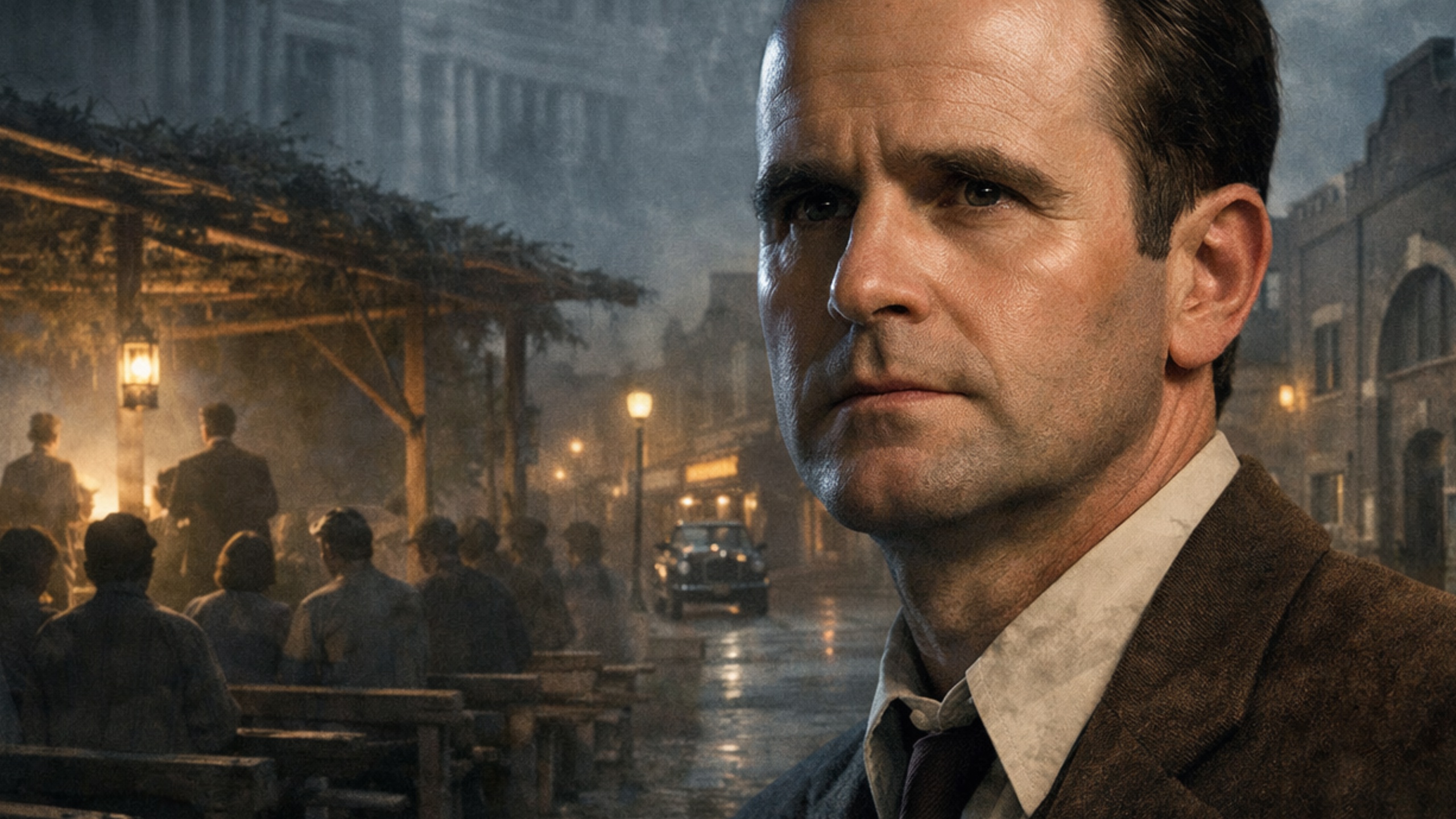
Dan S. Davis: How the Davis Brothers, the Klan, and Pentecostal Revival Shaped William Branham
William Branham’s early ministry did not emerge in isolation but developed within a tightly connected network of Pentecostal churches, revival infrastructure, and influential figures linked to both organized religion and extremist movements. By tracing the roles of Dan S. Davis, Roy E. Davis, and Caleb Ridley, this study documents how institutional control, shared worship spaces, and overlapping political-religious networks created the environment that produced Branham.
By the early 1930s, Jeffersonville, Indiana had become a dense and fragmented Pentecostal environment shaped largely by the activities of Dan S. Davis and his immediate family network. Dan S. Davis operated multiple Pentecostal congregations under changing names and locations, including the First Pentecostal Church, Pentecostal Assembly, and the Baptized Church of God Pentecostal, with documented addresses at 741 Spring Street, 722 Spring Street, and 922 Mechanic Street respectively [1][2][3]. Newspaper listings repeatedly identify Davis as “Pastor–Evangelist,” indicating both pastoral oversight and itinerant revival activity rather than a stable denominational structure.
This environment was marked by deliberate institutional separation. Public notices explicitly stated that Dan S. Davis’s churches were “not affiliated in any way with the Pentecostal Baptist Church,” distancing his work from that of his brother, Roy E. Davis, even while both men operated simultaneously within the same small city and revival network [1]. Despite this claimed separation, the coexistence of multiple Pentecostal churches led by members of the same family created overlapping audiences, shared revival labor, and a competitive religious marketplace.
Dan S. Davis also controlled physical revival infrastructure that would later become critical for emerging ministers. Beginning in 1933, Davis owned and operated a brush arbor at Eighth and Graham Streets, where extended revival meetings were held and publicly advertised [4][5]. Construction delays, municipal issues, and weather-related interruptions documented in local newspapers nevertheless confirm Davis’s authority over the site and his intent to establish it as a permanent revival location [5][6]. This arbor functioned as an early Pentecostal hub before permanent tabernacle structures were established elsewhere in Jeffersonville.
Taken together, the documentary record shows that Jeffersonville’s early Pentecostal environment was neither unified nor spontaneous. It was structured around family-led ministries, competing church identities, shared revival labor, and temporary worship spaces. Dan S. Davis stood at the center of this environment, providing both organizational models and physical venues that would later be occupied by other Pentecostal figures emerging from the same milieu, including William Branham, who was ordained in the Pentecostal ministry by Dan's brother, Roy E. Davis.
Roy E. Davis, Nashville Revivals, and the Caleb A. Ridley Connection
In July 1929, Roy E. Davis organized a large public rally at the Pentecostal Baptist Church located at Spring and Meridian Streets in Nashville, explicitly aimed at raising interest and funds for a new church building [7]. Contemporary newspaper coverage identifies Roy E. Davis as pastor and confirms that the event was intentionally designed as a high-profile public gathering rather than a routine church service.
Crucially, Roy E. Davis selected Dr. Caleb A. Ridley, former Imperial Kludd for the Ku Klux Klan, as the featured speaker for this rally [7]. Ridley was not a peripheral figure. He was a nationally known revivalist and lecturer who had been closely associated with William Jennings Bryan on the Radcliffe Chautauqua circuit, lending cultural legitimacy and public draw to the event [7][8]. Follow-up notices in the same Nashville press confirm that Ridley continued lecturing at additional Pentecostal Baptist events at Spring and Meridian, including outdoor festivals sponsored by the church’s Ladies’ Missionary Society [8]. This establishes an ongoing working relationship between Roy E. Davis and Ridley rather than a one-time appearance.
Ridley’s presence at Roy E. Davis’s Nashville rallies is significant because it situates the Pentecostal Baptist Church of God sect within a broader network that blended revivalism, public lecturing, and ideological movements. Only eight years earlier, Ridley had been publicly identified as the speaker selected to organize Ku Klux Klan activity in Jeffersonville, Indiana, where meetings were transferred after being abandoned in Louisville [9]. The same individual who helped establish the Jeffersonville Klan was now featured as a trusted revival speaker in Roy E. Davis’s Pentecostal campaigns.
William Branham later recalled participating in a revival with Roy E. Davis during this period, though he misidentified the city while accurately describing the interior features of the Nashville Parthenon art gallery located near the Spring and Meridian church site [10]. Branham’s recollection places him directly alongside Roy E. Davis during the same revival season in which Caleb Ridley was publicly advertised as the main speaker. This convergence corrects later timelines that place Branham’s association with Roy E. Davis only after the latter’s relocation to Indiana and demonstrates that Branham’s formative ministry experiences occurred within an already-established network linking Roy E. Davis and Caleb Ridley.
One day down in Memphis, Tennessee, or one...I don't think it was in Memphis. It was one of the places there. I was with Brother Davis and was having a—a revival. It might have been Memphis. And we was, went to a coliseum, and they had in there, not a coliseum, it was kind of an art gallery, and they had the—the great statues that they had got from different parts of the earth, of different, Hercules and so forth, and great artists had painted.
- William Branham, 1962. In His Presence
Taken together, the Nashville revival documentation shows that Roy E. Davis deliberately aligned his Pentecostal sect with prominent revival figures tied to broader political and ideological movements. These alliances predate the Jeffersonville period and form a direct bridge between southern revival networks, Ku Klux Klan-associated organizers, and the Pentecostal environment that would later shape William Branham’s ministry.
Ku Klux Klan Expansion into Jeffersonville and Religious Infrastructure
The arrival of the Ku Klux Klan in Jeffersonville, Indiana was not a spontaneous local development but a coordinated transfer of activity involving outside organizers and religious figures already embedded in revival networks. In September 1921, Klan organizers publicly announced that a planned meeting in Louisville, Kentucky had been abandoned and that all activities were being moved across the Ohio River to Jeffersonville [11]. The Jeffersonville armory was secured specifically for an address by Rev. Caleb A. Ridley of Atlanta, whose role was described as preparatory to forming a local branch of the Klan [11]. This places Ridley at the center of the organizational moment when Jeffersonville became a new Klan foothold.
Ridley’s involvement is significant because he was simultaneously active as a revival lecturer and church figure. Within a decade, he would appear repeatedly as a featured speaker at Pentecostal Baptist Church events organized by Roy E. Davis in Nashville, demonstrating that the same individual functioned comfortably in both overtly political-racial movements and religious revival contexts. The Jeffersonville Klan, therefore, did not emerge in isolation from the religious landscape but overlapped directly with it through shared personnel and public venues.
The timing of the Klan’s establishment in Jeffersonville coincided with the later arrival and expansion of the Davis family’s Pentecostal enterprises. By the early 1930s, Jeffersonville contained multiple Pentecostal churches led by Dan S. Davis and his brothers, along with revival arbors and temporary worship spaces that drew large crowds. The Klan’s earlier organizational presence provided a ready-made civic and social framework in which mass meetings, public rallies, and fraternal loyalty were already normalized. This environment proved conducive to revival-style mobilization, even when the ideological content differed.
The evidence shows that Jeffersonville’s religious infrastructure and its Klan presence were not parallel but intersecting phenomena. The same city armories, public halls, and open-air gathering practices were used for both Klan organization and Pentecostal revival. Personnel such as Caleb Ridley functioned as connective tissue between these worlds, moving seamlessly from organizing a Klan branch to lecturing at Pentecostal church rallies. This convergence created a social environment in which religious authority, racial ideology, and mass mobilization reinforced one another, setting the stage for the revival culture that would later elevate William Branham within the same city.
The Davis Brothers: Cooperative Revivals and Competing Pentecostal Churches
By the early 1930s, the Pentecostal landscape in Jeffersonville was shaped not only by individual ministries but by coordinated activity among the Davis brothers. In April 1931, local newspapers announced a planned Pentecostal revival involving Roy E. Davis, Dan S. Davis, and W. L. Davis working together in Jeffersonville [12]. The report explicitly describes Roy E. Davis returning from El Paso accompanied by Dan S. Davis, with W. L. Davis expected to join them, establishing a deliberate, family-based revival effort rather than isolated ministry initiatives.
This cooperation, however, quickly gave way to institutional fragmentation. As Dan S. Davis settled into Jeffersonville, he began operating multiple congregations under different names and at different addresses, including the First Pentecostal Church and Pentecostal Assembly, while publicly emphasizing non-affiliation with Roy E. Davis’s Pentecostal Baptist Church [13][14]. These disclaimers indicate that although the brothers cooperated in revival labor, they simultaneously competed for converts, authority, and institutional control within the same limited geographic area.
The result was the unusual situation of two distinct Pentecostal churches, led by brothers, operating concurrently in a small Midwestern town. Dan S. Davis pastored congregations at Spring Street and Mechanic Street while Roy E. Davis maintained leadership over the Pentecostal Baptist Church network, creating overlapping Pentecostal identities that could easily confuse attendees but maximized the family’s collective reach. This dual structure allowed revival audiences to be drawn into Pentecostalism through multiple entry points while remaining within a shared social network.
Despite institutional separation on paper, the brothers continued to share revival infrastructure and personnel. Dan S. Davis’s brush arbor at Eighth and Graham Streets became a central revival site in 1933, drawing crowds to extended meetings [15][16]. This same location would later be used for services associated with William Branham before the construction of permanent tabernacle facilities. The Davis brothers’ cooperative revivals, followed by competing church establishments, thus created a Pentecostal ecosystem defined by both collaboration and rivalry.
This environment is critical for understanding how authority functioned within early Jeffersonville Pentecostalism. Leadership was not centralized or denominationally regulated but negotiated through revival success, family ties, and control of meeting spaces. The Davis brothers’ pattern of cooperation and competition provided the structural and cultural template into which William Branham would later be ordained and begin his own ministry.
Arbor Meetings, Early Worship Sites, and the Foundations of Branham’s Ministry
The physical spaces used for worship and revival in Jeffersonville during the early 1930s were not incidental; they played a formative role in shaping emerging Pentecostal ministries, including that of William Branham. Among the most significant of these spaces was the brush arbor located at the corner of Eighth and Graham Streets, owned and operated by Dan S. Davis. Newspaper notices from mid–1933 document Davis’s active use of this site for extended revival meetings, including a publicly advertised nine-day arbor campaign beginning June 24 [17]. These notices establish the arbor as a recognized revival venue rather than a temporary or informal gathering place.
Additional reports confirm Davis’s ongoing control of the Eighth and Graham site. Construction of the arbor itself was postponed due to municipal considerations involving a proposed city swimming pool, and later delayed further because of extreme summer heat . Despite these interruptions, services continued either at the arbor or in an associated assembly hall, demonstrating that the location functioned as a central node for Pentecostal worship regardless of logistical setbacks. The repeated references to “our arbor” in the church notices underscore Davis’s ownership and authority over the site.
This same location later became directly associated with William Branham’s early ministry. By 1935, newspaper coverage reports Branham conducting revival services at the Eighth and Graham Street tabernacle, a site already established in the public consciousness through Dan S. Davis’s earlier campaigns [18]. The continuity of location links Branham’s earliest public ministry not to a novel or independent initiative, but to an inherited revival infrastructure created and normalized by Dan S. Davis.
The pattern is consistent with how authority and legitimacy operated within Jeffersonville Pentecostalism. Control of a recognized worship site conferred credibility, visibility, and access to an established audience. By occupying the Eighth and Graham location, Branham stepped into an existing revival stream rather than creating one. This transition also illustrates how leadership succession functioned informally within the Pentecostal environment: sites, audiences, and expectations were transferred without formal denominational mechanisms.
Taken together, the documentary record shows that Branham’s ministry foundations were materially and geographically rooted in the revival spaces developed by Dan S. Davis. The arbor at Eighth and Graham served as both a literal and symbolic platform, bridging earlier Davis-led Pentecostal activity and the emergence of Branham as a public revivalist within the same local ecosystem.
The Kearns Household, Orphan Homes, and Branham’s Early Prophetic Claims
Alongside the revival arbors and church buildings, private homes and institutional residences played a critical role in early Pentecostal activity in Jeffersonville. One such location was the home of the Kearns family, which appears repeatedly in contemporary newspaper notices connected to Dan S. Davis’s Pentecostal work. In March 1933, the Jeffersonville Evening News explicitly announced that handicraft meetings associated with the Baptized Church of God Pentecostal were being held at the home of Mrs. Charlie Kearns [19]. This places the Kearns household squarely within the active operational network of Davis-led Pentecostalism prior to the establishment of permanent tabernacle sites.
The significance of the Kearns name becomes clearer when examined alongside William Branham’s later prophetic narratives. In a 1960 sermon, Branham claimed to be reading from a prophecy dated “1932” and described the location of early services as being held “on Meigs Avenue, at the old orphan’s home where Charlie Kern lives in part of the building” [20]. Although the surname appears as “Kern” in the sermon transcript, the phonetic similarity and geographic correspondence strongly indicate that Branham was referring to the Kearns household documented in Jeffersonville newspapers. No contemporary records support the existence of a separate “Charlie Kern” involved in Pentecostal work at that location during the same period.
Branham’s statement is important for two reasons. First, it independently corroborates the use of private residences and orphan-related properties as early worship sites, aligning with documented practices within Dan S. Davis’s Pentecostal circle. Second, it demonstrates that Branham later anchored his prophetic authority to specific locations and individuals already embedded in the Davis Pentecostal environment. By situating his prophecy at a site associated with Charlie Kearns, Branham implicitly tied his early visionary experiences to a preexisting network rather than an isolated or divinely segregated setting.
The orphan home reference further underscores the informal and fluid nature of early Pentecostal worship spaces. Meetings shifted between churches, arbors, private homes, and institutional buildings depending on availability and circumstance. This fluidity allowed emerging ministers to construct retrospective narratives that were difficult to verify without archival documentation. In this case, however, the appearance of the Kearns household in both newspaper records and Branham’s later sermon provides a rare point of convergence between contemporaneous documentation and retrospective prophetic claims.
Taken together, the evidence shows that Branham’s earliest prophetic framing drew directly from the same domestic and institutional spaces utilized by Dan S. Davis’s Pentecostal ministry. The Kearns household functioned as both a practical meeting site and a later symbolic anchor for Branham’s prophetic memory, reinforcing the conclusion that his early ministry emerged from, and was shaped by, an existing Pentecostal infrastructure rather than a separate or supernatural origin story.
Financial Operations, Rescue Missions, and Criminal Controversies
By the late 1930s, the Pentecostal ministries associated with Dan S. Davis extended beyond revival meetings and church services into organized fundraising operations, most notably through the Bethel Rescue Mission. Newspaper coverage from multiple cities documents that Davis actively solicited funds under the banner of charitable mission work, presenting himself publicly as the head or minister in charge of the Bethel Rescue Mission [21][22]. These activities placed Davis in direct contact with donors across state lines and elevated his operations from local church fundraising to regional solicitation.
This expansion brought sustained legal scrutiny. In October 1938, Rev. Daniel S. Davis was arrested in Newport, Kentucky, along with several women solicitors, on charges of conducting business without a license while collecting money for the Bethel Rescue Mission [21]. The arrest records identify Davis by name and address, confirming his direct leadership role rather than peripheral involvement. Subsequent reporting in 1939 shows that Davis continued to face legal challenges connected to his mission activities, including allegations that donors were misled into believing they were contributing to established charitable organizations rather than Davis’s independent operation [22].
Court proceedings further exposed the internal mechanics of Davis’s fundraising model. In April 1939, a circuit judge denied Davis’s request for a temporary injunction against interference by rival mission leaders, issuing a sharply worded rebuke from the bench [23]. The judge’s remarks criticized the testimony presented on Davis’s behalf and condemned the solicitation practices employed by the mission, stating that witnesses described a scheme so deceptive that potential donors would recoil if they knew the full details [23]. This judicial commentary publicly undermined Davis’s credibility and framed his operations as exploitative rather than charitable.
Despite these setbacks, Davis continued to assert control over the Bethel Rescue Mission. Newspaper listings later in 1939 still identify him as being “in charge” of the mission and conducting full-gospel meetings, indicating that legal controversy did not immediately halt his activities [24]. Letters to the editor published in Louisville newspapers further demonstrate the level of public confusion generated by Davis’s solicitations, with unrelated missions forced to clarify that they had no connection to Bethel Rescue Mission amid the scandal [25].
These financial controversies are essential for understanding the broader Pentecostal environment from which William Branham emerged. They reveal a pattern in which revival authority, religious language, and charitable appeals were intertwined with aggressive fundraising and minimal oversight. Dan S. Davis’s transition from revival leader to embattled mission operator illustrates how Pentecostal authority could be leveraged for financial control, setting a precedent for later figures shaped within the same ecosystem.
Legal Battles, Public Rebukes, and the Collapse of Davis-Led Missions
The legal controversies surrounding Dan S. Davis did not resolve quietly but escalated into a prolonged public reckoning that exposed the internal operations of his rescue missions and eroded his standing as a religious leader. Following his arrests and the judicial rebuke issued in April 1939, Davis became embroiled in a series of court actions that kept his activities in the public eye and under sustained scrutiny. Newspaper reports from late April 1939 document multiple warrants and legal maneuvers initiated by Davis himself, portraying him not only as a defendant but also as an aggressive litigant attempting to counterattack critics and rival mission leaders [26][27].
These efforts proved unsuccessful. Subsequent court rulings clarified that earlier reports had understated the seriousness of the allegations involved, noting that the warrants concerned accusations of banding together to commit a felony rather than minor administrative disputes [28]. This reframing intensified public perception that Davis’s operations were fundamentally compromised. The repeated appearance of Davis’s name in legal columns, rather than religious listings, marked a decisive shift in how his ministry was understood by the public.
The cumulative effect of these cases was the practical collapse of Davis-led mission credibility in Louisville and surrounding areas. Welfare authorities moved to restrict solicitation privileges, and unrelated missions were forced to publicly distance themselves from Davis’s operations to avoid reputational damage [25]. Even when Davis continued to assert leadership over Bethel Rescue Mission in church listings, the surrounding legal context rendered these claims increasingly hollow. What had once been framed as “full-gospel” mission work was now widely associated with deception, intimidation, and judicial condemnation.
This collapse is significant for understanding the Pentecostal ecosystem that had earlier nurtured revival leaders in Jeffersonville. It demonstrates that the same informal authority structures that enabled rapid growth and charismatic influence also allowed abusive financial practices to flourish with minimal oversight. Dan S. Davis’s downfall was not the result of doctrinal dispute but of exposure to secular accountability mechanisms that Pentecostal networks had largely avoided.
By the end of the 1930s, Davis’s role had shifted from that of revival architect to cautionary example. His legal battles closed a chapter on the Davis brothers’ influence as institutional builders, leaving behind fragmented churches, discredited missions, and a Pentecostal environment increasingly dominated by new figures who had emerged from the same unstable foundations—including William Branham.
Institutional Aftermath: Incorporation, Decline, and Death
Despite the extensive legal setbacks and public condemnation that marked the late 1930s, Dan S. Davis made a final attempt to formalize and stabilize his mission work through incorporation. In March 1942, the Bethel Rescue Mission was legally incorporated as a non-stock organization, with Dan S. Davis named as an incorporator alongside Eleonora Vanatta and Mrs. Mary Davis [29]. This move represented a strategic effort to reframe the mission within a recognized legal structure after years of controversy surrounding solicitation practices and governance.
The incorporation, however, did not signal a revival of Davis’s influence. There is no corresponding evidence of renewed public trust, expanded mission activity, or restoration of his earlier Pentecostal prominence. Instead, the incorporation appears to have functioned as an administrative endpoint—a means of consolidating control and limiting liability rather than reestablishing religious authority. By this period, Davis had largely disappeared from revival announcements and church listings that once featured his name prominently.
Dan S. Davis’s declining health further curtailed any possibility of renewed leadership. When he died in June 1949, newspaper obituaries described him as a Pentecostal minister and former head of the East Market Street Mission, emphasizing his illness and retreat from public life over the preceding decade [30]. Notably absent from these notices is any reference to revival leadership, church planting, or Pentecostal expansion in Jeffersonville. The obituary framing reflects how thoroughly his earlier influence had faded from public memory.
This institutional decline is significant because it marks the dissolution of one of the key formative forces in Jeffersonville Pentecostalism. The infrastructure, audiences, and informal authority networks that Dan S. Davis helped create did not disappear with him, but they passed into other hands. By the time of his death, the Pentecostal environment he helped build was no longer defined by the Davis brothers, but by figures who had emerged from within that same unstable ecosystem.
The documentary record thus shows that Dan S. Davis’s career ended not in doctrinal vindication or revival success, but in administrative closure and obscurity. His trajectory—from revival leader to litigant to incorporator to forgotten minister—illustrates the fragility of Pentecostal authority structures in the absence of accountability, and sets the stage for understanding how influence could transfer to new leaders shaped by the same environment, including William Branham.