
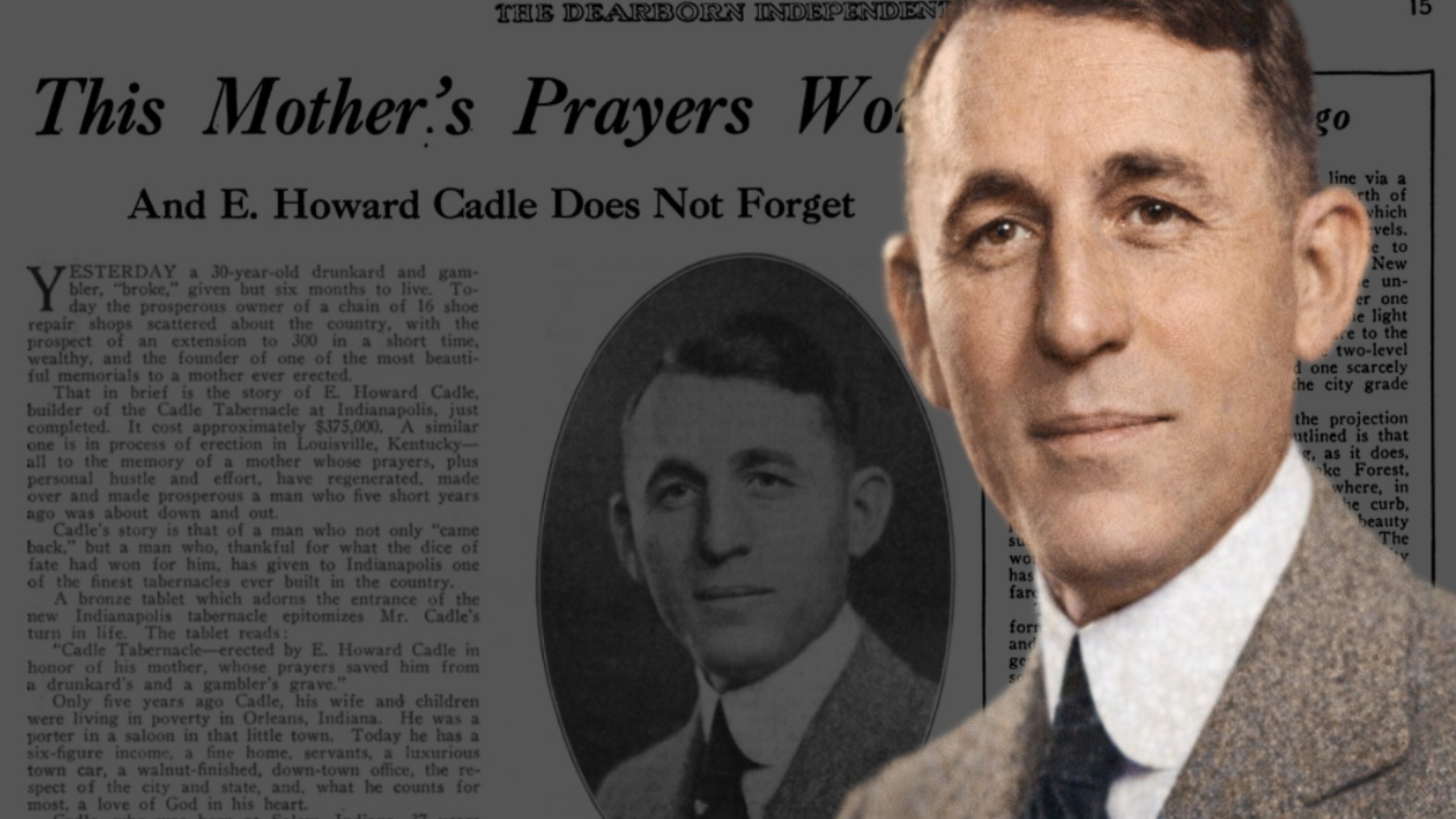
E. Howard Cadle: Revivalist, Power Broker, and the Church That Became Klan Headquarters
E. Howard Cadle rose from gambling and saloon culture to national religious prominence through wealth, revivalism, and the construction of the massive Cadle Tabernacle in Indianapolis. This study traces how that building became a center for political power, Ku Klux Klan activity, and later revival mythology, revealing how religious infrastructure can be repurposed to legitimize ideology, authority, and collective memory.
E. Howard Cadle was a confessed gambler and saloonkeeper who claimed to have converted to Christ and left his past life behind. Once known as the "slot machine king," Cadle was a well-known man in Chicago's "Levee" gambling district. His reputation was that of a magician with dice and cards and he was trained to manipulate and "trim the sucker" in the underworld of casino life. As a businessman, Cadle was the president of the American Shoe Repairing Company, with branches in Chicago, Terre Haute, Louisville, Dayton, Evansville, and other cities. His business locations appear to be strategically placed in cities with a reputation of a thriving gambling community.
But according to Cadle's story, he hit rock bottom before converting to Christianity. Claiming that he had no money for food for his wife and children, Cadle said that he returned to the home of his parents like a prodigal son. And after doing so, he decided to build a church. But rather than a meager church on a hillside, Cadle built a massive structure in downtown Indianapolis by putting down $305,000 in cash. In today's currency, the total downpayment for the building paid in cash would be $1.3 million, but based on the size of the structure in today's cost of construction, the Cadle Tabernacle would require several million dollars to complete
This quickly caught the attention of the news agencies. On August 17, 1922, a rather large article was published in the News and Observer newspaper. According to the reporter, "[He] was more interested in the man Cadle who put $305,000 in cash in the building and who carries it on than I was in the tabernacle."
The Cadle Tabernacle was completed and dedicated on October 8, 1921. From there, things get very strange. Rather than settle into his new church and build a congregation, Cadle formed an organization called the Cadle Tabernacle Evangelistic Association. On November 10, little over one month after its dedication, Ed Jackson, the Indiana Secretary of State was named head of the Cadle Tabernacle. This resulted in a church split, and Cadle claimed that he did not want to give ownership of his new church over to Jackson. Over a thousand members sided with Cadle, and he retained controlling interest for a period of time.
Not long afterward, men in white hoods started coming to the meetings. During a revival, the Ku Klux Klan made the news when they delivered a message during a gathering at the Cadle Tabernacle. The congregation watched silently as the church began doubling as a spiritual "house of God" on Sunday and a meeting place for high-level klansmen at night. Newspapers are filled with articles describing visits by the Imperial Wizard, Grand Dragons, and other elite figures as they discussed their intentions to enter politics and "clean house." Eventually, the Cadle Tabernacle became the headquarters for the Indiana KKK.
While services and high-level Klan meetings were being conducted, Cadle started facing problems. After making negative statements about a religious film, Cadle was sued for libel and slander. Not long after, the Tabernacle started struggling. Cadle was not able to keep controlling interest of the church. During the bank's foreclosure of the church, Cadle accused those with controlling interest of not allowing the church to function in a way that paid the bills. It was during all of these problems that Cadle announced that he was running for public office under the Republican ticket.
Meanwhile, Ed Jackson of the Cadle Tabernacle began to make a name for himself in the State of Indiana, moving eventually from Secretary of State to Governor of the State of Indiana. Others supported by the Ku Klux Klan started filling seats in the Indiana State government, and those who lost their place to the Klan-supported replacements began suspecting a conspiracy. Eventually, the entire Indiana State government was under scrutiny, and Ed Jackson of the Cadle Tabernacle was accused of receiving bribes from the Ku Klux Klan. Denying his accusations, Jackson remained in office during the investigation. Eventually, enough evidence was gathered to have likely convicted him of a felony crime. But unfortunately, the statute of limitations had expired on his wrongdoing. Jackson was never convicted.
E. Howard Cadle first ran for public office under a Republican ticket, not Democratic. Ed Jackson, Governer of the State of Indiana, was a Republican — not a Democrat. And the political agenda of the Ku Klux Klan was strongly opposed to Democratic policy. Klan groups were strong supporters of the Republican party, so long as they were not Catholic, Jewish, or African-American.