
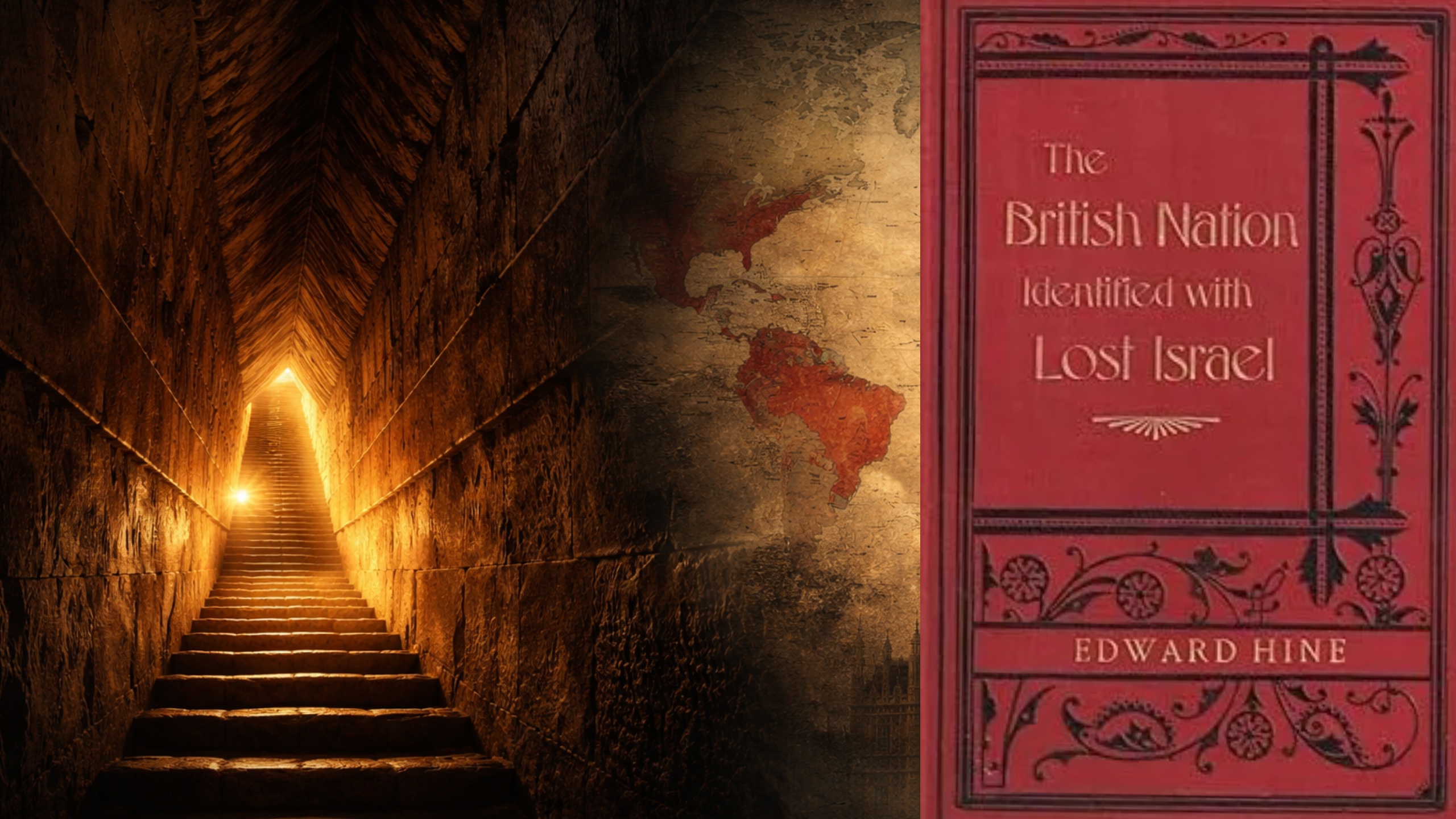
Edward Hine and the Secret Racial Roots of British Israelism
Edward Hine was a central figure in transforming British Israelism from a fringe theological theory into a racialized ideological system. His teachings blended pseudo-science, prophecy, and imperial politics, laying foundations that later influenced extremist identity movements.
Edward Hine and Racialized British Israelism
Edward Hine was a bank clerk[1] from England who worked tirelessly to spread the racialized version[2] of British Israelism throughout the world, especially in North America. Hine was a self-proclaimed disciple of British Israelite John Wilson during the period when Wilson's version of the British Israel doctrine began introducing claims of racial superiority.[3]
The principal exponent of the anti-Teutonist view was a self-proclaimed disciple of Wilson’s, Edward Hine (1825–91), whose indefatigable propagandizing consolidated the movement in England and North America. Hine claimed to have been converted to British-Israelism in 1840 when, as a youth of fifteen, he heard John Wilson lecture. "He [Wilson] lodged a thought in my mind which has lived there ever since," Hine recalled.[4]
Lectures, Publications, and Core Claims
Hine began holding lectures and producing literature on British Israelism as early as 1869 and founded his first magazine in 1873.[5] According to Hine, the Jews of the late 1800s were descended from the tribe of Judah and were not to be confounded with the Israelites led into captivity by the Assyrians.[6] The lineal descendants of King David, according to Hine, settled in the British Isles.[7]
Hine went so far as to declare that the United States would soon appoint the Duke of Edinburgh to be their "king" and that representatives from each "tribe" in the British Isles would send representatives to Palestine to form a Parliament of sorts. According to Hine, one of his own disciples who introduced him to Barnard Castle in Durham, England, would be the representative of that same Barnard Castle.[8] The British, said Hine, were "the only people that had never been conquered, and they were unconquerable; God had spoken it."[9] Hine believed that the tribe of Dan settled in Northern Ireland, the people of South Ireland were the Canaanites, and that Queen Victoria descended directly from King David. The Coronation Stone in Westminster Abbey was, according to Hine, the biblical stone of Jacob.[10] Hine was convinced that the Germans were the descendants of the Assyrians, labeling them as the enemy of Britain's "Israel".[11]
The Great Pyramid as a "Prophetic Clock"
Hine, like many British Israelites, believed the Great Pyramid of Giza was a "gigantic prophetic clock" to be read by the measurements and configuration of its internal passageways.[12] In his lectures on "Identity," Hine declared that the Great Pyramid of Egypt was the "sign in the midst of the land of Egypt, and the corners thereof," which predicted the timeline for the End of Days. According to Hine (and others reading the "pyramid clock"), the end of 1881 or the spring of 1882 would result in the return of Israel and Judah to their homeland. At this time, according to Hine, the Spirit would fall upon all Israel, and the British Israelites would enter the Holy Land. Because of this, declared Hine, the British Parliament must appropriate £6,000,000 to purchase various key points of land, including the Constantinople Gate.
The Lecturer, after recapitulating much of that he advanced in his previous lecture on the "identity" portion of the subject, referred particularly — indeed minutely — to the great pyramid of Egypt as the "sign in the midst of the land of Egypt, and the corners thereof," which should be the witness for Christ in the end of the age. The upshot of it all appears to be that in the end of the year 1881, or spring of 1882, the return of Israel and Judah together to their ancient country — connected with which will be an outpouring of the Spirit upon all Israel, though only a remnant of Israel, with the whole of Judah, will enter upon the Holy Land. This Eastern war would be associated with this. The vote of £6,000,000 asked for by the British Government must and would be granted, in spite of all opposition; but it would not embroil us in war; because the Lord had given peace to the House of Israel. This £6,000000 was not for the purpose of adding to the army, but was to enable the British government to secure the only gate or highway of the world that she did not now possess, namely, the Constantinople Gate.[13]
Scale of the Movement and North American Tour
The British-Israel movement in England peaked in the 1920s, having only about five thousand members. Because it was more of a political pseudo-science movement than religious, most of the members of the movement were middle-class and included aristocrats and high-ranking military officials.[14] On a global scale, however, Hine grew a massive following. By 1884, Hine had sold 320,000 copies of his pamphlet promoting British Israelism and focused on spreading the doctrine throughout the United States and Canada. From 1884 to 1888, Hine toured in cities across North America, spanning over two thousand miles.
After he left New Haven, Hine crisscrossed the northeast quarter of America and adjacent areas of Canada, lecturing from 1884 until 1888. He appeared in New York City, Long Island, Hartford, Boston, Cleveland, Detroit, Buffalo, Chicago, Grand Rapids, and Ann Arbor; Windsor, London, Stratford, Guelph, Hamilton, and Toronto, in Ontario; and a host of smaller communities. In the first eleven months alone, he traveled over two thousand miles, speaking to apparently large and enthusiastic audiences.[15]
Hine on Freemasonry and the Preservation of Israelite Secrets
Edward Hine argued that Freemasonry functioned as an unwitting vessel for preserving fragments of ancient Israelite knowledge after the Assyrian captivity.[16] According to Hine, the rites, symbols, and traditions of Freemasonry were not inventions of medieval guilds or Enlightenment fraternities, but survivals of Israel’s religious and national identity carried westward by the so-called “lost tribes.” He claimed that these remnants persisted in coded form—ritual gestures, sacred stones, architectural symbolism, and oath structures—long after their original meaning had been forgotten by those who practiced them.
Hine maintained that Freemasons themselves misunderstood the origin of their traditions, believing them to derive from Solomon’s Temple or speculative moral philosophy, when in fact they were, in his view, distorted echoes of Israelite law, monarchy, and covenantal worship. He presented Freemasonry as evidence for British Israelism: the continued existence of ancient Hebrew symbols among Anglo-Saxon institutions allegedly proved that the British people were the true heirs of Israel’s history. In this framework, Freemasonry was neither a religious authority nor a source of revelation, but a historical artifact—a shadowed archive preserving Israel’s past until its supposed modern restoration.