
The Hidden Influence of Finis Dake on Word-Faith and Charismatic Leaders
Finis Jennings Dake was a highly influential Pentecostal teacher whose Annotated Reference Bible shaped the theology of later Charismatic and Word-Faith leaders. His rejection of eternal Sonship, promotion of a pre-Adamic race, dispensational speculation, and racial segregation reveal theological and ethical errors that closely paralleled and influenced William Branham and related movements.
Finis Jennings Dake was a Pentecostal minister and evangelist. Starting in 1927, Dake served as an administrator for several Pentecostal Bible schools, including the Texico Bible Institute in Dallas,[1] and the Southwestern Bible School in Oklahoma.[2] He is best known for publishing Dake's Annotated Reference Bible, described by Charisma and Christian Life Magazine as "The Pentecostal Study Bible".[3] The volume’s commentary promoted a range of unorthodox and heterodox positions and went on to influence numerous Pentecostal and Charismatic leaders, including Kenneth Hagin, Jimmy Swaggart, Rod Parsley, Benny Hinn, Joyce Meyer, Marilyn Hickey, and Ralph Wilkerson.[4] Dake also held revivals with “Mr. Pentecost” David Du Plessis,[5] and appeared in contexts connected to the Full Gospel Business Men’s Fellowship International.[6] In addition, Dake conducted “School of Evangelism” seminars with Rev. Lester Sumrall,[7] an Assemblies of God minister known for defending William Branham’s Latter Rain ministry.
The fact is clearly seen that Mr. Dake put much work into this reference tool. However, there are severe problems with the theology contained in this work. For instance, heresies abound concerning subjects such as the nature and attributes of God, Soteriology, and Christology—just to name a few. Furthermore, many word-faith teachers, such as Benny Hinn and Kenneth Copeland, have verifiably used Dake as a source of their quizzical doctrines. The scope of this paper, however, is not a complete, systematic analysis of the Dake Annotated Reference Bible, but an analysis of what it says about Jesus.[8]
- Apologetics Index
Dake received training at the Glad Tidings Bible Training School in San Francisco and at Central Bible Institute in Springfield, Missouri.[9] He later resigned under pressure amid controversy over his anti-biblical tritheistic teaching on the Trinity and extra-biblical claims regarding a pre-Adamic world.[10] While affiliated with the Assemblies of God, Dake also founded a Bible school in Zion, Illinois, the same town associated with cult leader John Alexander Dowie. His public ministry ended abruptly when he pled guilty to violating the Mann Act[11] by transporting a 16-year-old girl into Wisconsin for sexual purposes. Dake served six months in prison for the crime.
[Finis J. Dake] became the pastor of Christian Assemble[sig] of God Church in Zion, Illinois, in June 1932 when he pled guilty and was convicted for violating the Mann Act. Dake confessed to picking up a 16-year-old girl for the purpose of debauchery and other immoral practices, spending time with her in Wisconsin and Illinois motels under the name of Christian Anderson and wife. He was stripped of his ordination and served six months in prison. [12]
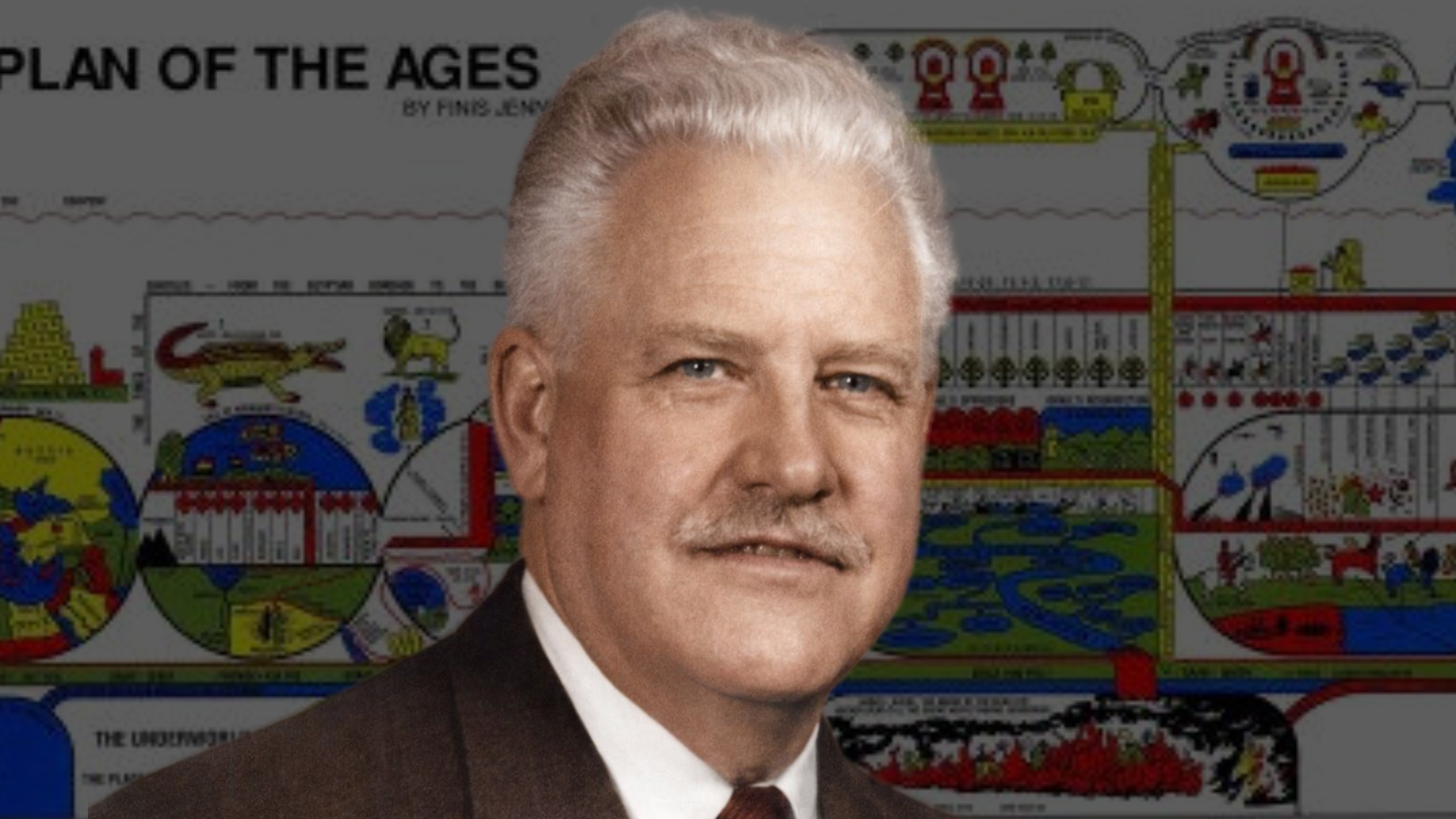
At Southwestern, Dake taught “Dispensational Truth” classes,[13] apparently echoing the title and framework of Clarence Larkin’s book. As a result, several features of William Branham’s church-age schema and eschatological outlook appear closely aligned with Dake’s approach. Dake also produced charts and drawings, including his “Plan of the Ages”, that closely resemble Larkin’s visuals in Dispensational Truth.[14]
Dake’s dependence on Larkin further shaped his teaching on the nature of God in ways that overlapped with Branham’s theory. Branham likewise drew on Larkin’s work while presenting the material as “divine revelation”.[15] Within this dispensational framework, Dake rejected the doctrine of the eternal Sonship, arguing instead that Jesus became the Son of God at the incarnation.[16] Branham differed by presenting Jesus as a human being “filled with the spirit” who suffered and died as a man rather than as God. Branham then located the decisive point of Jesus’ deity after the resurrection, whereas Dake placed it at Jesus’ birth.
As man and as God's Son He was not eternal, He did have a beginning, He was begotten, this being the same time Mary had a Son. Therefore, the doctrine of eternal sonship of Jesus Christ is irreconcilable to reason, is unscriptural, and is contradictory to itself. . . . The word Son supposes time, generation, father, mother, beginning, and conception. . . . If sonship refers to deity, not to humanity, then this person of the Deity had a beginning in time and not in eternity.
- Finis Dake
Or, as I have went through it, the Catholic call It, 'the Eternal sonship of God.' Which, as I have said before, the word doesn't even make sense. See, there cannot be an Eternal son, because a son had to have a beginning. And so Jesus had a beginning, God had no beginning. See? But the Son was the…not Eternal sonship, but the Son that was with the Father in the beginning was the Logos that went out of God.[17]
- William Branham
The Spirit left Him, in the Garden of Gethsemane. He had to die, a man. Remember, friends, He didn't have to do that. That was God. God anointed that flesh, which was human flesh. And He didn't…If He'd a went up there, as God, He'd have never died that kind of death; can't kill God. But He didn't have to do it.[18]
- William Branham
Branham was, however, closely aligned with Dake’s views of a pre-Adamic race. Branham taught that a civilization existed before the Garden of Eden, and that God did not necessarily have to create everything anew; instead, God could reuse what was already present. In that retelling of Genesis, even the “trees and everything” emerged from existing seeds that were watered by God.
I believe every seed was laying right there from some other civilization or something, and as soon as the water lifted off and the Light struck it, up come the trees and everything." The same thing with the human being; it's a type.[19]
- William Branham
Like Branham,[20] Dake supported the segregation of races and published a tract titled “30 Reasons for Segregation of Races”.[21]
30 Reasons for Segregation of Races
- God wills all races to be as He made them. Any violation of God’s original purpose manifests insubordination to Him(Acts 17:26; Romans 9:19-24)
- God made everything to reproduce “After his own kind” (Genesis 1:11-12, 21-25; 6:20; 7:14). Kind means type and color or He would have kept them all alike to begin with.
- God originally determined the bounds of the habitations of nations(Acts 17:26; Genesis 10:5, 32; 11:8; Deuteronomy 32:8)
- Miscegenation means the mixture of races, especially the black and white races, or those of outstanding type or color. The Bible even goes farther than opposing this. It is against different branches of the same stock intermarrying such as Jews marrying other descendants of Abraham(Ezra 9-10; Nehemiah 9-13; Jeremiah 50:37; Ezekiel 30:5).
- Abraham forbad Eliezer to take a wife for Isaac of Canaanites (Genesis 24:1-4). God was so pleased with this that He directed whom to get (Genesis 24:7, 12-27).
- Isaac forbad Jacob to take a wife of the Canaanites (Genesis 27:46-28:7).
- Abraham sent all his sons of the concubines, and even of his second wife, far away from Isaac so their descendants would not mix (Genesis 25:1-6)
- Esau disobeying this law brought the final break between him and his father after lifelong companionship with him(Genesis 25:28; 26:34-35, 27:46; 28:8-9).
- The two branches of Isaac remained segregated forever (Genesis 30; 46:8-26).
- Ishmael and Isaac’s descendants remained segregated forever (Genesis 25:12-23; 1 Chronicles 1:29)
- Jacob’s sons destroyed a whole city to maintain segregation (Genesis 34)
- God forbad intermarriage between Israel and all other nations (Exodus 34:12-16; Deuteronomy 7:5-6)
- Joshua forbad the same thing on sentence of death (Joshua 22:12-13)
- God cursed angels for leaving their own “first estate” and “their own habitation” to marry the daughters of men (Genesis 6:1-4; 2 Peter 2:4; Jude 6-7)
- Miscegenation caused Israel to be cursed (Judges 3:6-7; Numbers 25:1-8)
- This was Solomon’s sin (I Kings 11)
- This was the sin of Jews returning from Babylon (Ezra 9:1-10:2,10-18,44; 13:1-30)
- God commanded Israel to be segregated (Leviticus 20:24; Numbers 23:9; 1 Kings 8:53)
- Jews recognized as a separate people in all ages because of Gods choice and command (Matthew 10:6; John 1:11). Equal rights in the gospel gives no right to break this eternal law.
- Segregation between Jews and all other nations to remain in all eternity (Isaiah 2:2-4; Ezekiel 37; 47:13-48,55; Zechariah 14:16-21; Matthew 19:28; Luke 1:32-33; Revelation 7:1-8; 14:1-5)
- All nations will remain segregated from one another in their own parts of the earth forever (Acts 17:26; Genesis 10:5,32; 11:8-9; Deuteronomy 32:8; Daniel 7:13-14; Zechariah 14; Revelation 11:15; 21:24)
- Certain people in Israel were not even to worship with others (Deuteronomy 23:1-5; Ezra 10:8; Nehemiah 9:2 10:28; 13:3)
- Even in heaven certain groups will not be allowed to worship together (Revelation 7:7-17; 14:1-5; 15:2-5)
- Segregation was so strong in the O.T. that an ox and an ass could not work together (Deuteronomy 22:10).
- Miscegenation caused disunity among God’s people (Numbers 12).
- Stock was forbidden to be bred with other kinds (Leviticus 19:19).
- Sowing mixed seed in the same field was unlawful (Leviticus 19:19)
- Different seeds were forbidden to be planted in vineyards (Deuteronomy 22:9)
- Wearing garments of mixed fabrics forbidden (Deuteronomy 22:11; Leviticus 19:19)
- Christians and certain other people of a like race are to be segregated (Matthew 18:15-17; 1 Corinthians 5:9-13; 6:15; 2 Corinthians 6:14-15; Ephesians 5:11; 2 Thessalonians 3:6-16; 1 Timothy 6:5; 2 Timothy 3:5).