
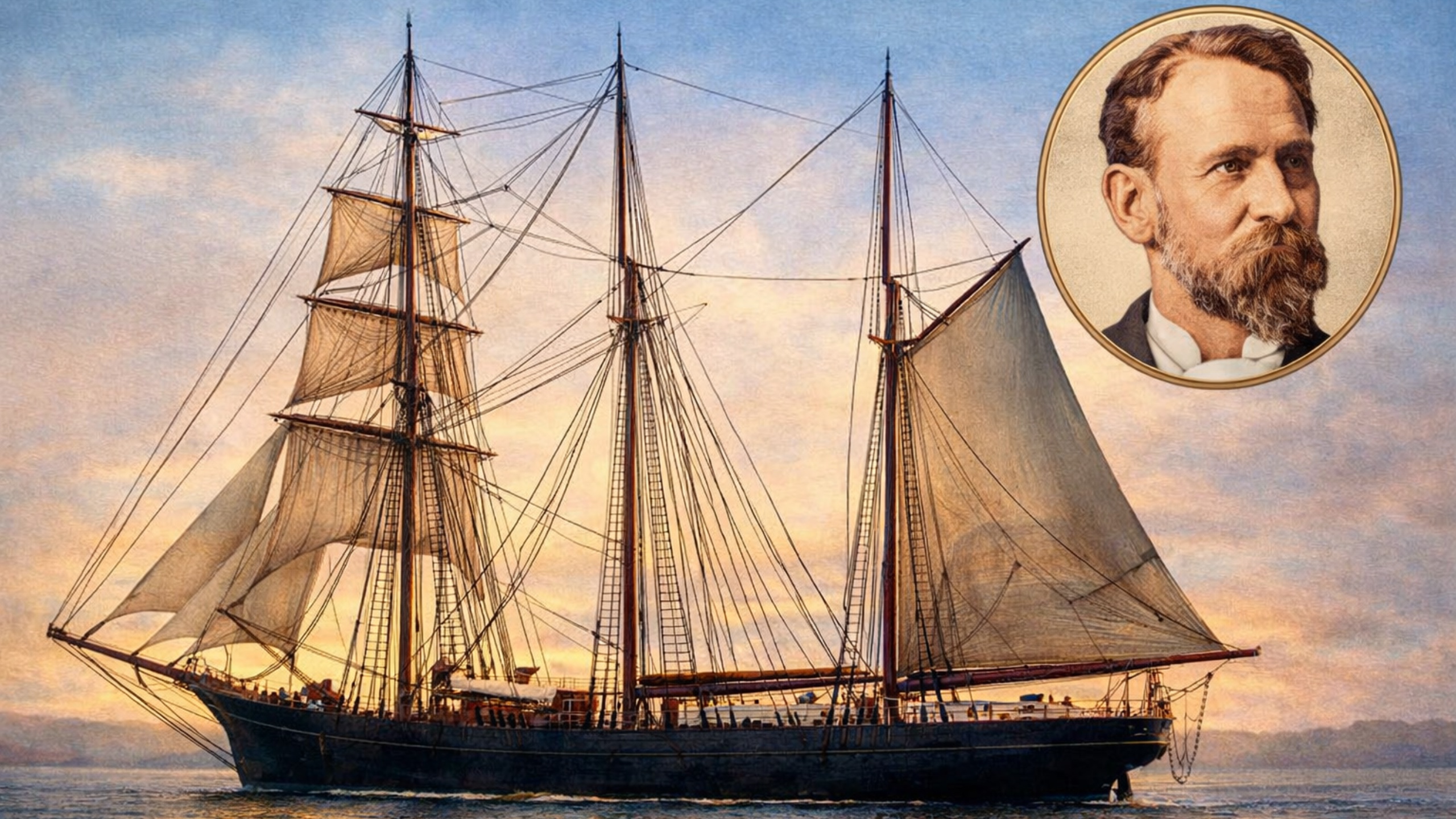
Frank Sandford: The Floating Utopia of Starvation That Shaped Pentecostal History
This account examines the rise of Frank Sandford, a Maine-based cult leader who claimed to be the prophet Elijah and led his followers into starvation, abuse, and death through apocalyptic theology and absolute control. From a land-based commune at Shiloh to a disastrous missionary voyage at sea, the narrative traces how selective biblical interpretation and charismatic authority produced one of the deadliest religious experiments of early twentieth-century America.
On a cold October night off the coast of Portland, Maine, a crippled yacht made its way into port. As it docked, men quickly scrambled to aid the vessel. To their surprise, they found fifty men, women, and children in critical condition, suffering from sickness and starvation. Death had already entered the vessel; scurvy was starting to claim the lives of the malnourished. Deck hands once strong and capable were reduced to skin-and-bone. The crew and passengers were so exhausted and weak that had they could barely stand. Had the ship not made port that night, it was doubtful they could have kept the craft afloat for even a day longer. Rescuers were shocked when they found mere skeletons working the pumps, alternating between three shifts.
They were even more astonished when one single passenger emerged, well nourished and well cared for. While the passengers and crew had struggled to survive, this particular passenger, viewed by the rest as their leader, had lived sumptuously in his luxuriously furnished cabin.
Ten months earlier, in December of 1910, more than seventy people had boarded sailing vessels, the Coronet and the Kingdom, bound for Africa on a "spiritual" mission. Convinced by their charismatic leader that spiritual bliss could be found at sea, cult followers set sail for foreign land to "spread the gospel to all nations." Those who later examined the vessels' mission considered it to be folly, or possibly a strategy to evade criminal conviction. These "evangelistic missionaries" did not set foot on foreign soil to preach or even to distribute religious literature to potential converts. Instead, their leader attempted to "subdue the world for Christ" by intercessory prayer, claiming nations and isles for Christ by sounding brass instruments as they passed by. The two vessels had become a floating commune of sorts, whose joint mission seemed very peculiar. The passengers were a small portion of a religious sect in Maine who believed that the world was soon to end. Those privileged enough to make the journey fully believed that they were playing a special part in the events leading to Armageddon.
Their journey was not an easy one, and the vessels met many hardships along the way. Violent storms attacked the ships off the coast of Cape Horn, breaking the mainsheet and part of the mast of the Coronet. The Kingdom went aground and was destroyed off the coast of French West Africa. As the forces of nature battered the vessel, the cult leader cast the blame on his followers for their "lack of faith." They were taught to believe that because of their doubts, their wretched lives on this earth were forced to continue while dramatically worsening. With each tragedy, they must have surely felt that life was, indeed deteriorating. Their leader was becoming more agitated and was aggressively reminding them of their lack of faith. But their trust in him was secure. He had convinced his cult following that he was the spiritual re-incarnation of the prophet Elijah from the Christian Bible, and was sent by Almighty God to announce the arrival of Jesus Christ immediately before the earth was to be burned by fire. Rather than seek assistance when the Kingdom ran aground, the crew and passengers from the Kingdom joined those on board the Coronet for a deadly journey home. They had faith that God would provide for their needs, regardless of their lack of food and supplies.
As rescuers helped the desperate men, women, and children from the Coronet to dry land, it was evident that those provisions never came. Passengers described receiving some supplies from a ship passing by, but it had withheld much-needed fruit and vegetables. Physicians began examining what looked like walking skeletons which once were able-bodied men. It was difficult to understand what motivated these people to follow Frank Sandford out to sea, trusting that God would supply their provisions. Most of them left a land-based "Utopia" suffering from starvation to join a sea-based "Utopia" of starvation.
Frank Weston Sandford was one man in a long line of "Malachi 4 Elijah" cult leaders. His cult following began to form in 1895 after he claimed to have seen a vision of an "angel of the Lord" standing before gold-lined, fleecy clouds. Many people believed him, and word began to spread. According to his testimony, this "angel" revealed that he was the Elijah to come. So he and others gathered around the site he would later claim for his temple dedicated it, naming it "Shiloh." The site was located just outside of Durham, Maine.
At its height, his land-based commune held more than six hundred residents. Each of the cult's victims labored for Sandford without pay, trusting Sandford's doctrine that God, or more specifically the "Holy Ghost" would supply their material needs. New recruits were required to forfeit all of their possessions and then placed them under the control of Sandford. Their schedule was routine: two hours of prayer in the morning, breakfast and kitchen cleanup until prayer at 9:00 am, spiritual teaching until noon, and household or office duties after lunch. Over time, the group became known throughout Maine as the "Holy Ghost and Us Society."
News of the Holy Ghost and Us Society spread quickly, especially after some reported that they had been healed of various diseases. Ministers near Shiloh, Maine started noticing their congregations dwindling. Members were splitting their time between Sandford's group and their own churches. Others had left to become full-time members of the Holy Ghost and Us Society. The ministers' problem worsened when Miss Olive A. Mills, a resident at the commune, was allegedly resurrected from the dead. Newspapers across the nation printed stories describing the "miracle," which one hundred and fifty members of the Holy Ghost and Us Society confirmed through "witness testimony."
As an attempt to combat the threat posed by the growing commune, ministers investigated the group and its methods. They began sending out letters exposing the hidden evil that was luring unsuspecting victims. When the Rev. W. M. Fanton of Stony Brook, Long Island read three letters from the ministers, he described their impact like a "bombshell upon the listeners, because several prominent members of the local Methodist Church had joined or were about to join [the] colony. Some of the richest men and women of their community had been targeted."
Newspapers began reporting accounts given by those who narrowly escaped the clutches of the cult following. Women claimed that they were treated with "cruelties heaped upon [them]," and that because of this some women were driven insane. Their forfeited possessions went to a general community fund, which presented unusual hardships for those holding joint ownership with an unwilling partner or spouse. Worse, many in the commune were starving, and the donations seemed to benefit only Sandford and his evangelistic trips. Mrs. Fred Gaillet and her three starving children escaped the commune after having lived for weeks on a diet consisting of only cornmeal mush and water.
One woman in particular, Bessie Phelps, made national news when her mother and a group of attorneys attempted to remove her from the harsh conditions of Sandford's commune. According to her mother, Bessie was given daily rations of one teacupful of parched grain or smaller, and was suffering from starvation and lack of clothing. Clad only in a calico wrapper and forced to sleep in a moist, drafty old shed on mounds of sawdust, Bessie claimed that her new life was the "true life." Her mother, noticing many of the other commune children in similar conditions of starvation and neglect, knew something was wrong and attempted to stop it. She, with her hired lawyers, started a legal battle to prevent Sandford from harming other innocent victims.
Stating he was called to spread his "gospel" overseas, Sandford purchased a ship and along with several cult members set sail to establish a colony in Palestine. Those observing the situation declared that his timing was highly suspect. While being sought to answer civil suits of up to $150,000, he was conveniently out of the country.
The floating commune was much like the land-based "Holy Ghost and Us Society" compound at Shiloh. Sandford lived like a king, while everyone on board suffered from starvation and neglect. Sandford sought to raise $1,000,000 to "spread his faith," but did so abroad without sufficient funds, food, or supplies to make the journey. When one of his two vessels, the Kingdom, first ran aground at Nova Scotia, one of his cult victims escaped to tell her story: "Over half the people aboard do not believe in Sandford, but are really forced by the circumstances to remain with the flock. One of Sandford's favorite moves was to ask us each day, when he was aboard, if we believe he was the real Elijah II and God's representative on earth. Naturally, we had to say yes, if we had not our lives would have been made unbearable." Miss Sarah Josephs went on to say that she was no longer afraid of him or his professed power, because their food supply was so limited.
Eventually, there were several concerned citizens issuing written appeals to the United States government, all alleging the commune had an alarming degree of human suffering, not to mention the children who had died of neglect in the colony. Governor Cobb of Maine held a special counsel to examine the claims of harsh conditions at the Holy Ghost and Us commune. Cult members retaliated with spiritual threats, claiming that their opposition "would be struck down by the hand of God, as Shiloh was declared by them to be holy ground."
To his following, Reverend Frank Sandford was more than just a minister of the Gospel. He was their teacher, their instructor, their king, and their "prophet" who had a "supernatural connection to God." His followers truly believed that he held direct conversations with God. Using key passages of text from the Christian Bible, Sandford convinced his following that the ancient scrolls predicted his arrival shortly before the End of Days and the return of Jesus Christ to the earth. Over time, he was given the title, "Elijah the Uncrowned King."
Because Sandford's doctrinal teaching was based on passages of the Christian Bible, it was difficult for the casual listener to notice the differences between his doctrine and that of the other local churches. If it were not for the group's celebration of Jewish Feasts and keeping the Sabbath on Saturday, one would not have found it to be so different from that of mainstream evangelical Christianity. The group claimed to be followers of Jesus Christ, and being so "Christian." This was affirmed with each sermon and "school" lesson given by Sandford. To fully understand the difference, one would have to first understand the unusual emphasis given to specific passages of symbolic text.
Sandford focused heavily on the Book of Revelation and its descriptions of the events leading to Armageddon. According to Sandford, the 11th chapter of the Book of Revelation was literal rather than symbolic, and the "two witnesses" mentioned in Revelation 11 would soon appear to prophesy. Sandford affirmed that his "school" would "stand by them and if need be die." This was referring to the 8th verse:
And their dead bodies shall lie in the street of the great city, which spiritually is called Sodom and Egypt, where also our Lord was crucified.
Since verse 8 of Revelation 11 describes the "great city that symbolically is called Sodom and Egypt" as "where their Lord was crucified," Sandford chose the latter part of the chapter as literal while accepting the symbolic nature of the rest of the chapter. Jesus was crucified in Jerusalem, and Sandford claimed to have had "spiritual revelation" that he must establish an outpost in Palestine. Heavily influenced by British Israelism, he taught that his followers were blood descendants of the ancient Hebrews, and must be reconnected with the Tribe of Israel.
Using the symbolic text of Revelation as a foundation, Sandford continued to build upon it using other passages of apocalyptic scripture from the Christian Bible – both Old Testament and New Testament. One passage critical to the establishment of his religious cult is found in the last paragraphs of the Old Testament, in Malachi 4:
For behold, the day is coming, burning like an oven, when all the arrogant and all evildoers will be stubble. The day that is coming shall set them ablaze, says the Lord of hosts, so that it will leave them neither root nor branch. But for you who fear my name, the sun of righteousness shall rise with healing in its wings. You shall go out leaping like calves from the stall. And you shall tread down the wicked, for they will be ashes under the soles of your feet, on the day when I act, says the Lord of hosts. "Remember the law of my servant Moses, the statutes and rules that I commanded him at Horeb for all Israel. "Behold, I will send you Elijah the prophet before the great and awesome day of the Lord comes. And he will turn the hearts of fathers to their children and the hearts of children to their fathers, lest I come and strike the land with a decree of utter destruction."
While many theologians in mainstream Christianity teach that this passage of text is referring to the first coming of Jesus Christ, and that "Elijah the prophet" is fully explained in the first few chapters of the Gospel of Luke to be John the Baptist, Sandford convinced his followers that this passage of text referred to his own ministry. Strategically teaching key verses to be literal while others were symbolic, Sandford compared similar features of his own ministry and personality to the symbolic text. In Sandford's theology, the hot day when the evildoers will be set ablaze referred to hell fires and those suffering God's punishment. The sun of righteousness with healing in his wings referred to God's blessing of "Divine Healing" which Sandford claimed as a fundamental part of both his ministry, as well as his contemporaries. The newspaper articles describing the miracles in his commune were used as affirmation, "vindicating" his ministry as divinely ordained. The passage of Malachi giving instructions to "remember Moses, his statutes and rules," was interpreted by Sandford as an instruction to follow the Jewish Feasts and observance of the Sabbath. But most critical to the formation of his cult following was found in verses 5 through 6: the return of "Elijah the prophet." On July 12, 1909, Frank Sandford made national news with his prophetic insight. According to Sandford, the world was to end at exactly 10:20:30 AM, Wednesday September 15th, 1909. Sandford claimed that at that time, "the world and all that is in it will come to a glorious windup." The more than six hundred members of the Shiloh commune dressed themselves in white robes, climbed up to the rooftops, and expected to see the sky "go to smash, the earth dashed to smithereens, and they themselves transplanted into the realms of bliss, while all others pass[ed] into destruction." Though the world did not end, most of Sandford's followers remained faithful to their "Elijah". Those chosen for the voyage to "spread the Gospel" eagerly joined Sandford. They fully believed that their lack of faith was the reason God had postponed Armageddon.
After the crippled Coronation, crew, and passengers were examined, the government intervened in the situation. "Elijah" Reverend Frank Sandford, was found guilty of manslaughter. Unable to be convicted under civilian law, he was tried under marine law. Shortly after, he was convicted for cruising with a defectively equipped vessel. Sadly, this conviction came only after five members of the crew of the Kingdom died of starvation in December of 1911. Under land-based law, Sandford was able to escape penalty for the inhumane conditions leading to prior deaths at his land-based commune. He was sentenced to 10 years of hard labor in an Atlanta, Georgia federal prison, but was released after only six years when his sentence was reduced for good behavior. Upon his release, Sandford publicly stated his intentions of re-establishing his cult.
Shortly after his conviction, one newspaper article summed up Sandford's "ministry" as a "religious grafter." The article claimed that of all the grafters, the "religious grafter" – the self-appointed Messiah, Elijah, Daniel, Israel, or Adam, was the "meanest." It was one of the most profitable grafts, and could be considered a "safe con game" to play for the cult leader. The article pointed out that in Sandford's case, however, it proved deadly for the cult victims.
Newspapers described his cult following as a "peculiar sect," but failed to make the connection to a quickly growing movement in the United States. Reverend Frank Sandford's divine healing "Elijah cult" was one of at least two such religious groups whose worship centered on the belief that a charismatic American evangelist was the reincarnation of the Old Testament Jewish "Elijah the prophet." Just north of Chicago, another divine healing commune was making waves in the religious communities by claiming that their leader was also "Elijah the prophet" who was sent by God to announce the End of Days.