
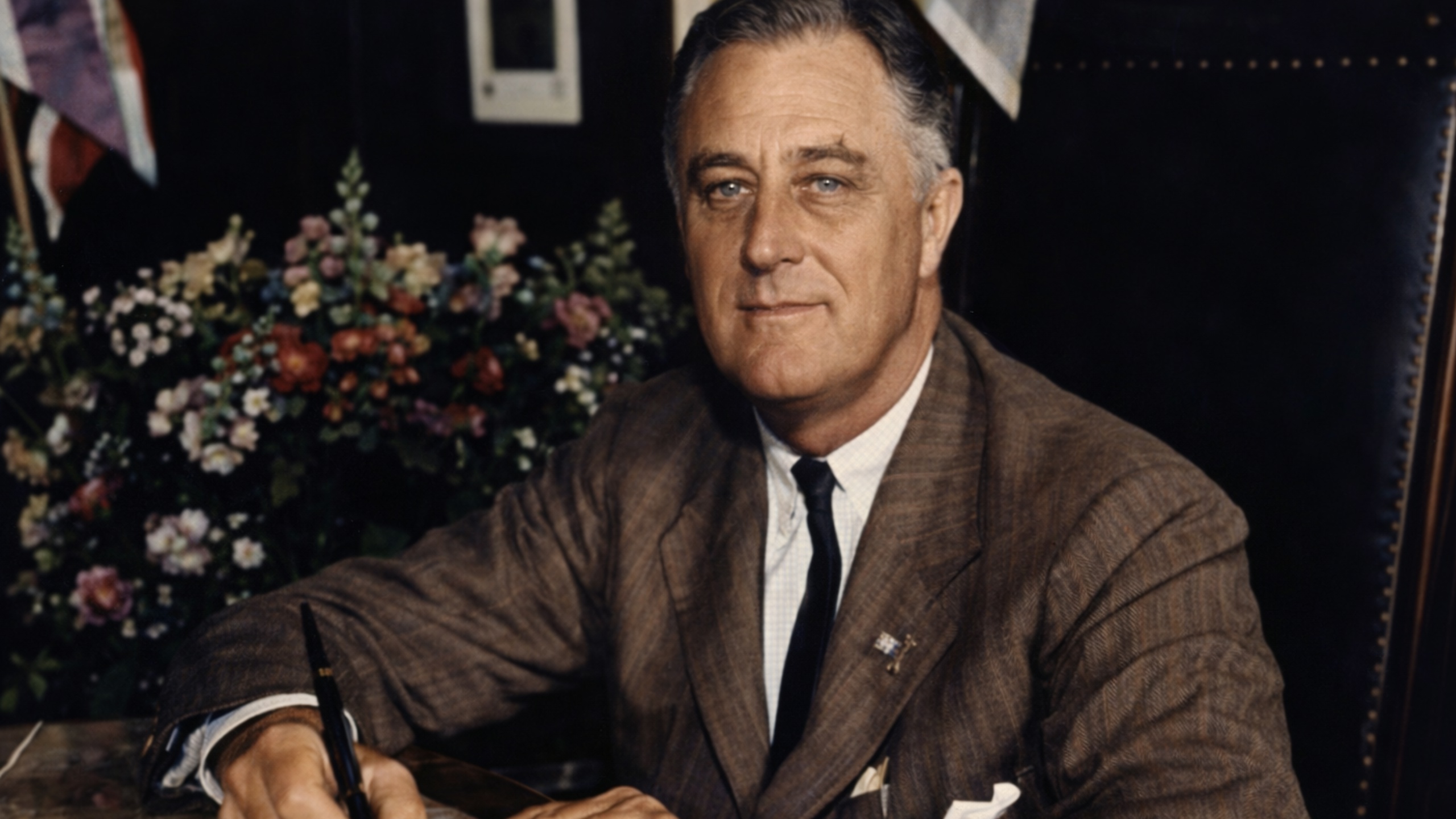
Franklin D. Roosevelt and William Branham’s Failed World War Prophecy
William Branham later claimed that a vision from 1932 or 1933 foretold Franklin D. Roosevelt leading the world into war, but his own recorded statements reveal shifting dates, expanding details, and retrospective framing. By comparing Branham’s evolving claims with the actual chronology of World War II, the narrative shows why the Roosevelt prophecy fails historical scrutiny.
William Branham's later ministry repeatedly centered Franklin D. Roosevelt as a prophetic signpost, claiming that a divine vision received in either 1932 or 1933 foretold Roosevelt's role in leading the world into war. This alleged 1930s prophecy did not appear in Branham's sermons or literature until the mid-1950s. Only years later did Branham begin to assert that Roosevelt himself was explicitly named in a supernatural revelation tied to global conflict [1].
The president which now is, President Franklin D. Roosevelt... (Now remember, this is twenty-eight years ago.) will cause the whole world to go to war; and the new dictator of Italy, Mussolini, shall make his first invasion towards Ethiopia, and he will take Ethiopia; but that'll be his last. He shall come to his end.
William Branham, 60-1113 Condemnation by Representation
As Branham retold the account across subsequent decades, the date of the vision shifted between 1932 and 1933, while its scope expanded to include Mussolini’s invasion of Ethiopia, the Maginot Line, women’s suffrage, and the eventual outbreak of World War II [2]. These retrospective claims emerged well after the historical events they allegedly predicted, raising questions about whether Roosevelt functioned as the original subject of a prophecy or was later incorporated into an evolving narrative shaped by postwar interpretation and ideological realignment [3].
Franklin D. Roosevelt in Branham’s Early Political Commentary
Before Roosevelt was framed as the object of a supernatural prediction, William Branham spoke of him in ordinary political and civic terms, describing public appearances, popular enthusiasm, and personal reactions rather than prophetic significance. Branham recalled seeing Roosevelt during whistle-stop visits in Southern Indiana and New Albany, Indiana, emphasizing the scale of public excitement and his own marginal position as a young preacher observing national politics from the sidelines [4]. These recollections functioned as social memory, not revelation.
In other early remarks, Branham used Roosevelt illustratively, comparing physical disability, political authority, or national symbolism without invoking divine foresight. References to Roosevelt’s paralysis appeared as analogies in healing narratives, while mentions of Roosevelt’s presidency were embedded in broader reflections on democracy, constitutional instability, or public morality [5]. The absence of any claim that Roosevelt had been named in a vision during these early statements is significant, as it contrasts sharply with later sermons where Branham asserted that Roosevelt was explicitly identified in a prophetic trance dated to 1932 or 1933 [6].
Roosevelt, the Ku Klux Klan, and Shifting Extremist Opposition
During Franklin D. Roosevelt’s early political ascent, extremist movements such as the Ku Klux Klan viewed him with a mixture of tactical support and suspicion, reflecting the instability of their political alliances rather than prophetic fulfillment. Contemporary Klan rhetoric warned members that Roosevelt was aligned with Catholic political machines and urban power brokers, framing him as a potential threat to Protestant dominance and nativist ideology [7]. This hostility demonstrates that Roosevelt was already a contested political figure within extremist subcultures long before Branham later reworked him into a prophetic antagonist.
"Don't be fooled. Farley is ROOSEVELT; Tammany Hall, Catholic controlled, is ROOSEVELT.... EVERY PROMINENT ROMAN CATHOLIC YOU CAN FIND IS FOR ROOSEVELT..... The Underworld is a unit for Roosevelt. The gangsters of Chicago, St. Louis... and New York are for Roosevelt.... Roosevelt, their subservient tool, will turn our country over to Tammany and thus we will have CATHOLIC CONTROL OF AMERICAN GOVERNMENT AND LIFE, if he is elected.... BE AWARE OF THE 8TH OF NOVEMBER!"
Wade, The Fiery Cross: The Ku Klux Klan in America
As Roosevelt’s administration increasingly accepted support from Catholics, Jews, Black Americans, and organized labor, Klan opposition hardened. The Klan’s public denunciations reveal a pattern of ideological recalibration in response to Roosevelt’s coalition-building rather than evidence of secret loyalty or prophetic inevitability. These historical dynamics undermine later claims that Roosevelt operated as a deliberate instrument of a hidden religious agenda foreseen in the early 1930s, showing instead that extremist interpretations of Roosevelt shifted reactively as political realities changed .
The Alleged 1932–1933 Vision: First Public Appearances and Dating Problems
William Branham’s claim that Franklin D. Roosevelt was named in a supernatural vision allegedly received in either 1932 or 1933 does not appear consistently or clearly in his early preaching record. When Branham later recounted the experience, he alternated between dating the vision to 1932 and 1933, sometimes within the same general period of retelling, undermining the stability of the claim’s chronology. These retrospective accounts surfaced decades after the events they purportedly predicted, rather than appearing contemporaneously in the early 1930s.
In later sermons, Branham emphasized that the vision had been written down and preserved, asserting that it predated Roosevelt’s wartime leadership and the construction of the Maginot Line by many years. However, the repeated adjustments in dating, setting, and detail suggest an evolving narrative rather than a fixed prophetic record. Roosevelt’s role appears increasingly sharpened in hindsight, transformed from a political figure observed during Branham’s youth into a central prophetic agent only after World War II had already unfolded.
World War II Chronology Versus Branham’s Retrospective Claims
William Branham’s assertion that Franklin D. Roosevelt “caused the whole world to go to war” conflicts with the established chronology of World War II and Roosevelt’s documented conduct prior to U.S. entry. World War II began in September 1939 with Germany’s invasion of Poland, followed quickly by declarations of war from Britain and France, while the United States remained officially neutral for more than two years . During this period, Roosevelt publicly resisted direct military involvement, emphasizing neutrality while navigating domestic isolationism and international pressure.
The United States entered the war only after the Japanese attack on Pearl Harbor in December 1941, an event initiated by a foreign power rather than by Roosevelt’s unilateral decision . By the time of U.S. entry, multiple world powers had already been engaged in sustained warfare across Europe, Asia, and Africa. Branham’s later framing collapses this complex sequence into a simplified causal claim centered on Roosevelt, retroactively attributing global agency to a single American president in a manner that does not align with the historical record .
Germany 9/1/1939
France 9/3/39
Great Britain 9/3/1939
New Zealand 9/3/1939
S. Africa 9/6/1939
Canada 9/10/1939
USSR 9/17/1939
Japan 9/22/1940
Bulgaria 4/24/1941
Romania 6/22/1941
Hungary 6/27/1941
India 12/7/1941
Panama 12/7/1941
Yugoslavia 12/7/1941
Dom Rep 12/8/1941
El Salvador 12/8/1941
Haiti 12/8/41
Honduras 12/8/1941
Nicaragua 12/8/1941
Manchukuo 12/8/1941
Netherlands 12/8/1941