
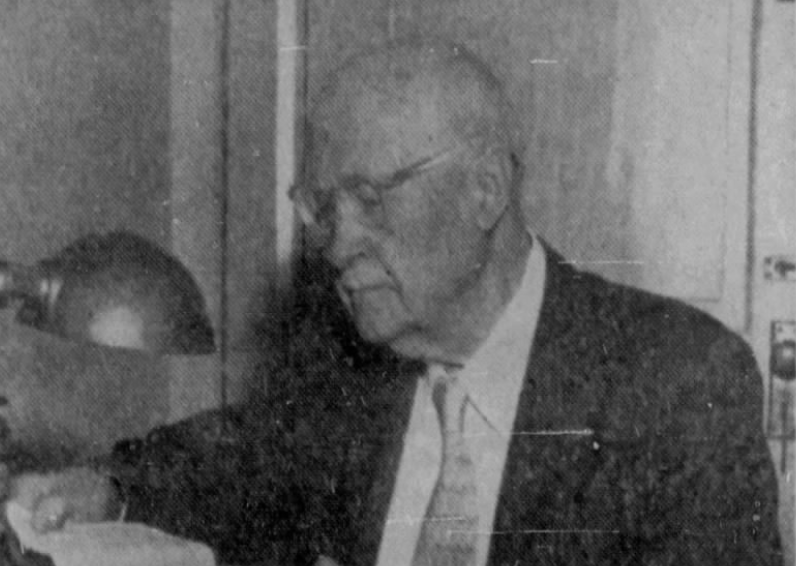
Mordecai Ham
Mordecai Ham was a controversial Baptist evangelist within the fundamentalist and revivalist movement of the early 20th century. Known for his fiery preaching style and unwavering commitment to fundamentalist Baptist beliefs, Ham was part of a wave of evangelists who sought to "awaken" America to Christian repentance through dramatic revival meetings. Among his alleged hundreds of thousands of converts during his ministry, none were as notable as Billy Graham, who converted at a Ham revival in 1934.[1] Ham advertised himself as a "New Testament Prophet,"[2] though his critics provided substantial evidence to claim that he was a false prophet.[3]
Mordecai Ham was a controversial Baptist evangelist within the fundamentalist and revivalist movement of the early 20th century. Known for his fiery preaching style and unwavering commitment to fundamentalist Baptist beliefs, Ham was part of a wave of evangelists who sought to "awaken" America to Christian repentance through dramatic revival meetings. Among his alleged hundreds of thousands of converts during his ministry, none were as notable as Billy Graham, who converted at a Ham revival in 1934.[1] Ham advertised himself as a "New Testament Prophet,"[2] though his critics provided substantial evidence to claim that he was a false prophet.[3]
Like others in this movement, Ham's approach to evangelism was confrontational, often addressing what he viewed as moral decay in American society. This direct style led him to publicly condemn not only individual sins but also societal groups and ideologies he considered contrary to Christian values. He was an advocate of the British Israel doctrine, a belief that began to evolve into the more antisemitic Christian Identity movement during his era. Ham was openly antisemitic in his radio broadcasts and sermons as early as 1924, and believed in an alleged Jewish plot to overthrow the United States Government.[4] As a result, his sermons and revival meetings frequently targeted Jews, Catholics, and other groups.[5] Notably, in 1949, Ham was accused by a judge of promoting antisemitic rhetoric in his radio broadcasts, although the Federal Communications Commission ultimately declined to bar him from the airwaves.[6] Ham’s anti-Catholic stance was intertwined with his endorsement of Protestant supremacy, and his revivals received strong support from the Ku Klux Klan. Ham apparently welcomed the support, allowing the Klan's Fiery Cross newsletters to be distributed in his revival meetings.
On November 6. 1935, speaking over radio station WLAT in Lexington, Ky. Ham stated that the persecution of the Jews in Germany was justified. On May 28, 1949, speaking in Minneapolis, Minn.. Ham stated *Germany is not to blame . . . the Hebrews started it .. • the Hebrews started all this misery." According to an article in the CHARLOTTE OBSERVER, Char-lotte, N. C.. October 14, 1943, Ham spoke in Charlotte and made the statement that he wanted "the streets of North Carolina to run with 'Jewish blood.'"[7]
- Southern Jewish Weekly
Ham served as the pastor of Walnut Street Baptist Church in Louisville, located just across the river from William Branham's hometown of Jeffersonville, Indiana. Ham's sermons were regularly broadcast on the radio, and despite his anti-Catholic and antisemitic themes, Branham promoted these broadcasts as "Gospel."[8] Branham regarded Ham as "one of the finest friends".[9] He frequently mentioned Ham in his own healing revivals, claiming to have known him for "years and years" and to have been invited to Ham's personal residence.[10] Although Ham was Baptist and Branham was ordained in the Pentecostal faith,[11] Ham's revivals were advertised as inter-denominational, and he was the President of the Interdenominational Evangelistic Association.[12] This inclusive approach would have resonated with Branham, who rose through the ranks of the Pentecostal Baptist Church of God, a sect planted by Roy E. Davis that also promoted itself as welcoming to all faiths. Both Ham and Branham headlined together at least one event sponsored by the Full Gospel Business Men's Fellowship International (FGBMI).[13] Their connection ran deeper, however, through key figures in the Fundamentalist, Temperance, and Revival movements, which Branham and his mentor, Roy E. Davis, both helped to organize and promote.
In the years leading up to the Great Sedition Trial of 1944, Mordecai Ham was named, along with Gerald Burton Winrod, William Bell Riley, Gerald L. K. Smith, and several others, as an American "Quisling" engaged in religious propaganda to spread Hitler's doctrines of racism and hatred in the United States. In 1942, several leading Protestant ministers accused Ham and others of promoting Nazism in America under the guise of "Christianity." These ministers vowed to unite against the rise of "Christian Nazism" by exposing those involved. [14]
Misusing the name of Christ they seek to undermine our democratic way of life and spread Hitler's doctrines of racial and religious hatreds. They would interpret Christianity in terms of racialism and a narrow nationalism. They would deny Christianity as a universal religion, Among those who are most active as American Quislings are the Rev. Gerald B. Winrod of Wichita, Kan.; the Rev. E. J. Rollings of Detroit, Mih.; the Rev. W. B. Riley of Minneapolis, Minn.; the Rev. Gerald L. K. Smith of Detroit, Mich.; the Rev. Willard Pope of Portland, Ore.; the Rev. Harvey Springer of Denver; the Rev. Mordecai Ham of Louisville, Ky.; the Rev. W. D. Herrstrom of Akron, O.; the Rev. Joseph Jeffers of Los Angeles; the Rev. Clarence Erickson of Chicago; the Rev. Harry Hodges of Beau-mont, Tex., and many others.[15]
- Metropolitan Pasadena Star News
In 1935, just months after Billy Graham's conversion and before World War II began, Mordecai Ham preached that the persecution of Jews in Germany was justified. His antisemitic views gained him notoriety among religious leaders. Bob Jones, founder of Bob Jones University, came to his aid. Jones declared that his "nondenominational college" in Cleveland was known for awarding Doctor of Divinity degrees to ministers whom other universities would not recognize, and he granted Ham an honorary degree. Jones stated, "We even gave one to Mordecai F. Ham because we knew nobody else would give him one."[16]
In 1943, Ham publicly declared that he wanted "the streets of North Carolina to run with 'Jewish blood.'" After WWII ended, Ham continued his antisemitic hate speech, arguing that "Germany [was] not to blame ... the Hebrews started it.".[17] In 1949, Ham faced accusations from Judge Emanuel Lewis of Savannah, Georgia, who charged that Ham was broadcasting antisemitic messages on the radio, an accusation serious enough to prompt an appeal to the Federal Communications Commission (FCC) to ban him from the airwaves. Although the FCC ultimately declined to restrict his broadcasts, the incident highlighted how his ministry had crossed lines that many found unacceptable.[18]
Critics noted that Ham preached "a sort of religion that inflames the people and encourages the Ku Klux Klan. He spends most of his time telling about how the Jews are in charge of the country and how the poor Gentile is gradually being forced into the deep, deep sea. Little real gospel preaching is ever done from his platform."[19] One minister noted that Ham displayed the "fiery cross" in his services, though Ham later denied the allegations.[20]
Mordecai Ham would not be considered a Latter Rain minister, but his fundamentalist and Christian Identity views aligned with leaders within the movement. He held a dispensationalist view of the end times, deeply rooted in the political landscape surrounding the Holy Land. Like many who would join Latter Rain, Ham proclaimed the "fullness of the Gentile Age."[21] William Branham, who spearheaded the Latter Rain movement, taught the dispensationalism views of Clarence Larkin and others, claiming to have received knowledge of Larkins's works as "divine revelation." Branham was ordained by the second-in-command of the 1915 Ku Klux Klan, and was one of several ministers who popularized the Dual-Seed doctrine that was popular among Christian Identity leaders. Branham's campaign manger and founder of Christ for the Nations Institute, Gordon Lindsay, was a keynote speaker in multiple Christian Identity conferences, including the antisemitic Anglo-Saxon Federation led by Howard Rand and William J. Cameron.[22] Founding members of the Sharon Orphanage and Schools from which the Latter Rain Revival emerged held Christian Identity views well into the 1980s.[23]
In 1956, during the height of the Latter Rain movement, Ham was invited to speak with William Branham at the Fourth Annual Full Gospel Business Men's Convention in December in Minneapolis.[24] He had previously spoken with Branham in that same city in February, and apparently had been together before that in Memphis.[25] Branham described Ham as "one of the dearest friends that I have." Though Branham had previously claimed not to have known Ham personally,[26] in 1958, he admitted to having associated with Ham since he was "a little boy."[27]
And I got to meet some more pastors. And I hope that someday by God's grace, we can have a great, union revival here and stay a little while. You, see? If you notice, you from the Maranatha Temple, each night how the services just get...See? You get the superstitions away and all the, as the Doctor Mordecai Ham used to say, 'the spooks away.' That's the scares. Mordecai Ham, how many ever heard of Mordecai Ham? Are you...He was one of...I was...Finest friends that—one of the finest friends that I have. And he's a...Billy Graham was converted under Mordecai Ham's ministry. And he and I were together when we met Billy the other day. Mordecai Ham lives just across the river from me and we've lived there together for years.[28]
William Branham, 1956. Voice of Healing Convention.