
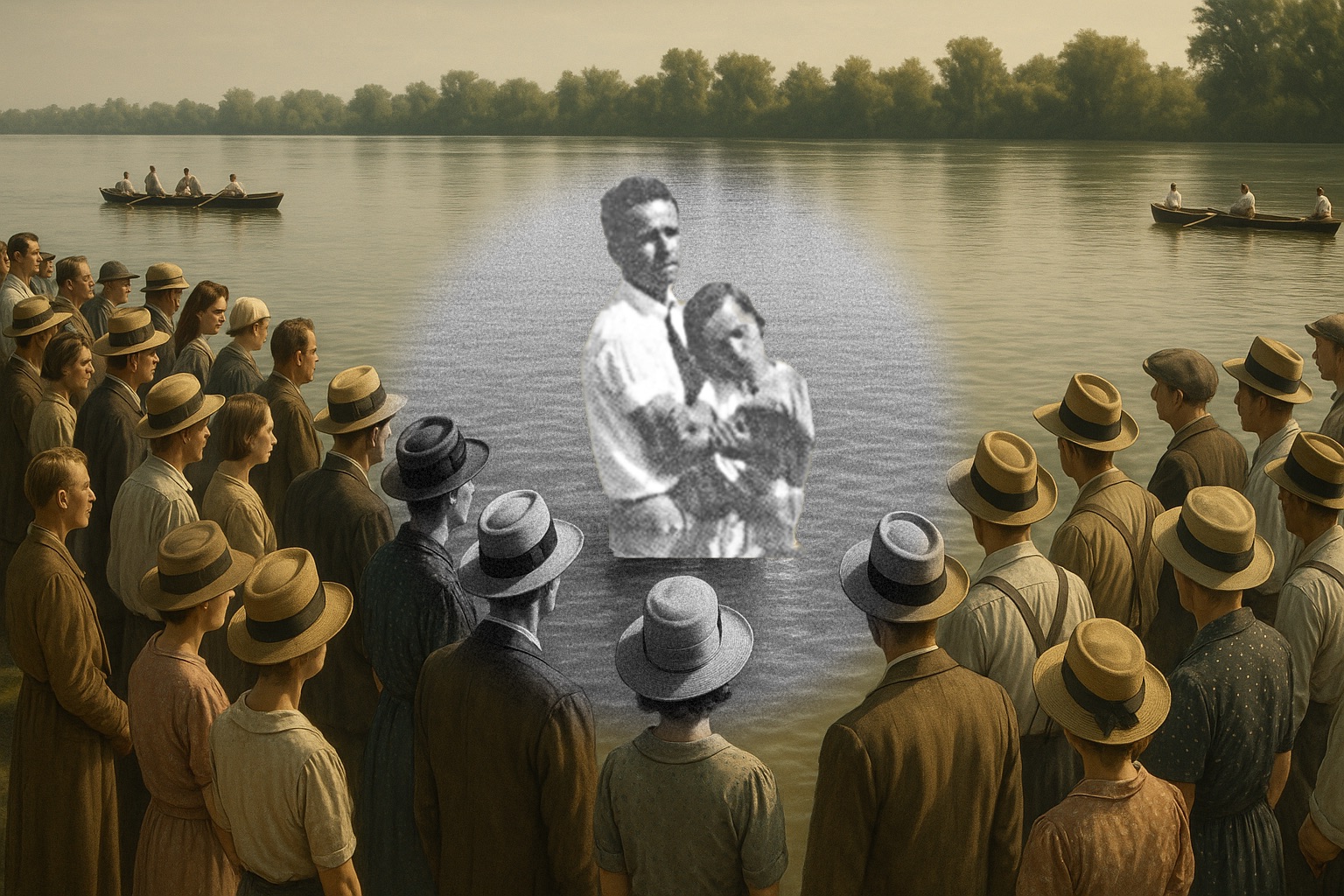
1933 Baptism: The Voice No One Heard
Dismantling William Branham’s famed 1933 Ohio River baptism story—showing that claims of a visible light, an audible commissioning voice, massive crowds, and nationwide newspaper coverage are contradicted by eyewitnesses, contemporary press records, and the documented history of his church and mentor, Roy E. Davis. It argues that the baptism narrative and the so-called 1933 prophecies were retrofitted into Branham’s biography as tools of authority, illustrating how myth-making and repetition, rather than verifiable evidence, became the foundation for prophetic belief in the Message movement.
A Light in the Water: The Myth of Branham’s 1933 Baptism Revival
One of the most fundamental mythologies for Message movement is William Branham’s claim that a divine visitation occurred during his baptismal service in 1933 at the Ohio River. According to Branham, while baptizing his seventeenth convert, a supernatural light descended from the sky and a voice declared that his ministry would "forerun the second coming of Christ." Over the years, Branham would repeat this account in increasingly detailed terms—mentioning crowds of up to ten thousand, newspaper reporters on site, and widespread coverage through the Associated Press (AP) reaching as far as Canada.[1]
Years ago, when a little boy, when I was baptizing down on the river that day, just my first message in the Missionary Baptist church, I was baptizing five hundred. And that afternoon, on June, 1933, on June, about the 15th, here come that Pillar of Fire whirling out of the skies, right in the pretty, sunshiny afternoon, and go right down and that Voice that shook the whole country round there, said, "As John the Baptist was sent to forerun the first Coming of Christ, your Message will forerun the second Coming." Now, that's started the revival immediately after that. And there it's went across the nation, around the world, Pentecost reviving. And that's what has taken place, the second coming of Christ. 258 And now, the newspapers packed it way up in Canada. It was on articles, and so forth, and went on the Associated Press, I kept telling people. Then finally the eye of the camera begin to catch It, and now they've got it back there.
- William Branham, Jun 23, 1962. 62-0623. Perseverant
This story also became foundational for his prophetic identity. Followers point to this event as the moment when Branham was supernaturally commissioned, equating it to the baptism of Jesus. Yet, modern archival research reveals a shocking absence of any press coverage matching the description. No such article has ever surfaced in the Louisville Herald-Post, Courier-Journal, or Jeffersonville Evening News. We have examined every issue of the local newspapers in the archives of the Louisville and Jeffersonville Public Libraries, as well as Associated Press articles in the Internet archives, and can confirm that Branham's claim of the newspaper article was fabricated.
In a 2002 recorded testimony, Message pastor Pearry Green—a close associate of Branham—acknowledged speaking to eyewitnesses who were present at the river that day. His admission undercuts the supernatural narrative:
"I have had the privilege to talk to some of those witnesses that were on the bank... nobody heard the voice... That was on June the 11, 1933."
— Pearry Green, Testimony, April 9, 2002
Green’s remark directly challenges Branham’s description of an audible voice heard by thousands. Our researchers have also interviewed witnesses of the event and can confirm Green's findings.
The Earliest Claims: How the Story First Emerged
The first known references to the alleged supernatural event at the Ohio River appear in Branham’s public ministry by 1948. In an article titled “How the Gift Came to Me,” published in The Voice of Healing, Branham stated that during a baptismal service on the Ohio River, “a great bright star came and hung over where I was standing.” He went on to claim, “Many of you will remember reading that in the newspapers. It has appeared many times since.”[2] At this early stage, the story lacked many of the embellishments that would later be added, such as the appearance of a divine Voice or claims of a prophetic commission.
By 1950, the account had undergone significant evolution. In multiple sermons, Branham began adding estimates of five hundred people being baptized, crowds of up to ten thousand, and vivid descriptions of a visible Light descending from heaven “like a great morning star.”[3] The claims of mass attendance and supernatural manifestation appeared to grow in direct proportion to the development of Branham’s healing ministry. These early iterations reveal a pattern: as Branham's following expanded, so too did the details of the baptismal story.
Crowd Size and Conversion Counts: A Growing Legend
In earlier accounts, Branham mentioned "hundreds" of attendees without providing specific figures. However, by the early 1950s, he began citing increasingly larger crowds, with some sermons referencing “seven or eight thousand,” “ten thousand,” or simply “thousands” standing on the banks of the Ohio River to witness the event.[4] Similarly, the number of baptisms began to escalate. In several accounts, Branham claimed he baptized five hundred people during the service, a number that eventually became standard in later retellings.[5]
Notably, Branham also claimed that the supernatural sign occurred while baptizing his seventeenth convert—implying that more than 480 individuals were baptized after the alleged Voice from Heaven was heard. If such an extraordinary event truly took place in front of thousands of witnesses, one would expect contemporary newspaper coverage, independent confirmation, and official church records. Instead, the only verified press report from that period mentions just fourteen conversions, with no reference to a mass baptism, supernatural light, or audible voice from heaven.[6] This stark contrast between Branham’s grand narrative and the documented evidence raises important questions about the authenticity and embellishment of the event over time.

Central to Branham’s baptism story is the climactic claim that happened as he baptized his seventeenth convert.[7] In multiple sermons, Branham describes raising his hand to baptize when a light appeared and a voice spoke from above, saying, "As John the Baptist was sent forth to forerun the first coming of Christ, you have the Message that'll now forerun the second Coming of Christ." [8] This moment, presented as a public prophetic commissioning, became one of the most iconic narratives in Branham’s ministry and is often cited as the origin of his divine authority. The newspaper's account of the small revival, which reported fourteen converts, combined with the exaggerated numbers, adds further evidence against the legitimacy of the claims.
A Newspaper That Never Was: Investigating the Louisville Herald-Post
In one version of the story, William Branham claimed that the supernatural event at the Ohio River was reported in a major Kentucky newspaper, the Louisville Herald-Post. The Louisville Herald-Post ceased publication in 1936 and has since been preserved on microfiche. Researchers examining every issue from May through July 1933 have confirmed that no such article ever appeared. There is no mention of William Branham, no baptismal event at the Ohio River, and no associated supernatural occurrence. Despite Branham’s repeated insistence that “newspapers packed it all across the nation,” there is a complete absence of corroborating press evidence. No copy of the article has ever been produced, and the Voice of God Recordings ministry, which archives Branham’s materials, has never released such a clipping. The story of the newspaper coverage is itself a myth within a myth.
Roy E. Davis and the Culture of Fabrication
At the time of the alleged 1933 baptismal event, William Branham was still closely associated with Roy E. Davis, the man who had ordained him into ministry. Davis had established the Pentecostal Baptist Church of God, and Branham was a leading bishop within that denomination. Davis was a controversial figure with a notorious history—he had been indicted in Louisville, Kentucky, on charges of sexual misconduct involving a minor and financial fraud related to swindling his congregation. After fleeing legal consequences in Kentucky, Davis reestablished himself in Jeffersonville, Indiana, where he promoted his ministry as a continuation of Pentecostal revivalism.[9]
Davis was also an avowed white supremacist and an official spokesperson for the Ku Klux Klan. His efforts to gain public legitimacy often involved elaborate publicity stunts. When the Jeffersonville Evening News refused to publish his press releases—many of which were fabricated or self-written as news articles—he founded his own newsletter, The Banner of Truth. In a statement published by the Evening News, the editors explained that Davis had been submitting articles written to appear as if composed by journalists, which the paper ultimately refused to print.[10] It should be noted that the article, if it existed, was published by Davis and that Branham altered the name of the paper and the details of the article in later versions of the story.
The Cornerstone and the Clock: The 1933 Prophecies Timeline Problem
Branham’s baptismal event was not an isolated claim—it was tightly woven into the broader mythology of his so-called “1933 prophecies.” According to his later sermons, Branham wrote a series of divine visions on paper and placed them in the cornerstone of his newly constructed church building. He often claimed this prophetic document, allegedly sealed in the cornerstone during the summer of 1933, foretold major historical developments including World War II, the rise of fascism, and the election of a female U.S. president.[11] These claims were intended to retroactively validate Branham’s prophetic authority and lend credibility to the supernatural event at the Ohio River.
However, the historical record complicates this narrative. The deed to Branham Tabernacle shows the property was not transferred to the church until years later, casting doubt on the timing of the alleged cornerstone ceremony.[12] Even more troubling, none of the so-called 1933 prophecies were mentioned in any sermons or publications prior to the mid-1950s. Branham’s earliest known descriptions of the cornerstone event omit any reference to written prophecies entirely. This suggests that the entire timeline—baptism, voice from heaven, and cornerstone prophecies—was constructed retroactively as part of a carefully curated public persona. The prophetic date of 1933 became a cornerstone of its own: one that held the myth together.
Pillars of Fire and Changing Details: The Story Evolves
As Branham’s ministry matured and his audience expanded, so too did the details of his baptism story. In early retellings, he spoke only of a light appearing in the sky. However, over time, the light acquired greater theological significance, eventually being identified as a manifestation of the same “Pillar of Fire” that led the Israelites through the wilderness. This association drew from Pentecostal and Latter Rain imagery, reinforcing Branham’s identity not only as a prophet but as a direct successor to biblical figures.[13] Later versions of the account began to describe people fainting in the presence of the light, with photographers present to document the event, although no such photos or articles have ever surfaced.
What the Archives Really Show: A Complete Absence of Evidence
Comprehensive archival research conducted at both the Louisville and Jeffersonville public libraries has yielded conclusive results: no newspaper article exists documenting a mass baptism, a mysterious light, or a divine voice associated with William Branham in the summer of 1933. Every issue of the Louisville Herald-Post and other local papers from the relevant timeframe has been reviewed in full. Not a single article contains any reference to Branham’s alleged revival or a supernatural event at the Ohio River. Despite decades of sermons referring to a nationally circulated newspaper article and the supposed presence of photographers, not one piece of photographic or journalistic evidence has ever surfaced.
The only known newspaper coverage of Branham’s ministry in 1933 is a modest article from the Jeffersonville Evening News, dated June 2. It reports merely that “fourteen conversions” occurred at a tent meeting. This isolated notice, free from sensationalism or supernatural claim, stands in stark contrast to Branham’s elaborate retellings. If thousands were present—as he claimed—and the event was covered by the Associated Press, it is statistically improbable that no secondary coverage, photographs, or local commentary would exist. The complete absence of corroboration cannot be ignored. It points not merely to gaps in the record, but to a story that was likely invented—or at minimum, grossly exaggerated—long after the fact. This article overturns Branham's claim that the alleged light and voice occurred with the seventeenth convert.
Why It Matters: Myth, Manipulation, and Modern Belief
The myth of William Branham’s 1933 baptismal commissioning continues to play a central role in the belief systems of Message adherents around the world. More than just a nostalgic tale, it serves as theological bedrock: the moment when God Himself allegedly authenticated Branham’s prophetic authority. It is frequently referenced in sermons, doctrinal materials, and printed literature produced by Voice of God Recordings, and is often invoked to defend the legitimacy of Branham’s later teachings and visions. The supernatural light and audible voice are presented as evidence that his ministry was divinely appointed and uniquely anointed.
Yet the absence of verifiable evidence, coupled with contradictory eyewitness testimony and shifting narrative details, renders this foundational story deeply problematic. It demonstrates how religious myths are constructed, maintained, and leveraged—sometimes at the expense of historical integrity. For critics and researchers, the inconsistencies serve as a cautionary example of how spiritual authority can be manufactured through repetition rather than verification. For believers within the Message, however, the myth persists not because of what the archives reveal, but because of what the movement demands: an unbroken chain of supernatural validation. Whether viewed as a lie or a legend, the story’s endurance reflects the enduring power of myth to shape modern faith.