
1933 Prophecies: A Self-Proclaimed Prophet
William Branham’s alleged 1933 prophecies show every sign of being constructed backwards: there is no contemporaneous 1933 documentation, his own references to the list are inconsistent (including a slip reading “1932” while admitting the prophecies were being revised), and several early items were borrowed from other writers like Gerald Winrod. Over the following decades the list expanded from “seven major events” to as many as eighteen wildly varied predictions—ranging from Mussolini’s fate to egg-shaped cars, a female U.S. ruler, “don’t eat eggs,” and “don’t live in a valley”—revealing a flexible, evolving narrative shaped by postwar fears and theological needs rather than a single, fixed prophetic vision.
The Myth of 1933: How William Branham's Prophetic Legacy Was Built Backwards
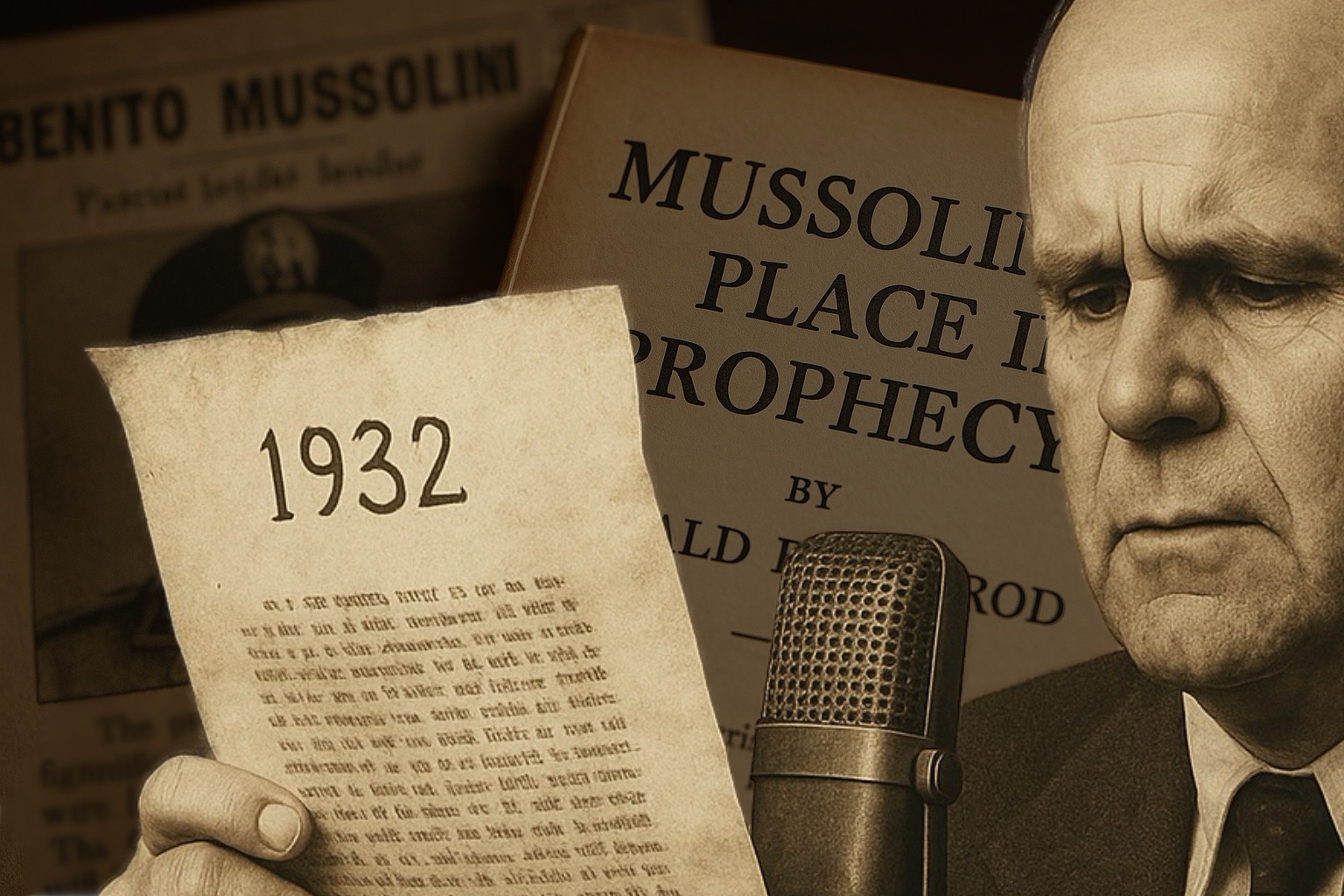
Starting in the mid-1950s,[1] William Branham began to assert that in 1933, he received a series of divine visions outlining future world events that would precede the end of time. According to Branham, these visions were written down and stored in various formats—on paper, in his Bible, or even sealed inside the cornerstone of the original Branham Tabernacle. However, no original documentation of the visions exists from 1933. After apparently being pressed by his followers to show proof of the paper containing the visions, Branham raised even more questions after reading from what he claimed to be the original list of prophecies during a sermon. In the reading of the list, Branham read the year "1932" and admitted that he and his campaign team were revising the prophecies. The "1932" appears to have been a mistake; it is more likely that Branham retroactively selected the year 1933 for these prophecies to align them with a baptismal event that had become central to his origin story.
It's wrote, and laying in the stone, on the fly-leaf of my Bible.
- Branham, William. 1958, Jul 20. By Faith, Moses.
It's on yellow paper. Will be printed in the "Herald of Faith" right away, because most all of it is fulfilled.
- Branham, William. 1960, Nov 25. Conference. "
The Seventieth Week of Daniel. "It's wrote down on old paper, at home. It's already in print and went out around the world. See? That was in 1933.
- Branham, William. 1961, Aug 6.
It's on old paper there at the church.
- Branham, William. 1963, Nov 17. Once More.
And, God in Heaven knows, that lays right there in the corner-...(of that tabernacle)...-stone since 1933, wrote on a page of a Bible, laying right there.
- Branham, William. 1965, July 18. Spiritual Food In Due Season
I'd like to read you a prophecy that was given. I got on...And may...By the way, Mr. Mercier and many of them are going to take some of these old prophecies, and dig them out, and revise them a little, or bring them up to date, and put them in papers. I'd like to read some things that I'd like for you to—to...This one, first. I'd like to read something to you. 33 '1932.' Listen to this.
- Branham, William. 1960, November 13. Condemnation By Representation
Initially, the 1933 claim began by describing a prophecy by Gerald Burton Winrod from the late 1920s, which is described in Winrod's 1933 book, Mussolini in Prophecy.[2] Over time, the claim transitioned to a list of "seven major events" foreseen in a single visionary experience, some borrowed from Winrod and others borrowed from the works of others or the communist fears of the era. The contents and number of prophecies evolved dramatically over the years. By the end of Branham's ministry in 1965, the number of prophecies attributed to this 1933 vision had grown to as many as eighteen, depending on the sermon or audience. The prophecies encompassed a wide range of subjects, including geopolitical shifts, technological advancements, moral decay, and apocalyptic judgment. While no 1933 documentation has ever surfaced, and there are at least seventeen variations of the prophecies, the followers of Branham have chosen seven of the eighteen as the "official" list of seven prophecies:
- Mussolini would invade Ethiopia and come to a disgraceful end.
- A second world war would break out, and Hitler would rise to power.
- Three great isms—fascism, Nazism, and communism—would rise, with communism prevailing.
- Technology would produce a driverless, egg-shaped car.
- A woman would rise to national power in America.
- Moral decay would lead to a general collapse of society.
- America would be destroyed shortly after 1977.
The Seven (or Eighteen?) Prophecies: An Expanding List
While William Branham originally referred to a series of "seven major events" revealed to him in a single vision in 1933, the number and content of these prophecies grew over time. In sermons delivered from the early 1950s through the final years of his ministry, Branham introduced additional details, some of which contradicted or expanded on earlier versions. By the mid-1960s, Branham and his followers were referencing up to eighteen distinct prophetic elements—all attributed to the same 1933 experience.
This gradual expansion is clearly observable when examining Branham's sermon history. The earliest prophecy mentioned was Mussolini's invasion of Ethiopia, first introduced in 1953. Over the next decade, references to egg-shaped cars, a woman ruling the United States, the Catholic Church's political power, and the destruction of America were added. Other elements, such as warnings not to eat eggs or live in valleys, appear only in the final years of Branham's life. The variation in number—seven, ten, twelve, or eighteen—often shifts depending on the sermon and its intended audience, suggesting the list functioned more as a narrative device than a fixed divine revelation.
- Mussolini would invade Ethiopia, and it would be his last invasion. (Introduced in 1953)[3]
- Automobiles would become shaped like an egg. (Introduced in 1953)[4]
- Three isms—Fascism, Communism, and Romanism—would rise, and one would dominate, though God did not specify which. (Introduced in 1953)[5]
- The United States would be ruled by a woman. (Introduced in 1955)[6]
- The United States would be completely destroyed. (Introduced in 1956)[7]
- Fascism, Communism, and Romanism would rise, and Communism would take over the world. (Introduced in 1957)[8]
- The United States would be ruled by the Catholic Church. (Introduced in 1960)[9]
- The United States would be ruled by President Kennedy. (Introduced in 1960)[10]
- Automobiles would operate with automatic guidance systems. (Introduced in 1960)[11]
- The Maginot Line would be constructed. (Introduced in November 1960)[12]
- The Siegfried Line would be constructed. (Introduced in 1960)[13]
- The United States would worship a woman named Mary. (Introduced in 1961)[14]
- The Catholic Church (Romanism) would take over the world. (Introduced in November 1962)[15]
- A warning not to eat eggs would be given. (Introduced in 1963)[16]
- A warning not to live in valleys would be given. (Introduced in 1963)[17]
- Women would begin wearing fig leaves. (Introduced in 1964)[18]
- Roosevelt would lead America into a second world war. (Introduced in November 1960)[19]
- Hitler would lead America into a second world war. (Introduced in 1964)[20]
"Don't Eat Eggs" and "Don't Live in a Valley": Retroactive Safety Warnings
Among the most idiosyncratic additions to William Branham's evolving list of 1933 prophecies are his warnings not to eat eggs and not to live in a valley. These peculiar instructions, which appear in sermons from the final years of his ministry, are typically framed as divine insights into coming dangers. The "don't eat eggs" warning was tied to a supposed vision in which a disease would soon be found in eggs that would cause widespread death. Similarly, the admonition to avoid living in valleys was often framed in eschatological terms, with Branham claiming that catastrophic earthquakes would strike low-lying regions as part of divine judgment.
Neither of these warnings appears in any of Branham's public statements before the mid-1960s. The earliest reference to egg consumption being dangerous comes from a 1965 sermon, in which Branham claims to have been supernaturally warned about a coming disease. The valley warning also appears in sermons from the same year, linked with prophetic scenarios of earthquakes and destruction. These late additions are difficult to reconcile with the core 1933 vision narrative and seem tailored to Cold War-era fears—nuclear fallout, environmental disaster, and health scares—rather than grounded in any early prophetic content. Their sudden appearance decades after the fact undermines their credibility as part of the original 1933 visions.
Contradictions, Revisions, and Post-War Additions
The evolution of William Branham's so-called 1933 prophecies reflects a broader pattern of contradiction, selective revision, and postwar adaptation. In some sermons, Branham claimed to have written the visions on paper immediately after receiving them; in others, he said they were inserted into the cornerstone of his tabernacle, or stored in his Bible. Despite these varied claims, no physical copy of the original 1933 list has ever been produced. Instead, the content of the prophecies appears to have changed in response to shifting cultural, political, and theological contexts across the mid-20th century.
Discrepancies abound not only in the number of prophecies—sometimes seven, sometimes ten, twelve, or eighteen—but also in their substance and timing. Key prophecies such as the destruction of America by 1977, warnings against egg consumption, or the prediction of a female ruler do not appear in Branham's early ministry and seem clearly retrofitted to reflect Cold War fears, moral panics, or contemporary technological trends. Moreover, Branham's attribution of his evolving statements to a single visionary moment in 1933 raises serious concerns about the retrospective construction of prophetic authority. The lack of consistent documentation, the postwar emergence of key themes, and the theological pliability of these visions all point to a mythologized origin rather than a verifiable prophetic event.
Prophecy, Memory, and Mythmaking
The alleged 1933 visions, while foundational to his later authority as a prophet, lack contemporaneous documentation and exhibit clear signs of retrospective construction. As new global events unfolded, Branham's prophecies expanded and shifted to accommodate them, suggesting a dynamic process of theological reinterpretation rather than the unfolding of a fixed divine plan.
For many of his followers, the fulfillment of these prophecies remains a central tenet of faith. Yet the inconsistencies in Branham's recounting, the absence of early references, and the unmistakable influence of mid-20th-century sociopolitical fears all point to a pattern of post hoc rationalization. Rather than viewing the 1933 vision as a singular supernatural event, it is more accurately understood as a developing narrative shaped by time, audience, and ideology.