
1933 Prophecy of the Isms: Branham’s Changing End-Time Vision
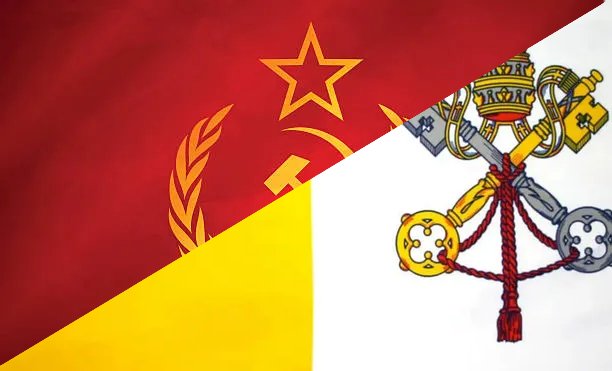
William Branham did not publicly mention his supposed 1933 visions until 1953, when he claimed to have prophesied that Communism, Fascism, and Nazism would merge into a single system that would dominate the world and burn the Vatican—a narrative that closely echoes earlier fundamentalist apocalyptic literature and is flatly contradicted by subsequent history. As Communism failed to conquer Europe and eventually collapsed, Branham quietly revised his message, recasting Roman Catholicism rather than Communism as the final world power, presenting this reversal not as a correction of failed prophecy but as further divine revelation.
What Branham Claimed — And When He Started Saying It
Although William Branham frequently claimed to have received a series of prophetic visions in 1933, there is no documented evidence that these prophecies were mentioned publicly or in print prior to March 26, 1953. On that date, in a sermon titled Israel and the Church #2, Branham declared that he had prophesied decades earlier about the rise of three global ideologies—Communism, Fascism, and Nazism—and claimed that these would ultimately merge into a single system that would dominate the world and destroy the Vatican. This marks the first verifiable appearance of the alleged 1933 prophecy. Despite Branham’s repeated insistence that the vision was written down and sealed in the cornerstone of the Branham Tabernacle during its dedication, no such list has ever been produced or independently verified. At the same time, the rest of Branham's alleged "1933 prophecies" are not mentioned during the first versions of his so-called 1933 prophecy.
People, we're living in the end time. How many of you people has heard years ago down here when they was going to have me arrested down here for preaching on that "mark of the beast"? When I said that Mussolini, when he first come in power twenty-some-odd years ago, I said, "If Mussolini ever goes towards Ethiopia, mark this down, there will never be peace till Jesus Christ comes." And I said, "There'll be three great isms, Communism, Fascism, and Nazism." And I said, "They'll wind up in one ism, and that one ism will dominate the world and will burn the Vatican City." You remember me saying that years and years and years ago. And just exactly that way!"[1]
- William Branham, 1953
Branham’s vision of Mussolini as an apocalyptic figure was far from unique. Other leaders of Christian Identity were outspoken in their opposition to Mussolini. In 1933, fundamentalist evangelist Gerald B. Winrod published Mussolini's Place in Prophecy, a widely circulated booklet that interpreted Benito Mussolini’s rise as a fulfillment of biblical end-time prophecy. Winrod warned that Fascism would bring divine judgment and positioned Mussolini as a key figure in a clash between political totalitarianism and apostate religion. The eschatological framework and symbolism in Winrod’s publication closely resemble the themes Branham would later introduce in his 1953 sermon.
The Three Isms and the Burning of the Vatican
Branham’s earliest known articulation of the “three isms” prophecy occurred in 1953, when he claimed to have foreseen that Communism, Fascism, and Nazism would ultimately merge into a single system that would dominate the world and burn the Vatican. This apocalyptic vision formed a critical part of Branham’s Cold War-era message, in which he portrayed the West as spiritually vulnerable to atheistic totalitarianism. He further claimed that he had received this vision decades earlier and warned his listeners that one of these ideological forces—Communism—would prevail over the others and execute divine judgment against Roman Catholicism.
Branham’s rhetoric was shaped by the geopolitical anxieties of the early 1950s, when tensions with the Soviet Union were escalating and the memory of World War II remained vivid. In sermons such as The Laodicean Church Age (1960), Branham reemphasized the merger of the three “isms” into Communism and tied this development to the prophesied destruction of the Vatican. His use of this imagery reinforced his anti-Catholic posture and positioned Communism not merely as a political enemy, but as an instrument of divine wrath. The burning of the Vatican, in his theology, was not a political outcome but an eschatological inevitability—supposedly foreseen by God and revealed through Branham’s prophetic gift.
Branham vs. History: What Actually Happened
Branham's prophetic scenario predicted that Communism would engulf both Nazism and Fascism, forming a single ideological force that would overtake the world and destroy religious institutions, especially the Roman Catholic Church. However, historical developments starkly contradict this vision. Nazi Germany collapsed in 1945 at the hands of Allied forces, not Communism. Fascist Italy, under Mussolini, was dismantled through a combination of internal resistance and Allied intervention, and its postwar government transitioned toward democratic governance, not Marxist ideology. Although the Communist Party of Germany (KPD) briefly resurfaced after World War II, it was suppressed under Nazi rule in 1933 and formally banned in West Germany by 1956. In the postwar era, West Germany became a central NATO ally, adopting a parliamentary democracy and social market economy. These developments directly contradict Branham's assertion that Communism would consume these other systems.
More decisively, the dissolution of the Soviet Union in 1991 marked the definitive collapse of Communist expansionism as a global threat. Under Mikhail Gorbachev's leadership, constitutional reforms dismantled the Communist Party's monopoly on power, leading to the formal end of the USSR on December 26, 1991. Rather than expanding into Europe or overtaking the world, Communist Russia fractured into multiple independent republics. This historical trajectory reveals a fatal flaw in Branham's predictive narrative: the ideology he claimed would dominate the globe instead imploded from within.
When Communism Failed, Branham Changed the Script
By the early 1960s, William Branham began altering his original prophetic narrative. As it became increasingly clear that Communism was not overtaking Europe or threatening to destroy the Roman Catholic Church, Branham revised his earlier claims to assert that Communism was merely a tool in the hands of a greater threat: Roman Catholicism, or “Romanism.” In a 1962 sermon titled The Restoration of the Bride Tree, Branham declared, “Don’t you never try to fight Communism. Fight Romanism. For, that’s THUS SAITH THE LORD. The Lord said Romanism is going to rule, not Communism. It’s just a puppet.” This represented a dramatic reversal of his earlier warnings, where Communism was portrayed as the final world power destined to burn the Vatican.
Any prophecy don't stay with that Word... That's exactly. That's the reason I say today; no matter how good it looks, how many preachers are saying this, that, or the other, "Communism is going to take the world and throw it down." Don't you never try to fight communism. Fight Romanism. For, that's THUS SAITH THE LORD. The Lord said Romanism is going to rule, not Communism. It's just a puppet.[2]
- William Branham, 1962
This reversal was not framed as a revision or correction; rather, Branham presented it as a further unfolding of divine revelation. Yet the shift coincided with global trends indicating that Communism was weakening and the Vatican was gaining renewed political and spiritual influence under Pope John XXIII and Vatican II reforms. By repositioning Roman Catholicism as the final enemy, Branham effectively erased the failed elements of his original prophecy and redirected the eschatological threat to align with long-standing Protestant fears of Papal authority. This allowed his apocalyptic message to remain relevant despite the collapse of its original premise.