
1948 Doomsday: Prophecy and Politics
After the birth of Latter Rain and the Latter Rain Revival, and as Branham's associates began to join into the Voice of Healing Revival, William Branham and his associate editors of the Voice of Healing Publication began promoting the idea that 1948 would be the year of destruction. A section of the publication entitled "The World In Prophecy" started informing readers of the "prophetic" and mathematic projections pointing to the End of Days using charts, graphs, numerologies, and specific passages from the Christian Bible without their surrounding Biblical context.
After the birth of Latter Rain and the Latter Rain Revival, and as Branham’s associates began to join the Voice of Healing Revival, William Branham and his associate editors of the Voice of Healing Publication began pushing the idea that 1948 would be the year of destruction. A section of the publication entitled “The World In Prophecy” was introduced to warn readers of the “prophetic” and mathematical projections pointing to the End of Days.[1]
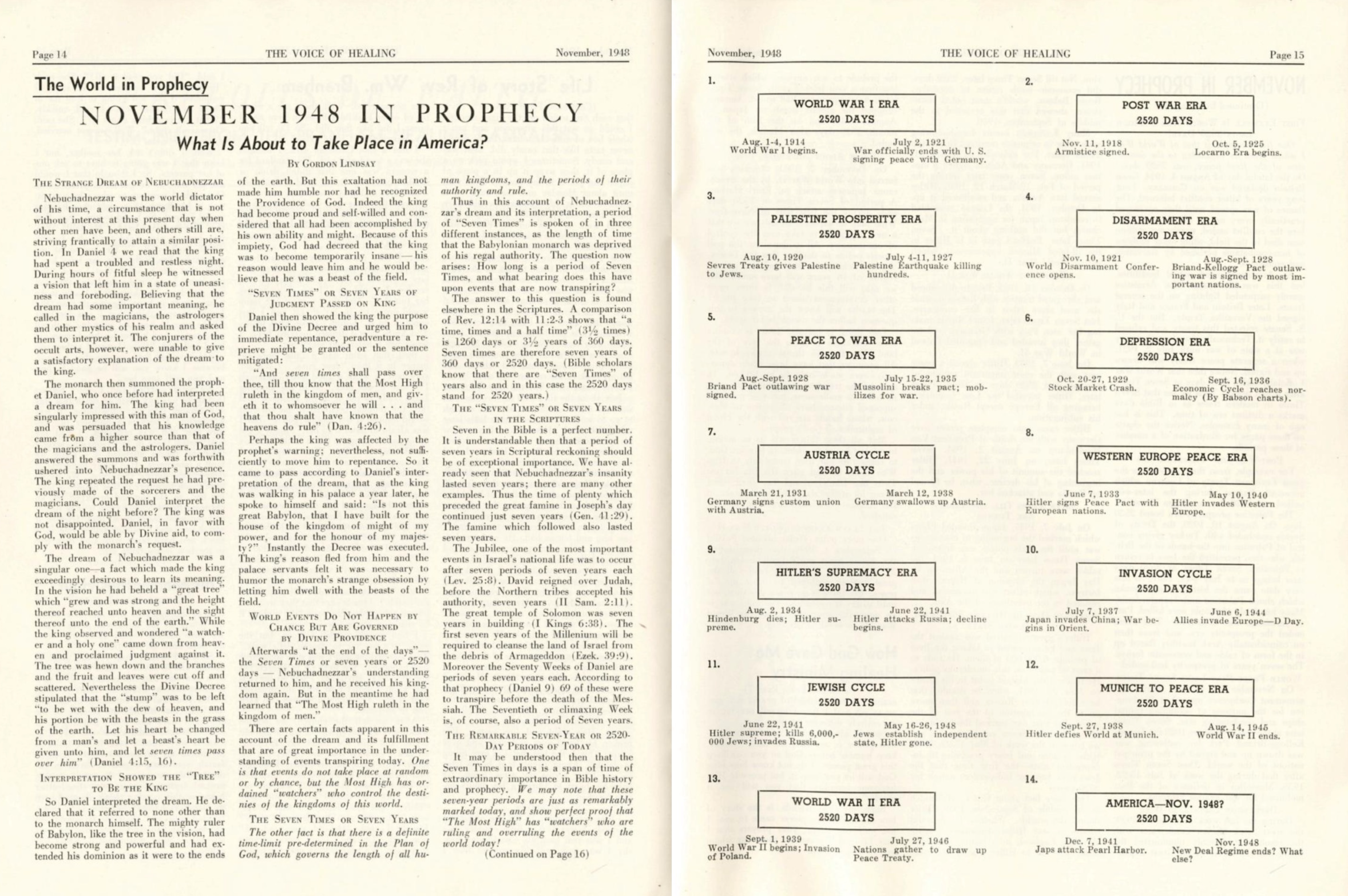
In the November 1948 issue, this section featured an article by Gordon Lindsay titled “November 1948 in Prophecy: What Is About to Take Place in America?” which framed contemporary politics in explicitly apocalyptic terms. Lindsay began, not with current events, but with a rehearsal of Nebuchadnezzar’s dream in Daniel 4. The narrative is retold in devotional style: the Babylonian king dreams of a great tree which is cut down in judgment, Daniel interprets the tree as the king himself, and God condemns Nebuchadnezzar to “seven times” of humiliation among the beasts of the field. Lindsay emphasizes God’s sovereignty over “the kingdoms of men” and the “watchers” who supposedly supervise human history—categories that will later be mapped onto twentieth-century geopolitics.
The crucial move in the article is hermeneutical and mathematical. Lindsay insists that the “seven times” of Daniel 4 must be understood as a fixed prophetic duration of 2,520 days (seven “prophetic years” of 360 days each), and then searches Scripture for other instances of seven-year periods to support this scheme. Joseph’s seven years of plenty and seven years of famine, the Jubilee cycle, Solomon’s seven years building the temple, the “seventy weeks” of Daniel 9, and the opening years of an imagined future Millennium are all invoked as confirmation that seven-year spans possess a unique prophetic significance. The article thus treats an internal literary motif in the biblical narrative as though it were a precise, reusable unit of sacred time that can be stretched across any period of history the interpreter wishes to highlight.
Having established 2,520 days as a presumed prophetic constant, Lindsay then turns to recent history. The facing page presents a series of boxes, each labeled as a distinct “era” or “cycle” lasting exactly 2,520 days. World War I, the “Post War Era,” the “Depression Era,” Hitler’s rise to power, the German annexation of Austria, and the outbreak and conclusion of World War II are all retrofitted into neat, seven-year intervals framed by carefully selected start and end dates. Particularly striking is the “Jewish Cycle,” which runs from Hitler’s 1941 invasion of Russia—described as the moment he becomes “supreme” and begins killing six million Jews—to May 1948, when “Jews establish independent state, Hitler gone.” In this scheme, the horrors of the Holocaust and the founding of the modern State of Israel are repackaged as a mathematically elegant fulfillment of a prophetic pattern.
New Deal "Regime" Ends
The final box is the real point of the exercise. Labeled “AMERICA—NOV. 1948? 2520 DAYS,” it counts a seven-year period from the Japanese attack on Pearl Harbor (December 7, 1941) to an ominous question mark in “Nov. 1948,” annotated with the suggestion, “New Deal Regime ends? What else?” By aligning the Roosevelt–Truman domestic program with an apocalyptic countdown, Lindsay implies that America is about to pass from one divinely-ordained dispensation into another—one that may involve judgment, destruction, or at least a radical political realignment. The article promises a continuation on page 16, indicating that this was not merely a curiosity but part of a longer, didactic argument urging readers to interpret American politics through this numerological grid.
From a scholarly standpoint, several features of this material deserve comment. First, Lindsay’s method is a classic example of apocalyptic numerology rather than historical exegesis. The 2,520-day “eras” are not discovered in the historical record; they are imposed upon it by selectively choosing beginning and ending points that roughly fit a pre-determined length. Many of the chosen dates (such as the 1927 Palestine earthquake or the July 1946 peace-treaty conference) would have been unfamiliar to ordinary readers and require the reader to accept Lindsay’s judgment that these particular events, rather than many other plausible candidates, mark decisive “turning points” in God’s timetable. The persuasive force therefore rests, not on rigorous historical reasoning, but on the visual impact of the chart itself—the sense that history has been forced into a tidy, divinely-ordered sequence.
Second, the biblical argument is thin by academic standards. Daniel’s “seven times” in chapter 4 refer to the period of Nebuchadnezzar’s madness within the narrative world of the book; the text does not itself invite readers to treat this as a modular, reusable span for calculating international events two and a half millennia later. Likewise, while the number seven is clearly a symbolic number of completeness in the Hebrew Bible, the jump from symbolic numerology to precise day-counts is never grounded in the texts Lindsay cites. In effect, the article treats Scripture as a quarry of numbers and phrases to be rearranged into a modern timetable, rather than as literature embedded in its own historical and theological context.
Third, the chart reflects the particular political anxieties of Branham’s circle in the late 1940s as much as it reflects any universal “prophetic” insight. The framing of 1941–1948 as a “New Deal Regime,” and the suggestion that this regime might “end” in November 1948, align closely with conservative evangelical hostility to Roosevelt’s domestic policies. That political framing is then sacralized by embedding it in a biblical-numerological system. The chart thus functions, not only as an end-times prediction, but as a theological critique of American liberalism: to oppose the New Deal becomes, implicitly, to take one’s stand with God’s prophetic calendar.
Finally, the prediction itself failed. November 1948 did not usher in the destruction of America, the collapse of the New Deal order, or any recognizable dispensational crisis. What it did witness was the election of Harry Truman to a full term—hardly the overthrow of the existing regime—and the continued, messy unfolding of postwar geopolitics. Yet in the revival culture surrounding Branham and the Latter Rain movement, such failed projections rarely prompted serious re-evaluation. Instead, timelines were adjusted, new dates were discovered, and fresh “revelations” were layered on top of the old ones, reinforcing an atmosphere in which Branham’s own claimed visions and prophecies could be received as plausible extensions of an already-established apocalyptic narrative.
When read in this light, the “World In Prophecy” feature from November 1948 is more than a curiosity. It provides a window into the intellectual world of the early Voice of Healing and the theological environment that nurtured the Latter Rain Revival. Scripture is flattened into a storehouse of numbers, modern history is compressed into a sequence of 2,520-day blocks, and American domestic politics are baptized as eschatological markers. For historians, the value of this material lies precisely in how wrong it was: the failure of “America—Nov. 1948?” exposes the extent to which Branham’s circle relied on speculative numerology and political fear, rather than careful exegesis, to construct their sense of living at the edge of the End of Days.