
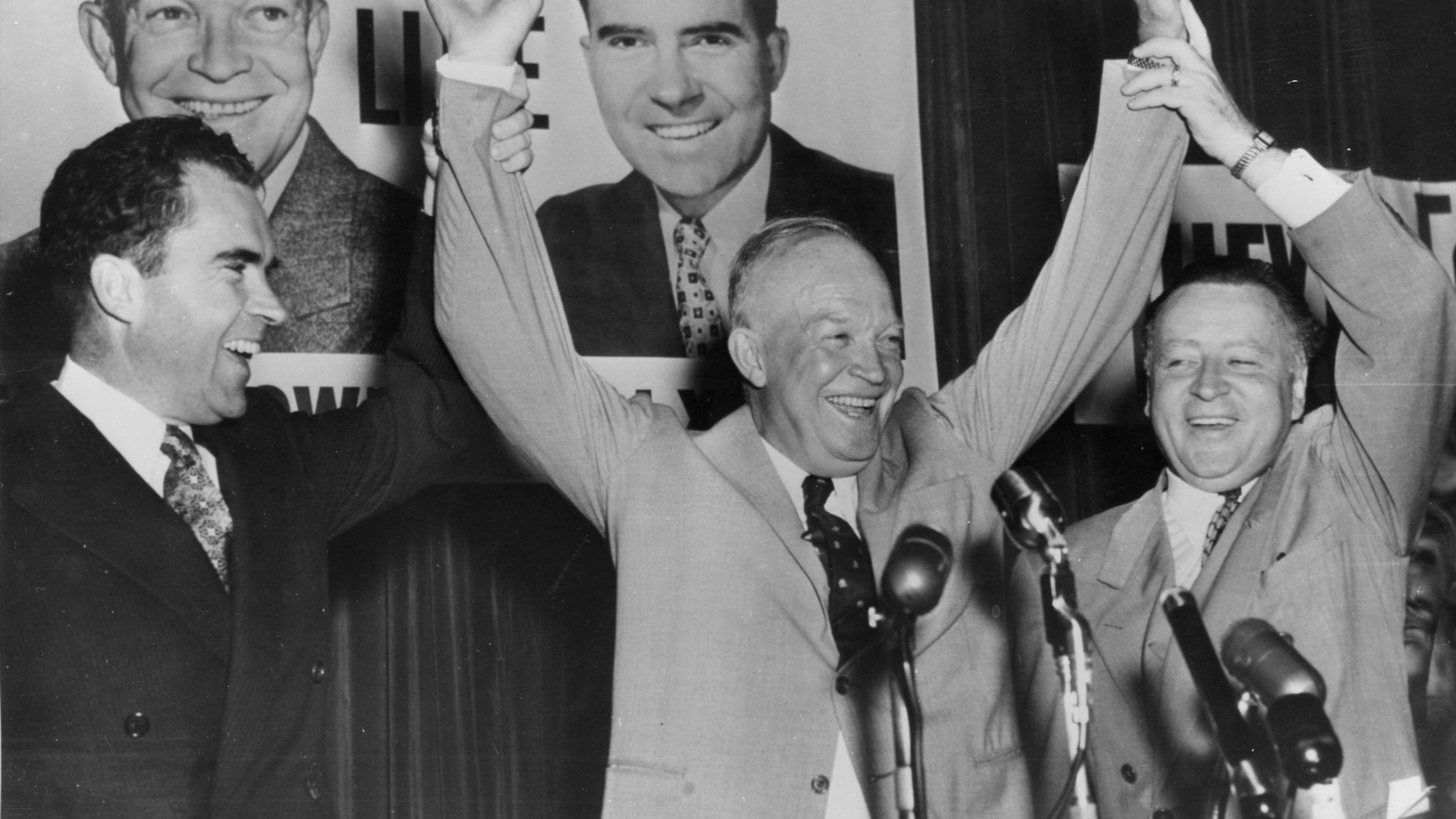
1952 Doomsday: Politics and Revelation
In June 1952, The Voice of Healing published Gordon Lindsay’s feature “The Coming Presidential Election and Prophecy,” claiming that a series of 666-day cycles drawn from Revelation 13 linked events from World War I through the New Deal to the upcoming U.S. presidential election, which it presented as a 1952
666, Armageddon, and the 1952 U.S. Election
In June 1952, The Voice of Healing devoted a major feature to the coming United States presidential election under the sensational headline "The Coming Presidential Election and Prophecy", with the subtitle: "Astounding Facts Revealed by the 666-Day Time Measure Reveal the Sinister Direction America is Heading."[1] The article, written by Gordon Lindsay, attempted to map the number 666 from Revelation 13 onto a carefully selected series of twentieth-century political events, culminating in the election scheduled for November 1952.
Lindsay's thesis was stated bluntly at the outset:
The number 666 startlingly identifies the direction that America has been drifting in recent years.
- Gordon Lindsay
Rather than treating 666 as an abstract symbol of evil or as a figure associated only with a future "antichrist," Voice of Healing presented it as a numerical key to interpreting the New Deal, the Second World War, the rise of international institutions like the League of Nations and NATO, and finally the present struggle against Communism. Contemporary American politics, and especially the presidential contest, were thus framed as milestones on a prophetic countdown to Armageddon.
This article will examine how The Voice of Healing bound current events to its numerological reading of Revelation, arguing that the 1952 election marked the close of a series of 666-day cycles stretching back to the First World War and signaling that "the time of the end" was near. By situating Lindsay's claims within the broader context of postwar American anxieties— about Communism, nuclear war, and expanding federal power— we can see how healing-revival leaders used apocalyptic rhetoric and number symbolism to promote a particular political and theological agenda, one that would echo throughout Cold War evangelical and charismatic culture.
The Voice of Healing in 1952: Publication, Network, and Audience
By mid-century The Voice of Healing had become one of the principal organs of the postwar healing revival, linking together a loose network of Pentecostal and charismatic evangelists through subscription lists, cooperative campaigns, and the exchange of sermons and testimonies. Edited by Gordon Lindsay and distributed nationally, the magazine functioned not only as a promotional vehicle for tent meetings and healing lines but also as an interpretive guide to world events for its largely holiness and Pentecostal readership. The June 1952 issue situates Lindsay's election article squarely within this prophetic role: the three-page feature is prominently credited "by Gordon Lindsay," signaling that the magazine's editor himself is speaking as interpreter of both Scripture and American politics.
The issue also demonstrates how prophecy and geopolitics were regularized within the periodical's format. On the facing page, an illustrated column titled "Prophecy Marches On!" appears under the byline of Chaplain Howard Rusthoi, who is introduced as a "renowned evangelist, Army Chaplain and Prophetic analyst" contributing this prophetic column "regularly in TVH."[2] Rusthoi's piece, with its headings such as "WORLDWIDE PERPLEXITIES," frames current Cold War crises in Europe and Asia as signs of the approaching end, providing a running commentary that complements Lindsay's numerological treatment of American history and the coming election.[3] Elsewhere on the same page, an advertisement for M. L. Davidson's book What Hope Has a Christian in an Atomic War? trades on nuclear anxiety, inviting readers who worry about "an atomic war" to seek biblical reassurance through Voice of Healing-approved literature.
Reading Revelation 13 in The Voice of Healing
Lindsay begins his exposition with a dogmatic reinterpretation of Revelation 13:18. "The number 666 is the number of man," he asserts, adding that although it has often been linked only to "the Antichrist and the false prophet," it is in fact "also the number of man and his ways, opposed to God and His ways." Under the bold heading "THE SINISTER SIGNIFICANCE OF THE NUMBER 666 IS REVEALED IN THE BOOK OF REVELATION," he quotes the verse in full: "Here is wisdom. Let him that hath understanding count the number of the beast; for it is the number of a man; and his number is Six hundred threescore and six." The move is subtle but crucial: by stressing "the number of a man," Lindsay broadens the symbol beyond a single apocalyptic figure to encompass an entire pattern of human rebellion, making 666 available as a code for modern political systems and historical processes.
From this expanded reading of 666 as "the number of man," Lindsay draws a sweeping diagnosis of the United States. "The number 666 startlingly identifies the direction that America has been drifting in recent years," he writes, insisting that the pattern is seen not in one isolated event but across a series of developments in government, economics, and international affairs. At the same time, he warns that this is not a partisan attack: "It must not be supposed that the number 666 is connected entirely with developments that have been taking place in one particular political party, but in fact is sinisterly involved in the whole stream of events of recent years." Here, prophetic numerology functions as a way to indict the entire modern order: both major parties, the expanding federal state, and emerging structures of world governance are all placed under suspicion as manifestations of "man and his ways."
This hermeneutic shift prepares the reader for the article's distinctive innovation: the use of 666 not merely as a symbolic number but as a unit of historical chronology. The subtitle promises "Astounding Facts Revealed by the 666-Day Time Measure," and the first page concludes with a chart headed "666 DAY CYCLES SHOW DRIFT OF EVENTS IN AMERICA," in which sequences of 666-day intervals are said to connect the Armistice of 1918, the onset of the Great Depression, and the rise of the New Deal. In Lindsay's hands, Revelation 13 becomes both a moral diagnosis of "man's ways" and a numerical key for decoding the timing of wars, economic crises, and elections--laying the groundwork for treating the 1952 presidential contest itself as the next great 666-marked turning point.