
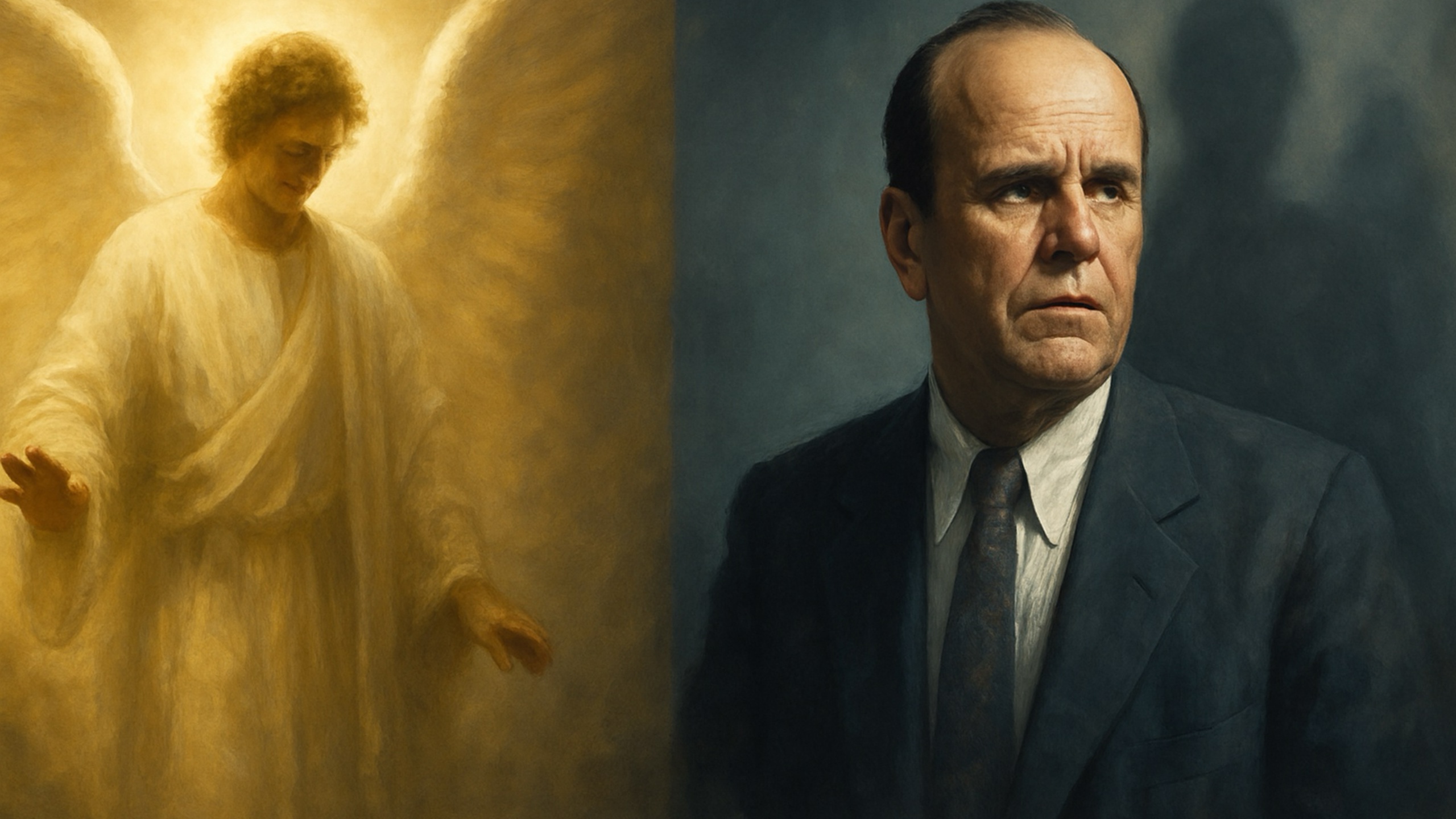
Angels, Mysticism, and Ministry: Reassessing William Branham’s Postwar Commission Narrative
William Branham’s post-1945 ministry increasingly relied on a supernatural “angel of the Lord” whose evolving identity, shifting chronology, and inconsistent role served to authenticate his healing revivals and prophetic authority. These developments stand in marked contrast to the biblical portrayal of angels as occasional messengers rather than ongoing spiritual partners, raising significant theological and historical questions about the legitimacy of Branham’s claims.
William Branham's post-1945 ministry centered around the claim that a supernatural "angel of the Lord" commissioned, empowered, and accompanied him throughout his healing revivals. Over the course of two decades, Branham's descriptions of this being varied significantly--sometimes a "minor angel," sometimes a divine messenger indistinguishable from the presence of God, and occasionally a personal guide who stood on the platform and assisted him in discerning illnesses. These shifting narratives raise substantive historical and theological questions: whether the being Branham described was real, whether it functioned in ways consistent with biblical angelology, and whether its role in Branham's ministry aligned more closely with occultic spirit-guide motifs, restorationist mythmaking, or theological constructs drawn from his own evolving system. Because Branham increasingly relied upon this "angel" as a legitimizing authority--at times even directing prayers to it--the phenomenon necessitates careful examination alongside the biblical portrayal of angelic beings and the scriptural warnings against angelic veneration.
The Role of Angels in the Biblical Narrative: Servants, Not Mediators
In the biblical canon, angelic beings (malʾākhîm in Hebrew; angeloi in Greek) function primarily as messengers and servants of God, not autonomous spiritual intermediaries. Their authority is consistently portrayed as derivative, never independent. Angels appear as divine agents who communicate revelation (e.g., Dan 8:15-19; Luke 1:11-20), protect God's people (Ps 91:11-12), execute judgment (2 Sam 24:15-17; Matt 13:41-42), and participate in the heavenly worship of God (Isa 6:1-7; Rev 5:11-12). Nowhere, however, do they serve as objects of prayer or devotion, nor do they function as personal spiritual patrons who accompany prophetic figures in an ongoing ministerial partnership.
A central feature of biblical angelology is the strict prohibition against venerating or invoking angels. When individuals attempt to worship angels, the angels themselves forbid it. In the Apocalypse, John twice attempts to prostrate himself before an angel and is sharply corrected: "You must not do that! I am a fellow servant with you... Worship God" (Rev 19:10; cf. Rev 22:8-9). These warnings reflect a broader biblical insistence that all worship and supplication must be directed to God alone (Exod 20:3-5; Deut 6:13-15). Even when angels mediate divine revelation--as in Daniel's visions (Dan 9:20-23; 10:10-21) or the annunciation to Mary (Luke 1:26-38)--the focus of faith remains upon God, not the messenger.
The New Testament further warns against angelic mediation becoming a source of doctrinal error. Paul cautions the church in Colossae against those who indulge in "the worship of angels" (Col 2:18), a phrase that likely refers to mystical practices or visionary ascent traditions in which angels were treated as spiritual guides or intermediaries. Paul's concern is that such practices "disqualify" believers by diverting attention from Christ, "the Head" (Col 2:19), undermining the sufficiency of Christ's mediatorial role (1 Tim 2:5). Similarly, Paul warns the Galatians not to accept any message--even one "from an angel from heaven"--if it deviates from the gospel already received (Gal 1:8). This places a canonical boundary around angelic revelation: no angelic encounter can authorize new doctrine, nor override previous divine revelation.
Even in apocalyptic literature, where angels play prominent roles, they do not form personal partnerships with prophets. Daniel is instructed by the angel Gabriel, yet Gabriel appears only at divinely appointed moments and never becomes an ongoing spiritual companion (Dan 9:21-23). Likewise, the angel who reveals visions to John on Patmos is not portrayed as his personal ministerial assistant; rather, the angel's authority ends with the completion of the revelation (Rev 1:1; 22:6). Taken together, the biblical materials present a coherent angelology: angels are servants, not spiritual patrons; messengers, not mediators of worship; and occasional emissaries, not permanent co-ministers to prophetic figures. Any movement toward prayer to angels, dependence upon angelic partnership, or elevation of angels within religious practice falls outside the boundaries set by Scripture and is consistently met with biblical correction.
The Post-1945 Transformation of Branham's Prophetic Stage Persona
After 1945, William Branham introduced an angelic being as a sidekick for his stage persona. Prior to his 1945 healing ministry, William Branham alleged that his "commission" came to him by vision. As early as 1947, however, Branham began claiming to have been visited by an angel in 1946, and claimed that this "angel" commissioned him to heal the sick. At times, he claimed to have had the assistance of an angel on the platform during his sermons and healing lines. In some versions of his persona, this "angel" was touted as a "minor angel", which would have been subservient to God. [1] In those versions, William Branham denied having prayed to the "angel". [2] In other versions, or while speaking to specific audiences, Branham did pray to his "angel".
William Branham Prays to an Angel
Angel of God, I do not see You. But I know that You are standing near. Please, Thou knowest my heart, and know how I love these people. Stand by me tonight [3]
Interestingly, later iterations of Branham's stage persona introduced an additional chronological modification to his angelic commission narrative, asserting that the "angel" appeared to him on the very day the modern nation of Israel was born. Although Israel formally declared statehood on May 14, 1948, and although Branham had already been circulating promotional materials in 1945 describing a thriving ministry of "divine healing," these revised accounts claimed that the angelic visitation occurred on May 6, 1947. This proposed date is noteworthy not only for its historical inaccuracy but also because it falls nearly one month after the earliest publicly available healing revival transcript — Faith is the Substance, delivered in Oakland, California, on April 12, 1947. The selective reconstruction of this timeline suggests that Branham increasingly sought to link his personal commission with broader eschatological milestones, thereby enhancing the symbolic weight of his angelic narrative within the developing mythology of his ministry.
And a strange thing of that, that you might not know, the very day the Angel of the Lord called me out, May the 6th, 1947, and issued the gift to pray for the sick, was the very same day that Israel become a nation for the first time for twenty-five hundred years. Oh, I believe there's something in it. I just can't keep from believing that we're near the end of time. That's right.
Branham, William. 1954, Jul 18. The Great Coming Revival And The Outpouring Of The Holy Spirit. 54-0718A
Some versions of Branham's stage persona further expanded his angelic framework by incorporating angelology into his dispensational schema. In these accounts, the "Church Age Messengers" of his adapted dispensational system were not historical human figures but angelic beings who presided over successive epochs of church history. Branham also taught that Jesus Christ was, in fact, the archangel Michael, a position closely resembling the Christological interpretation held by the Jehovah's Witnesses. He most likely derived this view from his engagement with The Emphatic Diaglott, whose translation and marginal notes were widely circulated among non-Trinitarian groups and may have shaped Branham's developing theology.
And at that time, Michael shall stand, the great prince." Michael was Christ, of course, Who fought the Angelic wars in Heaven, with the devil. Satan and Michael fought together, or fought against each other, rather. [4]
Branham's descriptions of the location where he allegedly received his "commission to heal the sick" also shifted over time, varying according to the theological or narrative needs of his evolving stage persona. In its most frequently repeated form--particularly among his later followers--Branham asserted that the "angel" first appeared to him in a cave,[5] a setting that imbued the account with ascetic and prophetic overtones reminiscent of biblical and monastic retreat narratives. Other versions, however, placed the encounter in far more domestic or ordinary surroundings. In some retellings, the visitation occurred in his room,[6] while in yet another strand of the story, the angel appeared to him in a cabin.[7] These inconsistencies in location underscore the fluidity of Branham's self-presentation and raise questions about the historical reliability of the experience as he described it.