
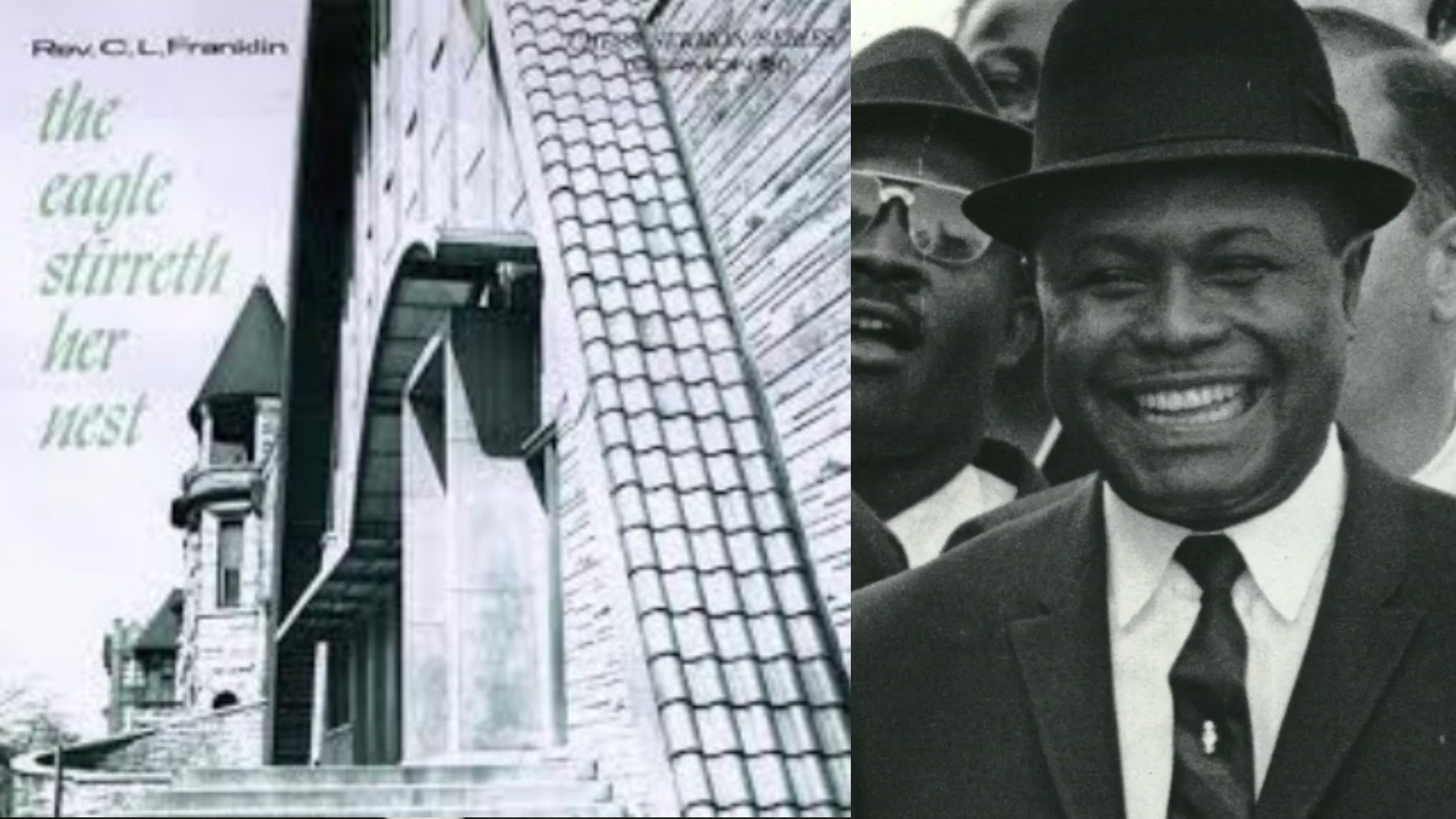
The Eagle Stirrith Her Nest”: C. L. Franklin, African American Prophetic Preaching, and William Branham’s Appropriation of a Tradition
C. L. Franklin’s celebrated sermon “The Eagle Stirrith Her Nest,” rooted in a long African American homiletical and civil-rights tradition, became a defining expression of communal resilience and theological depth. William Branham later appropriated the sermon without attribution, altering its meaning to reinforce his own authority and sectarian identity while misrepresenting its biblical and cultural foundations.
"The Eagle Stirrith Her Nest" was the title of a widely celebrated sermon recorded by Reverend C. L. Franklin in 1953. William Branham used the sermon's popularity to both boost his own public profile and to divert attention away from Franklin, notably never mentioning Franklin by name in any of his sermons.[1]In fact, William Branham called it "my little sermon."[2]He claimed that he had always had great respect for eagles, and the sermon was a result of his admiration of the bird.[3]According to Branham, "Jehovah" (God) was an eagle.[4]
Franklin had first preached the sermon in 1942,[5] though it was not his own. The earliest known version of the sermon was in 1846, delivered by Rev. Andrew Marshall to the First African Church in Savannah, Georgia.[6]That long lineage is significant: the sermon functioned as a touchstone within African American homiletical tradition, connecting generations of Black preachers who used the eagle metaphor to articulate themes of divine protection, maternal instruction, racial uplift, and perseverance amid oppression.
“The Eagle Stirrith Her Nest” is arguably the most demanding sermon in the African American Baptist tradition. To deliver it required a maturity of thought and faith, coupled with a superior musical delivery, so much so that most preachers who did attempt it waited until they were well advanced in their ministry. C. L. Franklin first delivered the sermon at age 26.[7]
For Franklin, who would soon become one of the most recorded preachers in American history, the sermon became both a signature performance and a theological statement. His version helped solidify his reputation as a master of the "whooping" tradition--an oratorical style blending chant, song, and exegesis. Scholars of Black preaching note that Franklin's soaring cadence, vocal dexterity, and rhetorical pacing made him a defining figure in mid-century African American religious life, influencing not only clergy but also gospel musicians and artists far beyond the church.
Franklin's sermon also occupied an important place within the broader political ethos of African American churches in the 1940s-1950s. Though Franklin was not a frontline civil-rights organizer, he consistently used his platform to advocate for racial justice, voter mobilization, and economic equality. His Detroit congregation became a center of political engagement, and the metaphor of the eagle--stirring, training, pushing its young toward maturity--resonated deeply with African American audiences navigating segregation, migration, and emerging civil-rights activism. The sermon's theological vision carried an implicit message of collective empowerment: God's guidance was not simply personal but communal, preparing a people to rise, resist, and transform their social world.
It is against this rich backdrop that William Branham's later appropriation must be understood. William Branham attempted to both limit Franklin's audience and grow his own by releasing a sermon with the same title and subject matter in July of 1957[8] -- four years after Franklin's popular sermon.[9]Branham called it "my little sermon," claiming it for his own.[10]It was one of the most fundamental sermons to Branham's cult of personality--Branham built upon that doctrine to say that his cult following are like eagles. Branham incorrectly claimed that eagles do not eat carrion[11] and that the Old Testament considered the bird to be holy. This, Branham said, was opposed to the buzzard, which was an unclean bird. Former cult members are often surprised when reading Leviticus 11:13, describing the eagle as an abomination to God because it is like the vulture and the buzzard.
Branham's theology was incorrect, however. Leviticus 11:13 includes the eagle in the list of birds that were an abomination under the Mosaic Law, immediately before the vulture and the buzzard.
And these you shall regard as an abomination among the birds; they shall not be eaten, they are an abomination: the eagle, the vulture, the buzzard[12]
Branham never mentioned Rev. Franklin when he made use of the popular sermon, though he preached variations of it to several different audiences from 1957 to 1961. Branham preached the sermon on:
- July 5, 1957, in Chicago, Illinois[13]
- July 14, 1957, in Jeffersonville, Indiana[14]
- March 16, 1958, in Harrisonburg, Virginia[15]
- Unknown month in 1958 in the New England Area[16]
- August 15, 1959, in Chautauqua, Ohio[17]
- April 3, 1960, in Tulsa, Oklahoma[18]
- August 4, 1960, in Yakima, Washington[19]
- January 22, 1961, in Beaumont, Texas[20]
Interpreting Branham's Use of Franklin's Sermon
From a scholarly standpoint, Branham's deployment of "The Eagle Stirrith Her Nest" reflects several intersecting dynamics:
1. Cultural Borrowing Without Attribution
Branham appropriated a sermon deeply rooted in the African American tradition without acknowledgment. This is especially significant given the sermon's theological, cultural, and political resonance within Black communities. His silence about Franklin--despite widespread popularity of Franklin's recordings--suggests deliberate distancing to avoid ceding influence to a Black preacher during a racially volatile period.
2. Transformation of a Civil-Rights-Inflected Metaphor
Where Franklin and earlier Black preachers used the eagle as a metaphor for divine care amid racial struggle, Branham reinterpreted the bird to confirm the supposed spiritual superiority of his followers. In the process, he stripped the metaphor of its communal and justice-oriented dimensions, repurposing it as a tool of sectarian identity formation.
3. The Construction of Religious Authority
Branham's insistence that the sermon was "my little sermon" functioned rhetorically to elevate his prophetic persona. By adopting and altering a historically weighty sermon, Branham fashioned a symbolic world in which "eagles" were elite, chosen, and set apart--imagery that reinforced obedience, exclusivity, and his own charismatic authority.
4. Theological Misrepresentation
Branham's mischaracterization of the eagle in Scripture illustrates his broader pattern of bending biblical interpretation to fit narrative and doctrinal aims. By inverting the eagle's biblical classification, he simultaneously embellished his metaphor and insulated his community from outside critique.
Conclusion
C. L. Franklin's "The Eagle Stirrith Her Nest" stands as a landmark of African American preaching--a sermon shaped by a century of Black homiletical tradition and resonant with the social aspirations of a people confronting Jim Crow, urban migration, and the early civil-rights era. Its theological richness, rhetorical complexity, and cultural power made it a defining work within the Black church.
William Branham's later appropriation of the sermon--without attribution, with altered theological claims, and with a sectarian reinterpretation--illustrates how influential Black religious ideas were often taken, transformed, and instrumentalized within white charismatic movements. Situating both preachers within their respective contexts highlights stark differences: Franklin's preaching nurtured communal uplift and spiritual resilience, while Branham's version reinforced insular identity formation and the mythmaking central to his movement.