
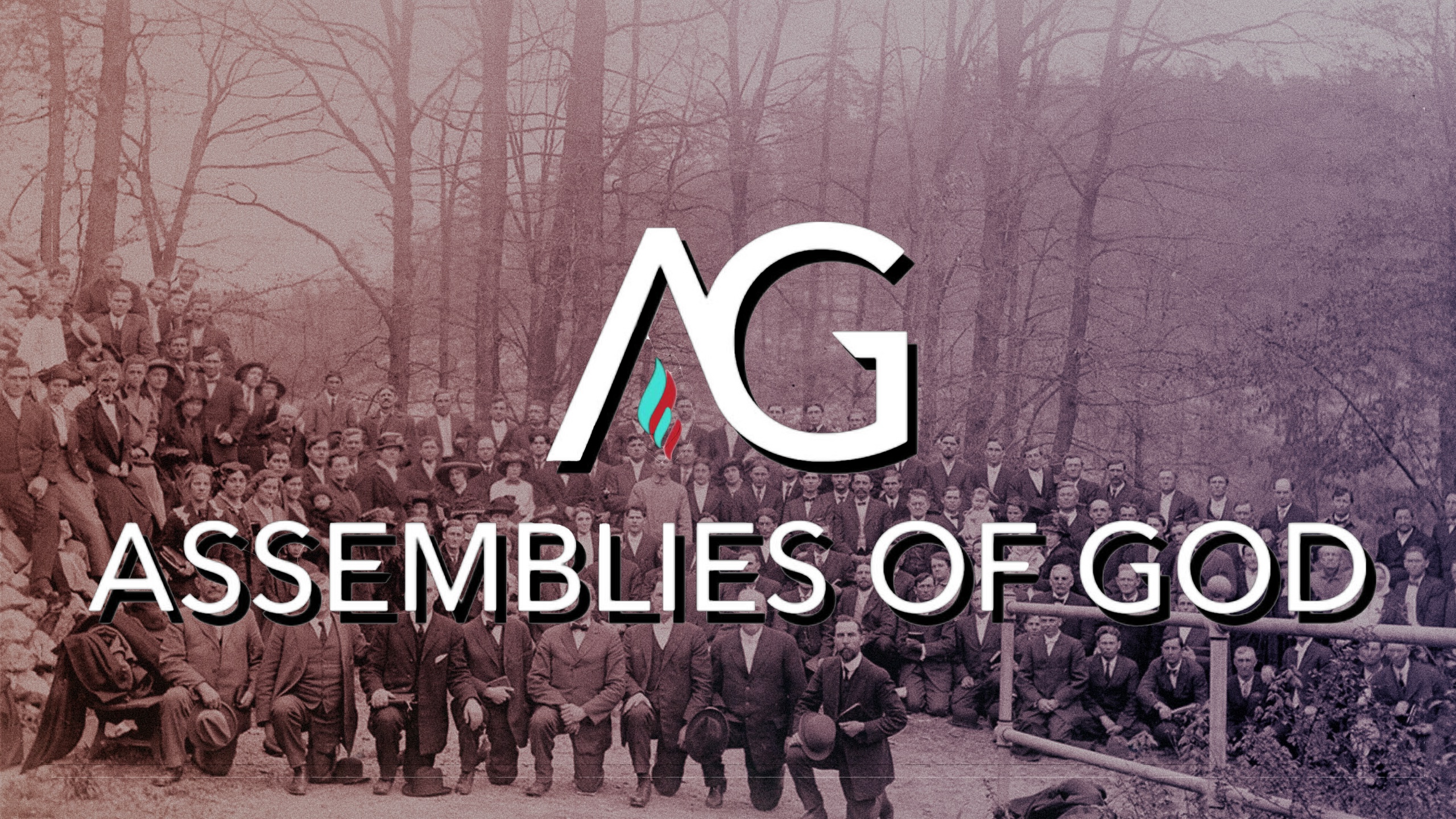
How the Assemblies of God Shaped Modern Charismatic Christianity
The Assemblies of God played a formative yet often paradoxical role in shaping global Pentecostalism, functioning both as a doctrinal stabilizer and as an unintentional conduit for revivalist streams that later fed into movements such as Latter Rain, the Charismatic Renewal, and the New Apostolic Reformation. Its attempts to regulate healing revivals, prophetic ministries, and restorationist currents never fully contained them, allowing these impulses to circulate through regional networks and influential leaders—ultimately contributing to the theological and organizational architecture of modern charismatic Christianity.
The Assemblies of God emerged in 1914 as one of several organizational responses to the rapid spread of early Pentecostalism. Formed by approximately three hundred ministers and laymen who separated from the black-founded Church of God in Christ, the new denomination sought to consolidate doctrinal unity and credentialing practices within a predominantly white leadership structure [1]. Although the founders emphasized spiritual renewal and evangelistic mission, racial exclusion shaped the earliest years of the organization. Requests for ordination and missionary appointment by black ministers such as Alexander Howard were rejected explicitly on the basis of race, leading to the eventual formation of the United Pentecostal Council of the Assemblies of God in 1920 [2]. These actions foreshadowed a long trajectory in which the denomination's growth, theology, and institutional development remained entangled with the social tensions surrounding segregation and the wider American landscape of racial inequality.
At the same time, the Assemblies of God arose during a period of intense revivalist energy in North America. The healing meetings, prophetic claims, and charismatic innovations emerging from figures like John Alexander Dowie and Charles Fox Parham formed part of the larger theological atmosphere from which the denomination drew its early membership. These revivalist currents introduced both vibrancy and instability, as unregulated teachings about healing, prophecy, and spiritual authority circulated widely. The denomination's founders attempted to balance this spiritual dynamism with organizational structure, yet the tensions inherent in early Pentecostalism--racial division, doctrinal disputes, and competing claims to supernatural authority--were embedded in the Assemblies of God from its inception.
Racial Dynamics and Early Segregation in the Assemblies of God
The Assemblies of God was founded during a period of deep racial tension in American Christianity, and despite its early connections to the interracial Azusa Street Revival, the denomination quickly developed into a predominantly white institution. Its formation involved approximately three hundred white ministers who chose to separate from the black-founded Church of God in Christ over disagreements regarding governance and ministerial credentials[3]. This separation produced a denomination in which racial segregation became embedded in both structure and practice, shaping the early identity of the Assemblies of God. Leaders within the movement increasingly sought to restrict the participation of black ministers and congregants, reinforcing a racial divide running contrary to the original interracial ethos of early Pentecostal revivals.
As debates over ministerial credentials and ecclesial order continued, key Assemblies of God leaders pushed for formal policies that excluded African Americans from positions of leadership. These efforts culminated in the approval of resolutions denying ordination to black ministers, effectively solidifying segregation in the institutional life of the denomination[4]. The consequences of these decisions soon became evident. In 1917, when Alexander Howard, a black Pentecostal minister from Chicago, requested appointment as a missionary to Liberia, his request was rejected solely because of his race[5]. This act of discrimination directly prompted the formation of the United Pentecostal Council of the Assemblies of God in 1920, a separate denomination created to support black Pentecostal ministers who had been marginalized by the Assemblies of God. For nearly a century, the UPCAG stood as a testament to the racial divisions rooted in the early decades of the movement. It was not until 2014 that the Assemblies of God formally reconciled with this body, inviting their congregations back into denominational fellowship and acknowledging the historical wrongs that had led to segregation[6].
British Israelism, Christian Identity, and Racial Ideologies Connected to AoG Figures
Several early Pentecostal and revivalist figures connected to the Assemblies of God were influenced by racialized theological systems such as British Israelism and, later, Christian Identity. These ideologies claimed that Anglo-Saxon peoples were the true descendants of the biblical tribes of Israel, elevating whiteness to a divinely chosen status. Though the Assemblies of God as an institution did not officially endorse these teachings, influential individuals operating around its perimeter helped transmit these ideas into Pentecostal and later charismatic movements. Figures such as Gerald B. Winrod, Clem Davies, and various Anglo-Israel lecturers worked within environments overlapping with Foursquare, Latter Rain, and the Voice of Healing networks, creating a diffusion pathway through which these doctrines interacted with Pentecostal revival culture[7]. Their teachings circulated in revival circuits that were also frequented by ministers connected to the Assemblies of God, underscoring the porous boundaries between institutional Pentecostalism and independent revivalism in this period.
Gordon Lindsay emerged as one of the most significant conduits of Anglo-Israelite ideas into the healing revival and proto-charismatic world. Born in John Alexander Dowie's Zion City and shaped by Parhamite Christianity, Lindsay embraced British Israelism early in his ministry and lectured for the Anglo-Saxon Christian Association, promoting apocalyptic readings of race and national destiny[8]. He also appeared at Anglo-Saxon Christian Movement conventions, where he fielded public questions and defended the doctrine[9]. Clem Davies, a fellow promoter of Anglo-Israel teaching and a recruiter for the Ku Klux Klan, spoke alongside Lindsay at these conferences, illustrating the ideological overlap between racialized theology and white supremacist organizing[10]. Through Lindsay's later work in the Voice of Healing, these views indirectly influenced prominent revivalists, including William Branham, whose own sermons blended British Israel themes with apocalyptic racial narratives. These connections reveal how fringe racial doctrines found entry points into segments of Pentecostal and post-Pentecostal movements, shaping the theological imagination of leaders whose ministries operated adjacent to the Assemblies of God.
Early Revivalism: Dowie, Parham, Lake, and the Roots of Pentecostal Extremism
The formative decades of American Pentecostalism were deeply shaped by revivalist leaders whose ministries blended apocalyptic expectation, authoritarian structures, and contested claims of supernatural power. John Alexander Dowie pioneered a model of charismatic leadership centered on divine healing and ecclesiastical control, establishing Zion City as the prototype for later Pentecostal experiments in community and authority. His staged healings and use of planted "witnesses" in services created an influential template for revivalist performance, one that attracted followers who later became major figures in the broader healing and Pentecostal movements[11]. Charles Fox Parham, emerging from similar revivalist currents, extended these patterns by promoting ecstatic manifestations and apocalyptic urgency. His followers, including those who later worked with John G. Lake, developed increasingly extreme practices as they anticipated the imminent End of Days.
John G. Lake's early career exemplified the entanglement of revivalism with both visionary claims and criminal controversy. Closely tied to Dowie in the 1890s and later aligned with Parham during the Zion schism, Lake participated in the tumultuous period marked by exorcisms, ecstatic rituals, and several deaths associated with Parham's followers[12]. As tensions escalated, armed groups formed inside Zion, and Lake fled the city amid public outrage. During this period he began promoting the visionary experiences that he claimed redirected his life toward missionary work in South Africa, presenting himself as a prophetic figure in the lineage of Dowie and Parham[13]. Such narratives lent spiritual authority to his ministry but obscured the controversies that followed him, including later arrests for fraud, impersonating an officer, and failure to report communicable diseases. These revivalist patterns--authoritarian leadership, miracle claims, apocalyptic urgency, and blurred moral boundaries--formed the cultural and theological soil from which later movements such as the Healing Revival, Latter Rain, and even extremist offshoots would emerge.
The Healing Revival and the Latter Rain Crisis
The post-World War II Healing Revival created a volatile environment in which charismatic personalities, disputed miracle claims, and emerging doctrinal innovations collided with the organizational structures of classical Pentecostalism. What began as a loosely connected surge of healing evangelists quickly expanded into a movement characterized by new prophetic claims, impartation rituals, and the assertion that God was restoring supernatural offices to the church. As these teachings spread, denominational leaders within the Assemblies of God became increasingly alarmed. By 1949 they concluded that the "New Order of the Latter Rain" promoted doctrines and practices that threatened the unity of the church, encouraged extremism, and undermined scriptural authority. Meeting in Seattle, the General Council formally condemned the movement, warning that its extra-biblical revelations, rejection of established church order, and elevation of self-appointed apostles and prophets were producing division throughout Pentecostal congregations[14]. This resolution marked one of the most consequential theological boundary lines in the history of the Assemblies of God.
The crisis was intensified by the influence of prominent healing evangelists who embraced or sympathized with Latter Rain teaching. Many ministers began identifying themselves with the revived "five-fold ministry," adopting prophetic titles and promoting the claim that mainstream Christianity had fallen into apostasy. As summarized by later analysts, Latter Rain doctrine taught that a purified elite--empowered by restored offices and supernatural gifts--would judge the apostate church, defeat evil, and ultimately transform the world before Christ's return[15]. Revivalist publications reinforced these ideas by presenting supernatural manifestations as evidence of a higher spiritual anointing and by framing dissent as resistance to God's end-time purposes[16]. The resulting atmosphere placed enormous pressure on local churches, including those affiliated with the Assemblies of God, to either embrace the revival or reject it outright. Even after the official condemnation, the movement continued spreading through independent networks and revival circuits, setting the stage for later developments in the Charismatic Renewal and, ultimately, the New Apostolic Reformation.
William Branham, the Voice of Healing, and Doctrinal Conflicts
William Branham's rise to prominence in the late 1940s positioned him at the center of the Healing Revival and made him one of the most influential figures shaping the direction of Pentecostal and post-Pentecostal renewal. Through his partnership with Gordon Lindsay, Branham became the face of The Voice of Healing publication, which amplified reports of miracles, visions, and prophetic revelations associated with his ministry. Yet the same platform that expanded his influence also exposed deep doctrinal fractures. By 1953, tensions erupted when Lindsay issued an ultimatum demanding that Branham correct or renounce teachings that were increasingly associated with white supremacist interpretations and Christian Identity-adjacent doctrines. When Branham resisted, a public dispute ensued between Lindsay's Voice of Healing and Joseph Mattsson-Boze's Herald of Faith, signaling a growing doctrinal crisis within the revival network[17].
These conflicts revealed fault lines that extended far beyond personality disputes. Lindsay himself had roots in racially charged theological movements--having been raised in Dowie's Zion City and later participating in British Israelite networks--which complicated his objections to Branham's trajectory. Nonetheless, the ultimatum exposed concerns among revival leaders regarding Branham's evolving prophetic claims, which increasingly centered on racialized end-times narratives and authoritative visions. Further strain emerged when Branham altered his origin story, shifting from the published account in *I Was Not Disobedient to the Heavenly Vision* to a new claim that an angel had commissioned him. Lindsay, who publicly explained Branham's ministry to Canadian newspapers in 1947, continued referencing the earlier vision narrative and appeared unwilling to support the later revisions[18]. These controversies ultimately weakened Branham's standing within segments of the healing revival, even as devoted followers embraced his expanding prophetic mythology. The doctrinal fractures that emerged during this period foreshadowed later divergences that would influence the Latter Rain, Charismatic Renewal, and the eventual development of New Apostolic networks.
Roy H. Wead, Indiana District Controversies, and Links to Branham's Movement
Roy H. Wead played a pivotal role in shaping the culture of the Indiana District of the Assemblies of God during the mid-twentieth century, cultivating an environment far more welcoming to healing evangelists and revivalists than other districts within the denomination. Serving first as youth and missions director and later as District Superintendent, Wead earned widespread recognition among pastors across Ohio and Indiana[19]. Under his leadership, the Indiana District experienced rapid growth, reportedly opening a new church every month for thirteen consecutive years and becoming one of the fastest-growing districts in the fellowship[20]. In 1952 he moved the district headquarters from Terre Haute to Indianapolis, further solidifying his administrative influence[21]. His openness toward healing ministries--many of which were banned elsewhere in the Assemblies of God--led national leaders to view Indiana as a "rogue district," unusually tolerant of movements later deemed problematic[22].
This posture positioned Wead at the center of denominational tensions when the Assemblies of God formally condemned the Latter Rain movement and the broader Voice of Healing network in 1949. While the General Council viewed these movements as divisive and unscriptural, Wead publicly defended them from the convention floor, aligning himself with ministers who embraced healing revivalism[23]. His involvement extended beyond administrative support. In 1949 he delivered the dedicatory address for the new Laurel Street Tabernacle in Indianapolis, a congregation that would soon become a hub for healing revivals and the early ministry of Jim Jones[24]. Figures associated with William Branham's revivals--such as F. F. Bosworth and Lester Sumrall--were active in the region, and Wead's district became a natural landing place for evangelists sympathetic to Branham's teachings[25]. By 1955, Wead openly affirmed Branham's "Message," proclaiming at a Voice of Healing convention that it was God's plan for all people to hear it and describing explosive growth in South American churches aligned with the movement[26]. These actions strengthened ties between Branham's network and sympathetic ministers within the Assemblies of God, contributing to the blurred boundaries that later allowed doctrines of the healing revival and Latter Rain to influence segments of Pentecostal and charismatic Christianity.
Laurel Street Tabernacle and the Recruitment of Jim Jones
The Laurel Street Tabernacle in Indianapolis emerged as a significant intersection point between mainstream Assemblies of God congregational life and the expanding influence of the Healing Revival and Latter Rain networks. Though the church began humbly in 1913 as a small Sunday School class led by the Rev. D. B. Rickard, it grew steadily, constructing its original tabernacle within two years and continuing to flourish under Rickard's leadership until 1922, when the Rev. John L. Price assumed pastoral oversight[27]. Price, an Indianapolis native and later a World War II veteran, was deeply embedded in Assemblies of God life, frequently speaking at district conventions and regional revivals[28][29][30]. By the early 1950s, his church had become well known throughout the Indiana district. The construction of a new 4,000-square-foot building--dedicated in 1950 with T. F. Zimmerman and District Superintendent Roy E. Wead officiating--positioned the congregation for greater involvement in the revivalist currents sweeping the region[31][32].
This environment proved fertile for the recruitment of Jim Jones. As the Healing Revival intensified and Latter Rain doctrines circulated through revival networks, Laurel Street Tabernacle increasingly hosted evangelists associated with Branham's movement, including Lester Sumrall and F. F. Bosworth[33][34][35]. Their influence created pathways for Jones--a Methodist minister already involved in Latter Rain circles--to become integrated into the local Pentecostal landscape. By 1954, Jones was ministering regularly at Laurel Street Tabernacle, and the congregation publicly announced its union with a "Mighty Move of God," listing Jones alongside Price in its advertisements[36]. His eagerness to embrace Latter Rain prophecy, miracle claims, and "five-fold ministry" language aligned him with the revivalist identity emerging within the church. When Price prepared to retire, Jones was even considered a potential successor, reflecting both his growing influence and the congregation's increasing openness to Latter Rain theology[37].
The relationship between Jones and Laurel Street Tabernacle quickly became complicated. The Assemblies of God, which had condemned the Latter Rain movement in 1949, viewed Jones's increasing prominence as a threat to doctrinal stability and congregational unity. By early 1955, Jones's preaching at the church was halted, leading to a fracture within the congregation[38]. Several members followed Jones into a new enterprise--Wings of Deliverance, later renamed Peoples Temple--while those who remained under Assemblies of God oversight aligned with the denominational leadership's effort to curb extremism. Laurel Street Tabernacle, once a staging ground for healing revivals and charismatic experimentation, thus became the birthplace of the Peoples Temple movement, demonstrating how revival networks and denominational tensions contributed to the emergence of one of the most infamous sects of the twentieth century.
Formation of Peoples Temple Through Latter Rain and Voice of Healing Networks
The emergence of Peoples Temple cannot be separated from the revivalist networks that shaped Jim Jones's early ministry. Before forming his own congregation, Jones was deeply embedded in the same Latter Rain and Voice of Healing environment that had influenced William Branham, Gordon Lindsay, and numerous independent evangelists throughout the 1940s and 1950s. His introduction to this world occurred through the Laurel Street Tabernacle, where exposure to healing revivals, prophetic language, and end-times expectation helped solidify his identity as a charismatic figure who operated outside the constraints of traditional denominational structure. The 1949 Assemblies of God condemnation of the Latter Rain movement inadvertently accelerated this trend: ministers sympathetic to Branham's teachings increasingly positioned themselves on the margins of Pentecostal institutions, creating informal networks in which Jones found both affirmation and opportunity[39].
Jones's recruitment into this environment was facilitated by the same mechanisms that had promoted Branham's healing ministry--revival advertising, testimonies of miracles, and the promise of a "restored" apostolic church. By 1954, Jones was publicly ministering alongside the Laurel Street Tabernacle congregation and identifying himself with a "Mighty Move of God," language directly borrowed from Latter Rain circles[40]. Under the influence of Roy E. Wead, Lester Sumrall, and other ministers who provided institutional cover for revivalist experimentation, Jones adopted the Latter Rain emphases on prophetic authority, impartation, and five-fold ministry leadership. These ideas later became core components of Peoples Temple theology, reframed in socialist and apocalyptic terms but still structurally indebted to the revivalist networks from which he emerged[41].
The formal creation of Peoples Temple began when Jones separated from Laurel Street Tabernacle following the Assemblies of God intervention that halted his preaching. His new congregation, originally called Wings of Deliverance, drew heavily from Latter Rain and Voice of Healing practices: miracle services, deliverance sessions, prophetic utterances, and claims of supernatural guidance. Advertisements and early Temple documents show continuity with healing-revival formats--promises of physical cures, emotional restoration, and demonstrations of divine power--which Jones used to attract a following across racial and denominational boundaries[42]. These revivalist practices helped him cultivate a sense of spiritual authority that positioned him as an intermediary between God and the congregation, a dynamic that laid the foundation for the authoritarian structure he later developed.
As Jones expanded his ministry, he further drew upon the revivalist itinerancy models popularized by Branham and Lindsay. He held mobile campaigns, blended humanitarian outreach with supernatural claims, and forged relationships with leaders in Indiana and Illinois who had previously circulated within Voice of Healing and Latter Rain circles[43]. Even after Peoples Temple's theology shifted toward radical socialist and apocalyptic themes, Jones continued to use the revivalist framework he inherited--visions, prophecies, signs, wonders, and claims of divine mandate--to consolidate control over his followers. The structure of Peoples Temple was therefore not an aberration but a direct evolution of the revivalist networks that nurtured Jones's early ministry, providing both the theological vocabulary and organizational blueprint for a movement that would ultimately become one of the most devastating sects in American religious history.
Gordon Lindsay, Anti-Semitic Networks, and Apocalyptic Teaching
Gordon Lindsay's ideological trajectory reveals how deeply early Pentecostal revivalism overlapped with racialized theology, British Israelism, and conspiracy-laden apocalyptic worldviews. Born in John Alexander Dowie's Zion City--an environment steeped in authoritarianism, British Israelite doctrine, and anti-establishment rhetoric--Lindsay inherited a theological framework that interpreted world events through the lens of Anglo-Israel identity and looming apocalyptic conflict. His parents' participation in Dowie's movement situated him within a lineage of sectarian thought that blended divine healing with claims of ethnic destiny and prophetic insight. After leaving Zion City due to financial collapse, the family migrated west, where Lindsay's formative spiritual experience occurred under Charles Fox Parham, a leader associated both with early Pentecostalism and with racialized end-times speculation. Lindsay soon came under the influence of John G. Lake, another figure connected to Dowie's legacy and to controversial revivalist practices, forging a ministerial identity rooted in healing, prophecy, and restorationist longing[44].
By the 1930s, Lindsay had become an evangelist within the Assemblies of God and later a minister in Aimee Semple McPherson's Foursquare Church, but his theological trajectory increasingly aligned with British Israelism. The political climate of the late 1930s and early 1940s further amplified this convergence. When McPherson temporarily appointed Gerald B. Winrod--a nationally known anti-Semitic propagandist and later a defendant in the Great Sedition Trial--to preach at Angelus Temple, Lindsay stood within a revivalist ecosystem that openly platformed British Israelite and nationalist voices. Lindsay's own activities soon reflected this alignment. By 1940, he was touring the United States and Canada as a lecturer for the Anglo-Saxon Christian Association, speaking on "America in Prophecy," and presenting numerological and racialized interpretations of Scripture that mirrored Winrod's themes. He addressed the Anglo-Saxon Christian Movement Convention, fielded doctrinal questions, and shared the platform with Clem Davies, a Christian Identity writer and Ku Klux Klan recruiter whose teachings blended biblical language with racial determinism[45].
These networks profoundly shaped Lindsay's apocalyptic imagination. His later writings--including articles in *The Voice of Healing* and books on biblical prophecy, flying saucers, and end-times signs--reflected a worldview in which supernatural intervention, national destiny, racial identity, and cosmic warfare all converged. Lindsay's eschatology influenced not only William Branham but also subsequent leaders shaped by Branham's ministry, including Jim Jones. By the mid-20th century, Lindsay had become a major conduit through which British Israelite logic and apocalyptic speculation entered the broader Healing Revival and, eventually, the independent charismatic movements that contributed to the rise of early New Apostolic structures. His career demonstrates how revivalism, racialized ideology, and sensational prophetic teaching formed a mutually reinforcing system that helped define the trajectory of mid-century Pentecostalism and many movements that emerged from it[46].
UFO Theology, Esoteric Doctrines, and Their Influence on Branham and Jones
The mid-twentieth-century Healing Revival did not simply elevate claims of supernatural healing--it also served as a conduit for esoteric doctrines that blended biblical prophecy, pseudoscience, numerology, and speculative cosmology. Within this ecosystem, figures such as Gordon Lindsay and William Branham popularized a theological imagination in which unseen dimensions, angelic beings, and extraterrestrial phenomena were interpreted as signs of the imminent end of the age. Lindsay wrote extensively about UFOs in *The Voice of Healing*, framing them as prophetic "signs in the heavens" that validated his Anglo-Israel apocalyptic worldview. His books and articles circulated widely among Pentecostal and independent charismatic networks, embedding UFO speculation into the developing mythos of the revival. This material directly shaped Branham's theology, reinforcing his belief that cosmic phenomena operated as divine signals and that human identity was tied to "light" originating in other dimensions[47].
Branham drew heavily from Lindsay's synthesis of biblical prophecy and astronomical symbolism, developing an elaborate metaphysical framework in which believers moved through successive dimensions after death and in which prophets appeared as "messengers of light" to each dispensation. He also adapted themes from British Israelism, numerology, and early twentieth-century occult-tinged Christian movements, framing them as revelations from an angelic commission. This cosmology later influenced his followers, including Jim Jones, who adopted UFO motifs while developing Peoples Temple's apocalyptic narrative. Jones' sermons and internal Temple discussions reveal that he incorporated extraterrestrial surveillance, cosmic judgment, and interdimensional travel into his worldview--drawing from Branham's teachings and the broader UFO-prophecy subculture that Lindsay helped mainstream within Pentecostalism[48].
The emergence of UFO theology within these circles represented more than curiosity about unidentified aerial phenomena; it provided a symbolic vocabulary that heightened the dramatic expectations of the revival. Cosmic imagery reinforced a sense of spiritual elitism, urgency, and destiny among healing evangelists and their followers. It also fused seamlessly with the Latter Rain movement's emphasis on restored apostles and prophets, producing an environment in which dramatic supernatural claims functioned as proof of divine authority. This convergence of esoteric teaching, apocalyptic expectation, and charismatic personality cults proved influential far beyond the 1940s and 1950s. It helped shape the doctrinal landscape inherited by later movements--including sectors of the Charismatic Renewal and early New Apostolic networks--and contributed to the sensationalist worldview that animated high-control groups like Branham's "Message" and Peoples Temple. In this way, UFO theology operated as both a theological novelty and a social mechanism, amplifying the extremism already present within these revivalist currents[49].
Historical Warnings, Denominational Responses, and Lessons for Preventing Extremism
Throughout the twentieth century, leaders within the Assemblies of God and related Pentecostal networks repeatedly confronted the rise of extremist doctrines, authoritarian ministry models, and racially charged ideologies circulating through the wider revivalist landscape. As early as the 1920s and 1930s, the denomination distanced itself from the excesses of Dowie's followers, Parhamite fanaticism, and the fraudulent healing claims associated with figures like John G. Lake. These early episodes demonstrated a recurring pattern: revival movements driven by spiritual enthusiasm, but vulnerable to manipulation by self-appointed prophets whose claims of special revelation placed them beyond accountability. By the mid-century Healing Revival, this concern resurfaced sharply as William Branham, Gordon Lindsay, and others blended healing claims with esoteric doctrines, British Israelism, and apocalyptic speculation. Assemblies of God leaders increasingly recognized the danger that such movements posed--not only theologically, but structurally--because they encouraged believers to submit uncritically to charismatic personalities claiming supernatural authority[50].
The crisis reached a turning point with the rise of the New Order of the Latter Rain. In 1949 the Assemblies of God issued a formal disciplinary resolution rejecting impartation rituals, restored-apostle teachings, prophetic dictation, and other Latter Rain practices. The General Council concluded that the movement's doctrines were divisive and lacked biblical foundation, warning that they threatened to fracture churches and elevate unqualified individuals into positions of unchecked authority. Although the resolution could not prevent figures such as Jim Jones or William Branham from continuing their ministries independently, it represented a clear attempt to draw boundaries against extremist theology and abusive leadership structures. These denominational warnings proved prescient: Jones' rise within the Pentecostal circuit, his early influence from Latter Rain networks, and his later descent into authoritarian control culminating in the Jonestown tragedy illustrated precisely the dangers the Council had sought to address. Historical evaluation of these events underscores an enduring lesson--churches must cultivate systems of accountability, theological clarity, and openness to scrutiny if they hope to prevent similar patterns of harm. When charismatic authority is allowed to operate without question, the risk of extremism, manipulation, and tragedy rises dramatically[51].