Azusa Street in Flames: Earthquake, Ecstasy, and the Birth of Pentecostal Chaos
In the aftermath of the 1906 San Francisco earthquake, the Azusa Street Revival in Los Angeles emerges as a racially charged, chaotic experiment in Holiness ecstasy that even contemporary newspapers depicted as fanatical, irreverent, and socially destabilizing. Drawing on reports from the Los Angeles Times, critics like Nettie Harwood, and Charles Fox Parham’s own disgust at interracial worship, the narrative traces how a confused mixture of Holiness practices, occult phenomena, and apocalyptic fervor produced “pilgrims” who carried this volatile spirituality into early Pentecostal denominations and later healing revivalists such as F. F. Bosworth.
The Azusa Street Revival (1906-1909) in Los Angeles is widely regarded as the catalytic event of modern Pentecostalism, transforming a small Holiness mission led by William J. Seymour into a global center for teaching "Spirit baptism," glossolalia, and divine healing. From this modest, interracial congregation, visitors carried Pentecostal doctrines and practices across North America and overseas, planting churches and founding denominations that would define twentieth-century Pentecostal identity. Later movements repeatedly drew on Azusa's legacy: the mid-century Latter Rain revival reworked its emphases on spiritual gifts, prophecy, and "restoration" language; the Charismatic Renewal imported Pentecostal experience into mainline Protestant and Roman Catholic contexts; and, more recently, New Apostolic Reformation leaders have appealed — explicitly or implicitly — to Azusa as proof that God is restoring apostolic authority, miracle ministries, and end-times "kingdom" advance. In this sense, Azusa Street stands not only as a historical event but as a continuing symbolic touchstone for successive waves of revivalism that trace their lineage to its theology, spirituality, and mythology.
On April 18, 1906, the San Andreas Fault violently shifted, setting the city of San Francisco ablaze. In the days that followed, religious alarmists throughout Los Angeles began claiming that judgment had struck the West Coast and that the wrath of God was about to consume the nation. As a result, Holiness groups far and wide began churning out tracts and pamphlets warning that the End of Days was near. By evening, news of William J. Seymour's new revival on Azusa Street had reached the newspapers. The Los Angeles Times ran a front-page article describing a "New Sect of Fanatics" that was "Breaking Loose" with a "Weird Babel of Tongues."
The Times coverage framed the mission as a racialized spectacle and a threat to social order:
Colored people and a sprinkling of whites compose the congregation, and night is made hideous in the neighborhood by the howlings of the worshipers, who spend hours swaying forth and back in a nerve-racking attitude of prayer and supplication. They claim to have “the gift of tongues,” and to be able to comprehend the babel. Such a startling claim has never yet been made by any company of fanatics, even in Los Angeles, the home of almost numberless creeds. Sacred tenets, reverently mentioned by the orthodox believer, are dealt with in a familiar, if not irreverent, manner by these latest religionists.”[1]
- Los Angeles Times, Wednesday April 18, 1906
In this account, the Los Angeles Times portrays the mission as a racially mixed religious disturbance marked by noise, disorder, and excess. Although the description is laced with the racial prejudice of its era, its emphasis on confusion, irreverence, and emotional frenzy parallels the concerns of many Holiness and evangelical critics who regarded the new “tongues” movement as religious fanaticism rather than a genuine work of the Holy Spirit.
A follow-up description in the same article continues to raise concern:
An old colored exhorter, blind in one eye, is the major-domo of the company. With his stony optic fixed on some luckless unbeliever, the old man yells his defiance and challenges an answer. Anathemas are heaped upon him who shall dare to gainsay the utterances of the preacher. Clasped in his big fist the colored brother holds a miniature Bible from which he reads at intervals one or two words – never more. After an hour spent in exhortation the brethren present are invited to join in a “meeting of prayer, song and testimony.” Then is that pandemonium breaks loose, and the bounds of reason are passed by those who are “filled with the spirit,” whatever that may be. “You-oo-oo gou-loo-loo,” shouts come under the bloo-oo-oo boo-loo,” shouts an old colored “mammy,” in a frenzy of religious zeal. Swinging her arms wildly about her she continues with the strangest harangue ever uttered. Few of her words are intelligible, and for the most part her testimony contains the most outrageous jumble of syllables, which are listened to with awe by the company.[2]
- Los Angeles Times, Wednesday April 18, 1906
The reporter's use of racial slurs and minstrel-style caricature collapses theological critique into overt racism. The worship service is described as "pandemonium" and the participants as having "passed" the bounds of reason, reinforcing the impression that Azusa Street represented not simply a new religious expression but a perceived breakdown of social and racial hierarchies.
Against the better wishes of J. M. Roberts and the Southern California Holiness Association, many local Holiness churches began to join Seymour's "revival." Each group, having its own practice of religious ecstasy that it claimed was "evidence of the Holy Ghost," began performing its distinct ritual. Soon, groups practicing the "holy jerks," "holy laughter," "holy dancing," "singing in the spirit," "speaking in tongues," and more filled Azusa Street. This proliferation of ecstatic practices illustrates how fluid and contested the category of "Spirit baptism" was within the Holiness milieu.
This widespread display of religious zeal began to attract non-Christian groups as well. Holiness converts, believing their specific form of ecstasy was "evidence of the Holy Ghost," suddenly found themselves standing next to spiritualists, mediums, and even the numerous occult societies of Los Angeles.[3] Before long, the Azusa Street Revival was home to occult séances and trances mixed with strangely similar "Christian" séances and trances. Having been taught that these experiences were "evidence of the Holy Ghost," Seymour was deeply confused. He wrote letters to Charles Fox Parham for advice, asking how to tell the occult ecstasy from the Christian ecstasy. While he waited for a response, hundreds of religious enthusiasts — Christian and occult alike — filled Azusa Street with noise and commotion twenty-four hours a day, seven days a week.
One visitor described the revival as pure chaos. Men and women were shouting, weeping, dancing, falling into trances, speaking and singing in tongues, all while "Elder" Seymour, the leader of the "revival," rarely preached. Most of the time, Seymour kept his head covered by a packing crate behind the pulpit, a posture that his supporters interpreted as humility and prayerful dependence on the Spirit. When he was seen walking through the crowds, five and ten-dollar bills were sticking out of his hip pockets, where passersby had crammed them full of money. When he did preach, he hurled insults and challenges at anyone who did not accept his views. To those who embraced his "message," Seymour would exclaim, "Be emphatic! Ask for salvation, entire sanctification, the baptism with the Holy Ghost, or divine healing!" This rhetoric reflects broader Holiness-Pentecostal emphases on a multi-stage spiritual experience and on visible manifestations as confirmation of divine favor.
When Charles Fox Parham, founder of the Pentecostal faith, finally arrived in Los Angeles in October 1906, after having been excommunicated from Zion City, he was shocked to find the interracial unity of the revival. He described the meetings, claiming the people were "all crowded together around the altar, and laying across one another like hogs, blacks and whites mingling; this should be enough to bring a blush of shame to devils, let alone angels, and yet all this was charged to the Holy Spirit."[4]
Parham's reaction reveals the tensions between his theological role as an architect of Pentecostal doctrine and his adherence to the racial segregation norms of his time. For Parham, interracial physical proximity itself became evidence that the meetings could not be of God.
This is confirmed by Nettie Harwood, a critic of the Azusa Street Revival and disciple of Alma White. After visiting the mission in late 1906, she reported that there was much kissing between the sexes and even between races. She was appalled at seeing an African American woman with her arms around a white man's neck, praying for him. Having been taught White's doctrine on the purity of races, she considered Seymour an "instrument of Satan." Harwood's report further underscores how opponents of Azusa Street fused theological objections with white supremacist ideology, treating interracial prayer as a moral and spiritual scandal.
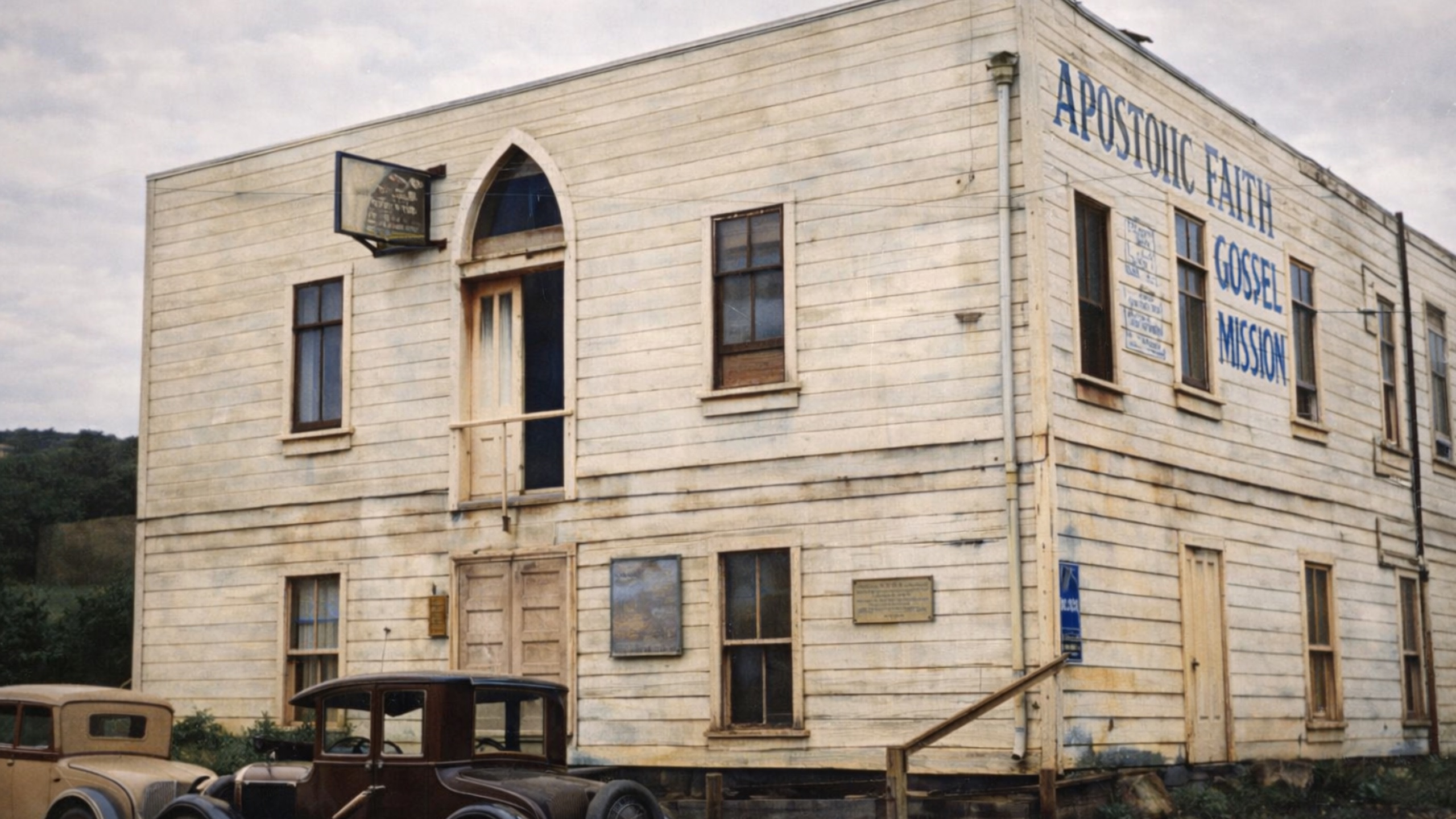
Though Seymour claimed Parham was his "Father in the Gospel of the Kingdom," Seymour's converts saw Parham's objections as threats. Some of them told Seymour that Parham "was not wanted in that place." Their anger increased even more after his harsh statements against the hypnotists and spiritualists who had taken over portions of the services. Eventually, Seymour himself banned Parham from the revival meetings, which had, ironically, been named the "Apostolic Faith Gospel Mission" after Parham's own organization. For spite, Parham opened competing meetings at a local W.C.T.U. building on the corner of Broadway and Temple Streets, less than a mile away. He was unable to compete with the circus at Azusa Street, however, and eventually retreated to Houston.
What had begun as an attempt by Charles Fox Parham to recreate a new sect modeled in part on the militaristic communal experiments of Reverend Frank Sandford and John Alexander Dowie's colonies became a loose cannon that blasted Holiness sects and organizations throughout the country. Most of the people in the Holiness faith who visited the Azusa Street Revival returned to their cities convinced they had the "gift" and the ability to impart it to others. Many who attended, even for a short time, later founded entire Pentecostal denominations. Over time, a list of "pilgrims to Los Angeles" effectively became a "who's who" of early Pentecostal leadership. One of those attending the Azusa Street Revival was F. F. Bosworth, who later rose to fame as a "faith healer" and worked closely with William Branham.