
Billie Branham Pentecostal Tabernacle: Myth of a 1933 Baptist Beginning
Deeds, advertisements, and location-based evidence place William Branham’s first organized congregation in 1936 rather than 1933, aligning the movement of meeting sites with a verifiable historical timeline. This chronology also situates Branham’s early ministry within Roy E. Davis’ sectarian Pentecostal network and highlights how later autobiographical claims reshaped these origins to support retrospective narratives such as the “1933 Prophecies.”
William Branham's repeated claim that he was a Baptist minister—rather than a Pentecostal—until after 1937 is historically significant because it undermines his credibility. The documentation uncovered places figures such as Pentecostal leader Rev. Frank Curts within the orbit of Branham's early Pentecostal congregation, and situates Branham within a concrete network of Pentecostal leaders, venues, and sectarian identities at precisely the period his later "life story" sought to sanitize or recast. Every detail of his so-called Life Story accounts relies upon his Baptist conversion, ultimately placing all of his supernatural claims into question.
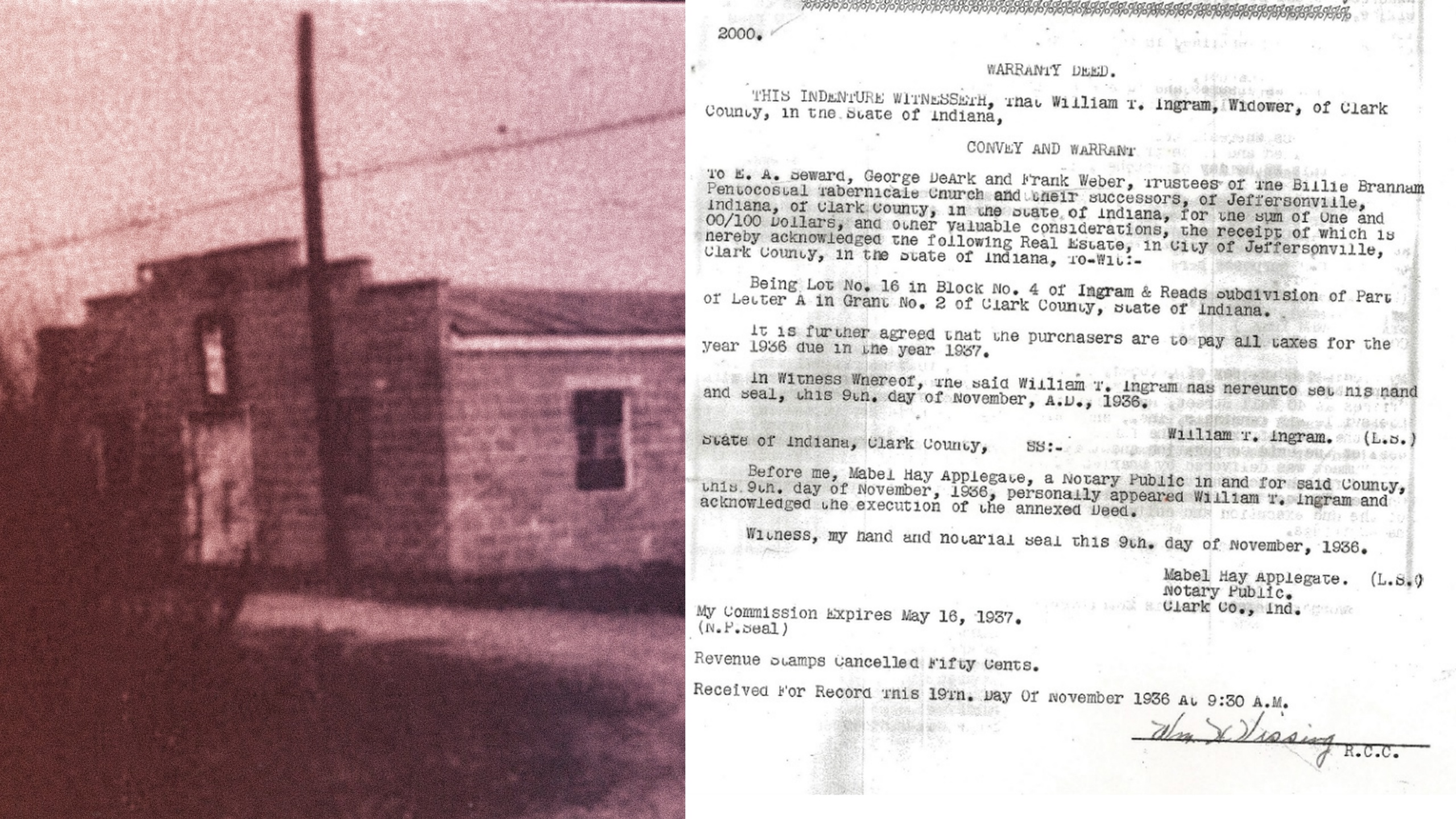
Branham's first church, the "Billie Branham Pentecostal Tabernacle," was officially organized on November 9, 1936, as a Pentecostal church on the corner of 8th and Penn Streets in Jeffersonville, Indiana.[1] In the mid-1930s—while still affiliated with Roy E. Davis' Pentecostal Church of God milieu—William Branham, following the 1934 burning of the church, held services in the home of Charley Kerns and later in a temporary "Pentecostal Tabernacle" on 8th and Pratt Streets, the lot behind the current Branham Tabernacle. Branham preached from the Pratt Street location as late as August of 1934,[2] the same location as his 1933 tent meetings.[3] Branham also held services in 1935 at an arbor owned by Dan Davis[4] on Eighth and Graham Street.[5] Mrs. Charley Kerns opened her house to meetings organized by Davis' Pentecostal sect.[6]
Although Branham's later stage personas included a "life story" presenting him as a Baptist minister who resisted Pentecostalism until the 1937 Flood of the Ohio River, he was ordained as a Pentecostal minister by Rev. Roy E. Davis, pastor of the Pentecostal Baptist Church in Louisville, KY, and later in Jeffersonville, IN. According to Davis, in a letter to Branham's promotional publication Voice of Healing, Davis was the one who ordained Branham into the Pentecostal Assembly and witnessed Branham's first prayers for the sick. William Branham, Hope Branham (Brumbach), George DeArk, and other leaders associated with Branham's later congregation also served as elders within Davis' church. Davis held leadership roles in white supremacist organizations and served as a spokesperson for the 1915 Ku Klux Klan.
Roy E. Davis relocated the Pentecostal Baptist Church to Jeffersonville, IN, following a series of criminal and legal charges in Louisville, KY. Davis had been serving in Ralph Rader's church until Davis' criminal history became public. Afterward, several members of Rader's church left to join Davis and Branham in the Jeffersonville work. Davis' legal difficulties continued until he was extradited to Kentucky for swindling church members and later extradited to Little Rock, AR, on charges of grand theft. After his departure, George DeArk and others formed what would later become the Branham Tabernacle. In 1935, Sante Davidson was advertised as the "revival song leader" at William Branham's "Billy Branham Pentecostal Tabernacle." The location listed in that advertisement described the church as the "Eighth and Graham street tabernacle," rather than the "Eighth and Penn street tabernacle" that exists today. Considered alongside the 1936 deed to the property at 8th and Penn Streets and the advertisements for Roy E. Davis' Pentecostal church, this evidence indicates that Branham did not begin the "Branham Tabernacle" in 1933, as later versions of his stage persona claimed. On this chronology, the alleged "1933 Prophecies" also could not have been buried in the cornerstone of the 1936 church, because Branham's own accounts of a "supernatural experience" align more closely with the 1936 historical timeline than with the retrospective timeline used for his stage persona.
Roy E. Davis—an official spokesperson for the Ku Klux Klan and other white supremacist organizations, and an eventual Imperial Wizard of the Ku Klux Klan—did not simply plant a church in Jeffersonville, Indiana. William Branham did not simply assume leadership of an existing congregation when he took over Davis' congregation[7] to form the Billie Branham Pentecostal Tabernacle. Roy E. Davis had established a Pentecostal cult.
The "Pentecostal Baptist Church," however, did not refer to a building; it referred to a distinct sectarian identity within Pentecostalism. Roy E. Davis was the "overseer" of the National Headquarters of the Pentecostal Baptist Church in Jeffersonville, Indiana.[8] Alongside his role as overseer, Davis was the editor of the Pentecostal Baptist Witness.[9] When William Branham toured with Davis, winning converts by allegedly drinking poison,[10] they were recruiting for this new sect.
After Davis was extradited to Arkansas on charges of grand theft, leadership of the sect transitioned to William Branham. In 1936, land was purchased for the Billie Branham Pentecostal Tabernacle. Branham's church continued to be advertised as the "Pentecostal Tabernacle" until 1945, when a later iteration of Branham's stage persona asserted that he had been a Baptist minister who avoided Pentecostalism until after 1937.