
Bosworth Brothers Campaigns: The Business of Revival
F. F. and B. B. Bosworth helped transform early twentieth-century revivalism into a polished, large-scale public program that blended music, disciplined preaching, and highly publicized healing services, often buoyed by unusually favorable newspaper coverage. Their campaigns grew from multi-day Alliance meetings into "mammoth tent" spectacles and month-long series, but the movement’s credibility faced sharper scrutiny when widely reported healings—especially the James Buck episode in Altoona—raised questions about claims, reporting, and accountability.
Much as William Joseph Seymour’s Azusa Street Revival reshaped Holiness movements across the United States, Fred Francis Bosworth and his brother, Burton Byrdia Bosworth, helped shift doctrinal commitments in many mainstream churches. Already known for his leadership in the Zion City Band, F. F. Bosworth was widely recognized for his musical ability in revival work. When B. B. Bosworth joined him, their combined ministry became a major public draw, filling large venues for extended meetings. F. F. Bosworth typically handled the preaching and promoted divine healing as a central theme, attracting people seeking relief from illness and affliction. Others attended for the overall program, which blended sermon and music. F. F. Bosworth played clarinet, while B. B. Bosworth served as musical director, soloist, and trombonist.
By 1920, the brothers were touring nationally with music-and-healing campaigns under the auspices of the Christian and Missionary Alliance, holding multi-day meetings in Louisville, Kentucky, and concluding with appearances at Carnegie Hall. During the Carnegie Hall portion of the week, they drew large crowds, then preached in surrounding local churches for the remainder. Their arrival in a city often generated significant anticipation, with meetings continuing for weeks before moving on. As attendance grew, the scale of the events expanded beyond the modest expectations typically associated with a “revival.” By 1921, they were conducting month-long series—six days a week—in which audiences also heard large musical presentations, including a chorus numbering in the hundreds.
When the Bosworth Brothers’ campaign returned to Chicago, the meetings took on the character of a large-scale public spectacle rather than a small Pentecostal-Holiness gathering. The Chicago Tribune advertised a “mammoth tent,” with three services a day (except Saturdays). Large restaurant and refreshment stands were available for attendees, and smaller tents were set up to provide sleeping accommodations. Rentals and sales were promoted at “low prices.” Advertisements for F. F. Bosworth and the “mammoth tent” ran from June through the end of August. On the final night, notices indicated that Bosworth would present his life story. While the campaign featured many speakers, observers reported that crowds were especially drawn to Bosworth’s testimony. To ensure audibility, amplifiers were installed so his voice would carry throughout the tent. Contemporary witnesses described the scene as follows:
The tent is a monster, 120 feet wide and 270 feet long, and the Magnavox Amplifier has been installed, thus making it convenient that everyone crowded into the tent or on the outside may hear the faintest utterance. Evangelist Bosworth can be heard distinctly in every quarter.[1]
- Bosworth Brothers Campaign Advertisement
Observers noted that the Bosworth meetings differed from other revival services in the structure of the appeals. An invitation was extended first to those who “wish to be saved,” then separately to those who “wish to receive the Holy Spirit,” and finally to “any who wish to be cured of whatever their afflictions may be.” In presentation, F. F. Bosworth drew on elements associated with John Alexander Dowie’s campaigns, while adopting a more polished and restrained demeanor than Dowie’s combative style. The meetings also incorporated popular features reminiscent of Charles Fox Parham’s work, while avoiding Parham’s emphasis on glossolalia. As an early visitor to Azusa Street, Bosworth could also invoke the prestige and mystique of an “original” Pentecostal connection.
Journalistic coverage frequently echoed the campaigns’ claims more sympathetically than earlier reporting on “faith healers” prior to Azusa Street. In many cities, newspapers printed promotional descriptions and meeting summaries with limited skeptical inquiry—contrasting sharply with the more adversarial press treatment Dowie faced. The Pittsburgh Daily Post, for example, reported on Bosworth meetings in the region with extensive detail, often presenting the narrative in a manner that closely tracked Bosworth’s own framing of events—from sermon topics and altar calls to accounts of those seeking healing. Without sustained investigative follow-up, readers encountered an overwhelmingly favorable portrayal of the campaigns regardless of the verifiability of particular healing claims. Supporters attributed this reception to the brothers’ public demeanor: rather than presenting themselves as personal “healers,” they emphasized prayer and divine agency, distancing themselves from overt claims of supernatural power. Contemporary observers described Bosworth’s manner in these terms:
Evangelist Bosworth is not an alarmist. He is cool, collected, and conservative. Never boisterous, never slangy, never appeals to the emotions; there is no whoop-it-up-stuff. Modest, unassuming, patient, quiet, with no excitement. … A remarkably gifted and well-seasoned champion of a truly ‘old fashioned’ religion which he is preaching to thousands daily.[2]
- Bosworth Brothers Campaign Advertisement
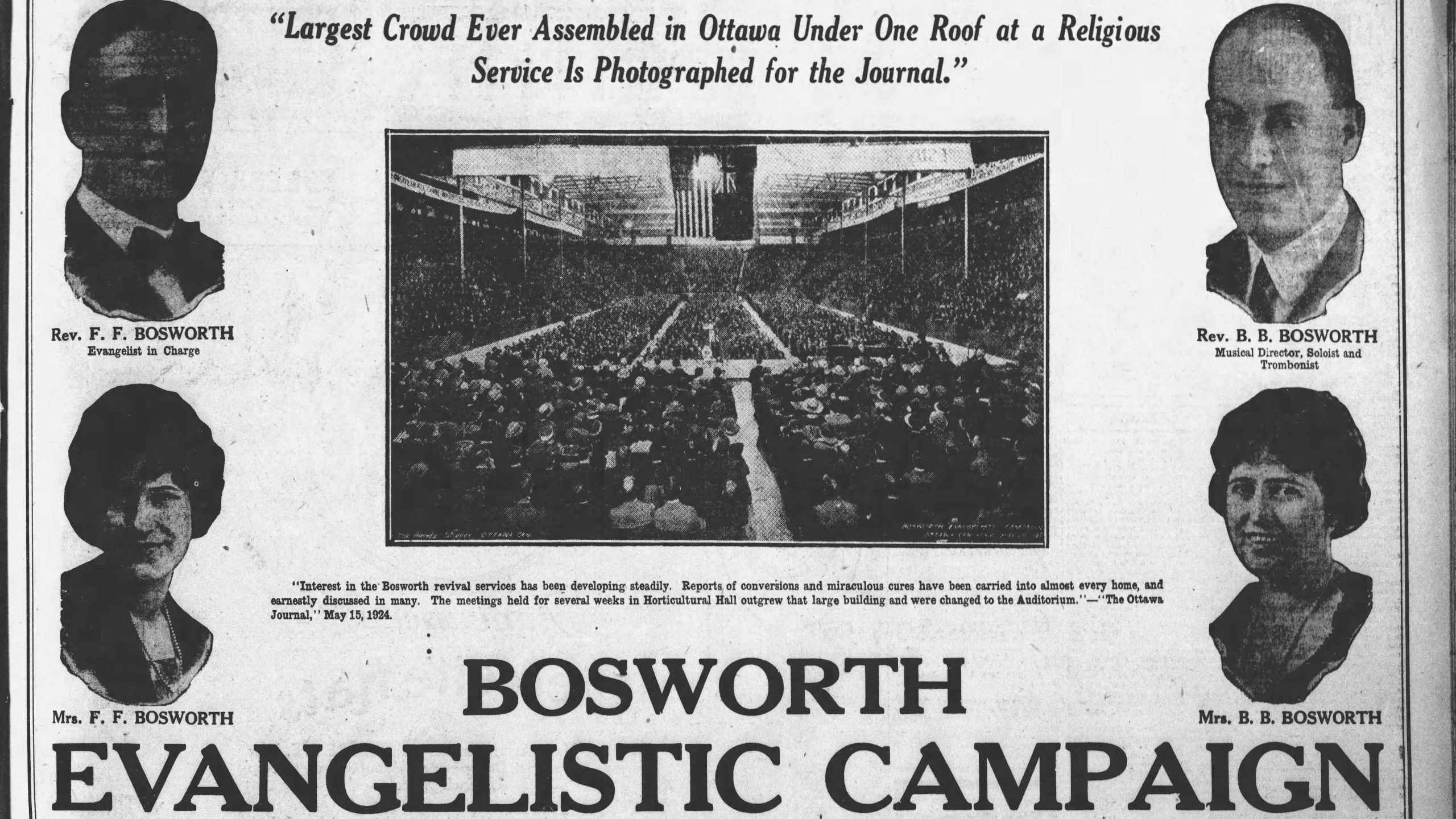
By 1924, press praise for the Bosworth meetings was so extensive that excerpts from major newspapers were incorporated into campaign advertisements. In a September meeting in Binghamton, New York, the brothers placed a full-page advertisement that devoted significant space to testimonies and statements from Ottawa (Canada), Pittsburgh (Pennsylvania), Toronto (Ontario), Chicago (Illinois), Toledo (Ohio), Brooklyn (New York), Detroit (Michigan), and St. Paul and Minneapolis (Minnesota). The Pittsburgh press was quoted as saying:
Never in the history of this gigantic center of the world’s industry has there been such a spiritual awakening. The results of the campaign seem to be sweeping everything before it. From all sections they come, and each attempt to get a larger hall to provide for those unable to gain admission to previous meetings finds only the larger auditorium crowded as soon as the meeting-place had been thrown open to the public. … Several hundred seekers after God crowded the platform daily. … Nothing like it has ever before been witnessed in Pittsburgh. … Patients seek bodily healing at the request of their physicians. … All classes of diseases have been healed in answer to the ‘prayer of faith.’[3]
- Miami Herald
The New York American used the word “cured” to describe those who attended Bosworth meetings seeking healing. Where more cautious reporting might have qualified such claims (for example, by using “alleged cures” or documenting follow-up interviews), the New York American reported “cured” as though established fact:
Hundreds cured of bodily ills and hundreds more called back into the fold of the church, are some of the things that have now become commonplace in the Bosworth Evangelist Tent on Bedford Avenue and Eastern Parkway. … Since the days of Moody and Sankey and Alexander and Torrey, no revivalist of the caliber of the Bosworths have held public meetings in New York. During this revival as many as 1500 persons responded to the invitation of the Evangelist in a single service[4]
– New York American
With comparatively little negative press, the Bosworth Brothers’ popularity exceeded that of Dowie in several regions. After a series of meetings in Ottawa, Canada, reportedly drawing crowds of 5,000, accounts described F. F. and B. B. Bosworth being lifted onto the shoulders of supporters and carried through the streets. Attendees reportedly formed a parade of more than 3,000 people, waving Canadian and American flags while singing hymns through the city.
Given the favorable coverage, questions remain about whether F. F. Bosworth would have felt compelled to employ “Elijah prophet” language to distinguish himself from critics and competitors. Earlier, Bosworth had embraced John Alexander Dowie’s claim to Elijah-like identity, a belief he reportedly held until 1906. After Azusa Street, he came under the influence of Charles Fox Parham, another figure framed by some adherents in Elijah terms. In that environment, claims of possessing a “double portion” of an “Elijah spirit” would have been plausible—especially as Bosworth’s influence came to surpass that of former mentors. Yet prior disillusionment with Dowie may have encouraged greater caution toward similar claims. Publicly, Bosworth appears to have positioned himself as anticipating an “Elijah” figure rather than adopting the role personally, even while maintaining theological commitments associated with Malachi 4 and related Holiness-Pentecostal interpretations.
Rather than attempting to reproduce earlier revival models, the Bosworth Brothers refined an approach centered on healing services and large-scale programming. They distinguished themselves from audiences’ expectations of prior revivalists in both style and presentation. Contemporary descriptions emphasized their polish, dress, and rhetorical skill. The Altoona Tribune characterized them in commercial terms:
Bosworth brothers strike you as being typical American business men, rather than preachers. They wear well-tailored clothes, and wear them well, and move about with a direction of purpose that is impressive.[5]
From 1907 to 1927, the popularity of the Bosworth Brothers—especially F. F. Bosworth—continued to increase. By the late 1920s, F. F. Bosworth was arguably more prominent and influential than many earlier healing revival figures. With sustained positive press, public opinion largely remained in his favor in a way that earlier leaders seldom achieved. He cultivated a following that appeared durable. Yet a single incident at a meeting in Altoona, Pennsylvania, soon placed the campaigns under intense scrutiny.
As was increasingly common, newspapers published enthusiastic accounts of “miraculous” events during Bosworth meetings with limited critical balance. One widely reported incident involved James Buck, who had been physically disabled for months before attending a Bosworth meeting. Although his physician reportedly warned him against exertion or excitement, Buck was determined to seek healing. Accounts state that he was carried to the platform, where he was said to have been “instantly healed” by F. F. Bosworth. After leaving the meeting, he later died from the condition that had brought him to the service. The Altoona Mirror reported the episode as follows:
James Buck, aged 40, of Duncansville, an invalid for the past seven months, and bedfast a great part of the time, being unable to walk, was carried to the platform by W. M. Fowkes of Duncansville, assisted by an usher. After appointment by Rev. F. F. Bosworth the man was assisted to rise from his chair and he walked unsupported for four or five steps and return as the big audience shouted, ‘praise God.’ The building was in an uproar of praises as the man, accompanied by Mrs. Buck and Mr. and Mrs. Fowkes walked slowly down the steps to the auditorium. Mr. Buck suffered a complication of diseases and has been unable to work for some time.[6]
-- Altoona Mirror.
The Altoona Tribune likewise published an account, describing the episode as a “cure”:
Probably the most outstanding cure claimed by the scores gathered on the platform last night was that of James Buck, of Duncansville, who was carried from an automobile to the altar by two men. He said that he had been suffering from complication of ailments more than four years, having been bedfast most of that time. He has been unable to take more than a few steps for years, he said, but after being anointed by F. F. Bosworth he walked across the platform and declared that he was vastly improved.[7]
-- Altoona Tribune.
After Buck’s death, competing newspapers published corrections and criticisms, each emphasizing the other’s reporting failures. The Altoona Tribune highlighted that Buck had reportedly been warned by a physician and noted that the Altoona Mirror had described him as “greatly improved.” The Tribune later issued its own apology for using the word “cured,” though readers reportedly had to search deeper in the paper to find it. Headlines drew attention to Bosworth’s refusal to comment directly on Buck’s death. In subsequent reporting, the Tribune referred to the “supposed healing of James N. Buck” and stated that Bosworth declined to address the case, instead citing other “instances of cures.” When pressed, Bosworth reportedly suggested that a person “may have been cured of one thing and die of another.”
Bosworth also described another purported healing that appeared to have failed. He stated that an elderly man was brought to the platform and healed of deafness, but later returned home still unable to hear. According to Bosworth, the man had been warned by the “Spirit” not to use tobacco, and Bosworth attributed the continued deafness to the man’s failure to comply.