
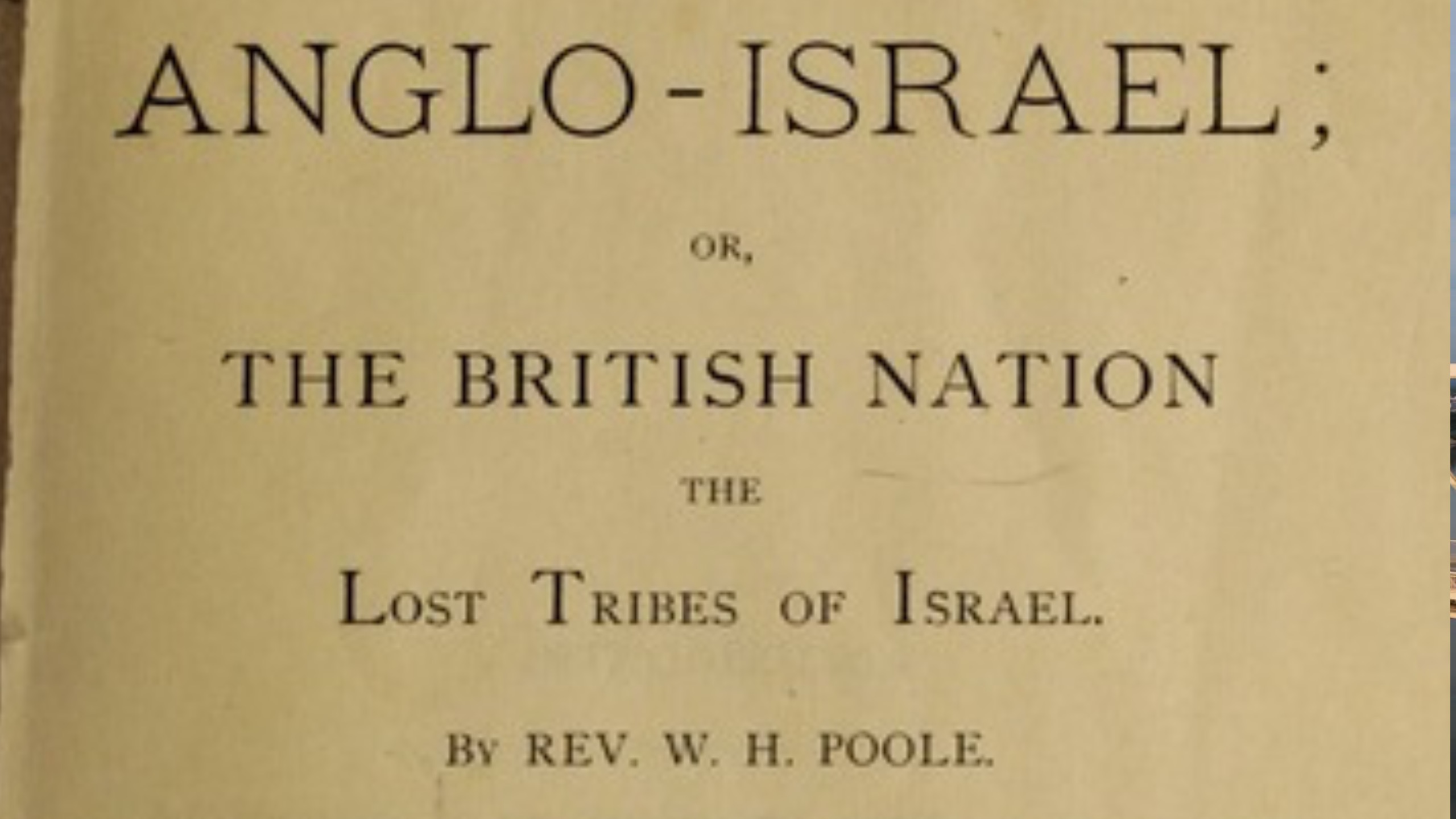
British Israelism and Its Hidden Influence on Early Pentecostal Theology
British Israelism emerged as a nineteenth-century pseudoarchaeological theology that reimagined Anglo-Saxon nations as the covenant heirs of biblical Israel. Through revival networks and healing movements, its themes of prophetic destiny and eschatology influenced early Pentecostal leaders and later provided a foundation for more radical doctrines adopted by figures such as William Branham.
British Israelism (also known as Anglo-Israelism) is a pseudoarchaeological theological movement that emerged in the nineteenth century, asserting that the peoples of the British Isles—and by extension their colonial descendants—are “genetically, racially, and linguistically the direct descendants” of the Ten Lost Tribes of ancient Israel. Although often treated as a fringe curiosity, British Israelism played a significant formative role in shaping the theological imagination of early Pentecostalism, divine-healing movements, and restorationist revival networks in the late nineteenth and early twentieth centuries.
Within these movements, British Israelism provided a sweeping historical narrative that reframed Anglo-Saxon nations as covenant heirs of biblical Israel, offering prophetic legitimacy, national destiny, and eschatological purpose to revival preaching. Its ideas circulated widely among Holiness leaders, healing evangelists, and restorationist teachers, influencing figures such as John Alexander Dowie, Clem Davies, and Gordon Lindsay—each of whom later exerted doctrinal influence on William Branham. Through these networks, British Israelism became embedded within strands of early Pentecostal and post-Pentecostal theology, where it functioned as a theological bridge between revivalism, apocalyptic expectation, and emerging racialized doctrines.
The core claims of British Israelism are commonly summarized as follows:
- Most Israelites are not Jews
- The British people descend from the Ten Lost Tribes of Israel
- The British monarchy represents a continuation of the Davidic throne
- Britain and the United States are the inheritors of Jacob’s birthright
In the United States and Canada, elements of British Israelism were adapted by religious leaders and used as a foundation for the extremist Christian Identity doctrine, which William Branham later rebranded as the “Serpent’s Seed” doctrine.[1] The International Centre for Counter-Terrorism has noted that while Christian Identity developed as a white supremacist extremist ideology, British Israelism itself did not originate as an explicitly extremist movement.[2]
William Branham claimed that he first encountered Christian Identity and British Israelism while working with elders in Roy E. Davis’ church in Jeffersonville, Indiana,[3] and later through associations with Clem Davies and Gordon Lindsay.[4] Clem Davies emerged as an early leader within the Christian Identity movement,[5] while John Alexander Dowie—whose teachings influenced Branham indirectly through Lindsay and F. F. Bosworth—was also a supporter of British Israelism and incorporated it into his failed 1910 doomsday prediction.[6]
Now I want you to listen close to the reading of them. …and there were sealed a hundred and forty and four thousand of all the tribes of the children of Israel. He perfectly names them. Now, if there happen to be a British-Israel discerner sitting here, listen how this takes the wind out of it, see.[7]
British Israelism has long been criticized for its lack of credible research and scholarly rigor. An article in the 1910 edition of the Encyclopædia Britannica, summarizing the theology of British Israelism, concluded: “The theory [of British-Israelism] rests on premises which are deemed by scholars—both theological and anthropological—to be utterly unsound.”[8]
Contemporary newspaper coverage confirms that Gordon Lindsay was actively promoting British Israelism well before the emergence of the Latter Rain movement and his later association with William Branham. In January 1940, reports announced that Lindsay had resigned from his pastoral position in Billings, Montana, in order to devote himself to writing and lecturing on "vital chronology," a subject closely associated with Anglo-Israelite prophetic interpretation.[9] The lecture was sponsored by the Anglo-Saxon Christian Association, and Lindsay's work was publicly aligned with leading British Israelite theorists such as David Davidson and Bernard Nicklin. This documented involvement demonstrates that Lindsay's interest in British Israelism was not incidental or peripheral, but a deliberate theological commitment pursued prior to his postwar revivalist activities and publishing career, providing important context for the ideological frameworks later transmitted through Voice of Healing networks and into Branham-centered theology.