
Brotherhood Healing Crusade: Joseph Mattsson-Boze, William Branham, and a Rival Revival Network
In the mid-1950s, William Branham’s rupture with his campaign leadership and the Voice of Healing intersected with Jim Jones’ formation of Peoples Temple, producing a short-lived alliance centered on the Brotherhood Healing Crusade and related Christian Fellowship Conventions. The naming strategies, publications, and personnel involved reveal how revivalist rivalries, doctrinal disputes, and organizational schisms shaped Jones’ early trajectory and Branham’s post-Voice of Healing network.
In the mid-1950s, William Branham's deteriorating relationship with key figures in the postwar healing-revival network intersected with Jim Jones' emergence in Indiana. The overlap between Branham's disputes with former campaign leadership, Joseph Mattsson-Boze's polemics, and the early institutional development of Peoples Temple helps clarify how Jones, Branham, Mattsson-Boze, and Glenn Parton converged, competed, and then fractured.
Convention branding and the Cadle Tabernacle meetings
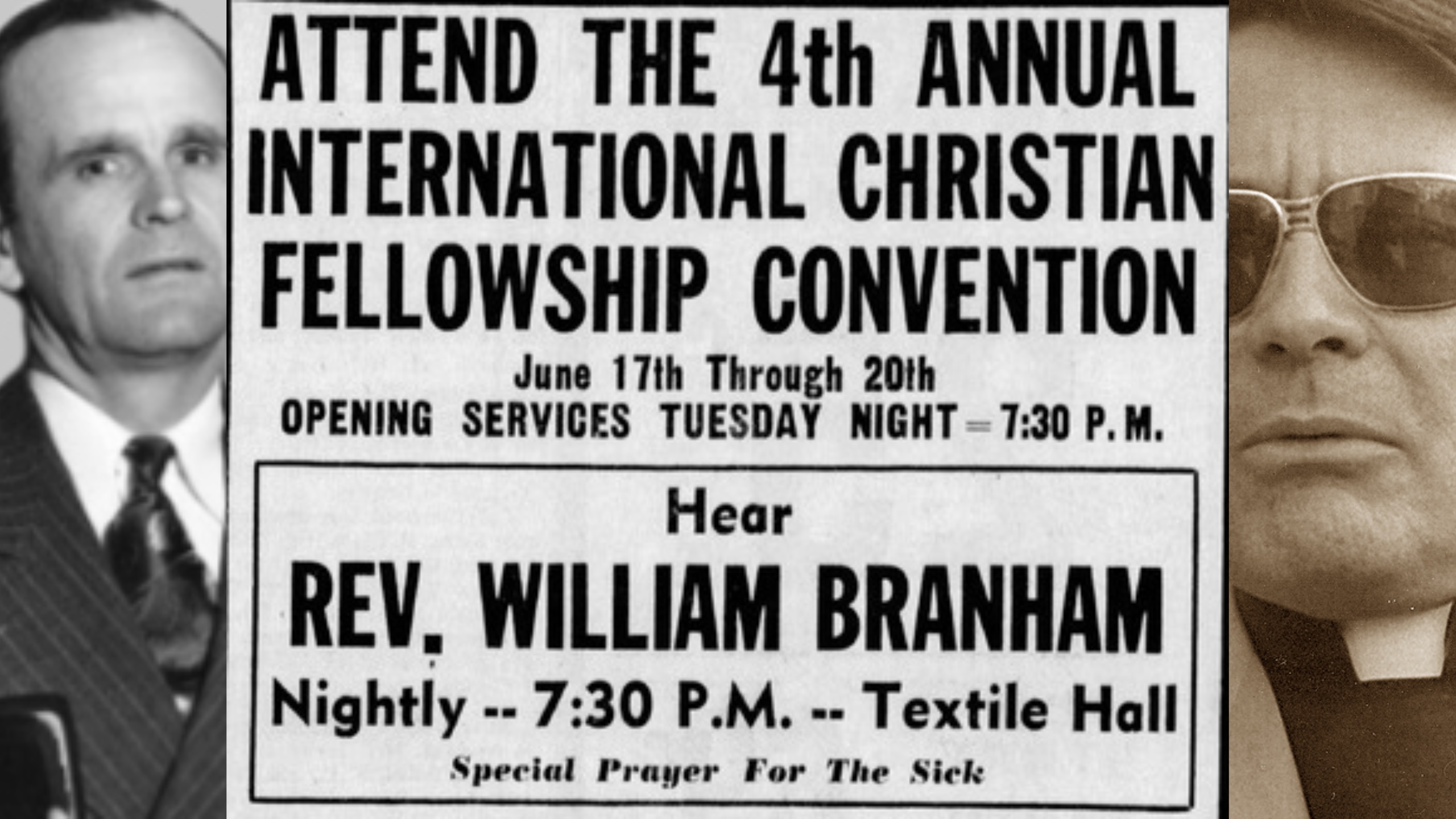
Jim Jones called his first convention with William Branham in 1956 at the Cadle Tabernacle in Indianapolis the "Brotherhood Healing Crusade," a label that is significant for tracing connections between Jim Jones, William Branham, Joseph Mattson-Boze, and the later evolution of Peoples Temple after Jones worked with Branham. The convention's official name was "The Second Annual International Christian Fellowship Convention."[1] Notably, "Brotherhood" also functioned as a collective nickname for the Disciples of Christ, the denomination Jones would later join. Officially, the convention name echoed "The Voice of Christian Fellowship," one of two publications that were combined to form Joseph Mattsson-Boze's Herald of Faith.[2] The convention also served as a rival platform to The Voice of Healing after Branham's campaign team broke with him.
Branham's split with campaign leadership and the Voice of Healing rupture
In March 1953, William Branham was scheduled to hold a revival in Connersville, Indiana,[3] near the Gospel Assembly that Jones frequented in Richmond.[4] Branham's campaign manager, Ern Baxter, was also scheduled to attend but had recently parted ways with Branham.[5] Branham described strong division among campaign leadership,[6] while Baxter later stated that the results of Branham's teaching ministry were not good.[7] Baxter left, and others appear to have followed, including Gordon Lindsay. Although Branham was scheduled to speak at the December 1953 Voice of Healing Convention in Chicago, many attendees reportedly expected to hear him; convention leaders issued an ultimatum and ultimately denied him the platform.[8]
Mattsson-Boze versus the Voice of Healing
Throughout 1954, Joseph Mattsson-Boze criticized The Voice of Healing leadership in The Herald of Faith. He published "An Open Letter to the Voice of Healing," demanding that Branham's former campaign team answer for their rejection of Branham.[9] Gordon Lindsay responded indirectly in The Voice of Healing,[10] and the dispute became increasingly public.
In this article, the editor of The Voice of Healing brings out the thought that The Voice of Healing's policy is never to fight other groups. It is hard to believe that the editor of The Voice of Healing thinks that the Herald of Faith is fighting The Voice of Healing just because we ask an open question.
- Joseph Mattson-Boze
Branham was absent from the 1954 lineup of evangelists at the Voice of Healing Convention in Philadelphia, Pennsylvania.[11] In 1955, Branham's name appeared in the program for the 7th Annual Voice of Healing Convention in Dallas, Texas with a disclaimer: "(May Be Present)."[12] During the convention, Branham was instead in San Fernando, California.[13]
Peoples Temple formation and a competing convention network
The timeline of Branham's conflict with his former campaign managers closely parallels Jim Jones' early institutional steps. On April 4, 1955, Jones registered Wings of Deliverance, Inc., in the State of Indiana, the corporate entity that developed into Peoples Temple.[14] Soon afterward, Jones announced that William Branham would be coming to Peoples Temple,[15] Joseph Mattsson-Boze began touring with Jones at revival meetings,[16] and plans advanced for a competing series of conventions under the name "Christian Fellowship Convention."
Peoples Temple advertised the Christian Fellowship Convention as the "Brotherhood-Healing Crusade," June 11 to 15 at the Cadle Tabernacle.[17] The Voice of Healing magazine gave the competing convention minimal advertising space; Branham was listed only in the schedule and only as a speaking engagement, rather than as a featured international convention of ministers.[18]
Interlocking signals: naming, publications, and key personnel
The convention name, the transition within Peoples Temple, Mattsson-Boze's promotional strategy, and pivotal events in Branham's public itinerary form a set of linked signals. "Brotherhood" corresponded to a Disciples of Christ identifier that Jones and Peoples Temple would later adopt. Mattsson-Boze promoted Branham's upcoming "Chicago Convention," hosted in Chicago by Jim Jones,[19] on the cover of his Herald of Faith Newsletter,[20] and published articles by William Branham and Rev. Glenn Parton.[21] Parton served as a co-editor of the Herald of Faith,[22] founded The Voice of Christian Fellowship,[23] and provided the institutional label for the new convention series.
Escalation and separation
Tensions continued to rise between William Branham, Jim Jones, Joseph Mattsson-Boze, and the Voice of Healing evangelists. When Branham was chosen as the main speaker for the June 1957 Christian Fellowship Convention in Indianapolis, an open letter condemning Branham circulated among evangelists.[24] Jones later separated from Branham, stating that many evangelists in the movement (including Branham) were financially motivated.[25] Branham continued working with Mattsson-Boze and Glenn Parton and headlined future annual International Christian Fellowship Conventions.[26] Taken together, the evidence suggests that Jones' move toward the Disciples of Christ reflected influences from Mattsson-Boze and Parton, intensified by the schisms associated with Branham's developing doctrine and the resulting fractures within the healing-revival network.