
Speaking Creation into Existence: How Branham’s Squirrels Shaped Modern Faith Teaching
William Branham repeatedly claimed that he spoke squirrels into existence as literal acts of creation, presenting these stories as divine confirmation of a new phase of spiritual authority. These claims laid an early theological foundation for later Word of Faith teaching by reframing spoken words as creative forces rather than petitions submitted to God’s will.
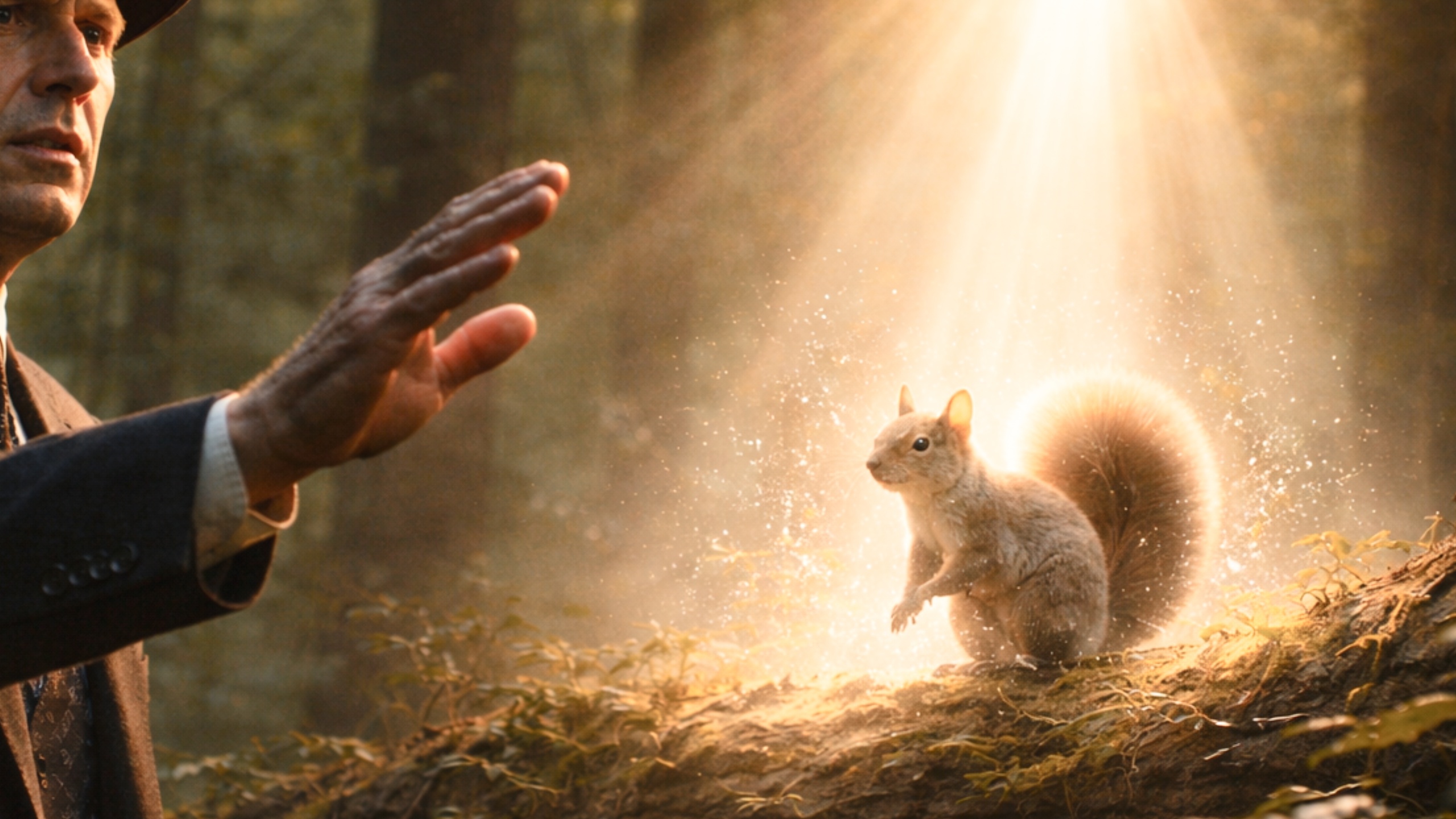
Between 1959 and the mid-1960s, William Branham repeatedly claimed that God had authorized him to speak material creation into existence, most notably recounting episodes in which squirrels allegedly appeared after he spoke the word. These narratives were not presented as symbolic illustrations or visions, but as literal acts of creation that resulted in physical animals which were then shot, handled, and eaten. Branham explicitly framed these events as divine confirmation of a new phase of his ministry, asserting that God Himself identified the act as speaking squirrels into existence [1].
From the outset, Branham linked these claims to biblical language drawn from Mark 11:23 and Genesis creation motifs, arguing that the same creative Word exercised by God in Scripture could be spoken through a human vessel without mediation of existing material. He assumed the role not merely of a prophet announcing God’s word, but of an authorized agent through whom creative fiat could occur. This claim marked a decisive escalation beyond healing, prophecy, or discernment, and functioned as a theological foundation for later assertions that believers—under the right conditions of faith and divine commission—could exercise creative speech analogous to God’s own acts of creation [2].
By consistently insisting that the squirrels were not visions and that their appearance was directly caused by spoken words, Branham positioned these stories as empirical proof of divine authority operating through human speech. This framing would later be echoed, expanded, and systematized in broader charismatic and Word of Faith teachings that emphasized verbal confession as a mechanism for producing material outcomes [3].
Early Accounts (1959): Speaking a Squirrel into Existence
William Branham first publicly framed the alleged creation of squirrels as a literal event in late 1959, presenting it as an unambiguous act of creation rather than coincidence, vision, or metaphor. In these early retellings, Branham emphasized that there were no squirrels present in the area prior to his spoken words and that the appearance of the animal followed only after he consciously resisted doubt. The narrative structure consistently centers on spoken declaration, internal resolve, and delayed materialization, reinforcing the claim that speech itself functioned as the causal mechanism [4].
Branham further insisted that the event was physical and verifiable, stressing that the squirrel was shot, bled, and eaten. By repeatedly denying that the experience was visionary, he distinguished the incident from prophetic symbolism and instead anchored it in material reality. This insistence was crucial to the theological weight of the claim, as it framed the spoken word not merely as predictive but as generative, mirroring divine creation language found in Genesis [5].
In these early sermons, Branham also began drawing explicit parallels between his experience and the biblical account of Abraham and the ram, asserting that God could speak an animal into existence when needed to confirm divine commission. By placing his experience within this interpretive framework, Branham laid the groundwork for later claims that creative speech was both scriptural and repeatable under divine authorization, a premise that would later be amplified and generalized in charismatic teachings on spoken faith [6].
Expansion and Repetition (1960–1961): Confirmation and Second Ministry Claims
Following the initial 1959 account, William Branham increasingly repeated and expanded the squirrel-creation narrative throughout 1960 and 1961, presenting it not as an isolated incident but as a recurring divine act intended to confirm a new stage of his ministry. In these retellings, Branham asserted that the squirrels appeared multiple times, sometimes in locations where he insisted squirrels could not naturally be present. He emphasized numerical repetition, claiming the act occurred “seven straight times,” framing repetition itself as evidence of divine intentionality rather than coincidence [7].
During this period, Branham explicitly connected the creation of squirrels to what he termed his “second ministry.” He stated that God had personally informed him that this new phase was imminent and that the spoken creation of animals functioned as supernatural validation of that transition. By anchoring the claim in divine speech addressed directly to himself, Branham elevated the event from personal testimony to an authoritative marker of ministerial progression [8].
This phase also marked a doctrinal escalation. Branham no longer described the creative act as something God did independently, but as something God accomplished through his spoken words. The distinction is subtle but significant: divine action was portrayed as contingent upon human speech aligned with divine will. This framing implicitly positioned Branham as an active participant in creation rather than a passive witness, reinforcing a theology in which faith-filled speech operates as the conduit for creative power. Such language would later become a core assumption within Word of Faith teaching, where spoken confession is treated as an instrument that releases material outcomes when properly exercised [9].
Doctrinal Integration: Manifested Sons of God and Creative Speech
As the squirrel-creation narratives were repeated, William Branham increasingly integrated them into the theological framework commonly referred to as the Manifested Sons of God doctrine. Within this system, believers—at its apex—were said to come into such complete union with God that divine attributes could be expressed through human vessels. Branham explicitly placed the speaking of squirrels into existence within this conceptual structure, presenting it as evidence that God’s creative prerogatives were being exercised through a man on earth [10].
In this doctrinal context, creative speech was no longer framed merely as an exceptional sign given to authenticate a ministry, but as a demonstration of restored Adamic authority. Branham asserted that the same God who spoke creation into existence in Genesis was now operating through spoken words once again, bypassing natural processes entirely. By insisting that creation occurred “without anything to break it from,” he rejected the idea of transformation or multiplication and instead claimed absolute creation ex nihilo through divine-human speech [11].
This teaching substantially altered traditional Christian distinctions between Creator and creature. While Branham verbally attributed ultimate power to God, the functional mechanism of creation was consistently located in human speech aligned with divine will. The implication was that certain believers, having attained sufficient spiritual maturity or commission, could participate in creative acts previously understood as belonging exclusively to God. This conceptual shift provided a theological bridge to later charismatic doctrines that framed faith-filled words as containers of creative force rather than petitions directed toward divine sovereignty [12].
The Three Pulls Framework and Internal Contradictions
By 1963, William Branham explicitly incorporated the squirrel-creation claims into his developing Three Pulls doctrine, using them as proof that he had moved beyond healing and prophecy into a higher, more authoritative phase of ministry. Within this framework, Branham taught that the first pull involved healing, the second involved prophetic discernment, and the third represented direct divine speech with irreversible consequences. He repeatedly referenced the creation of squirrels as evidence that God had authorized him to exercise creative authority through spoken words [13].
However, this integration produced internal contradictions that Branham never resolved. Earlier, he had identified the creation of squirrels as marking the beginning of his “second ministry,” while later teaching that the second pull consisted primarily of prophetic insight and discernment—activities he claimed to have exercised decades earlier. At the same time, Branham asserted that true creative speech belonged to the third pull, which he claimed to have entered only in 1963. The squirrel narratives were thus retroactively repositioned within shifting ministerial categories, creating chronological and doctrinal inconsistencies [14].
These contradictions are significant because they reveal that the theological meaning of the squirrel-creation claims was not fixed at the time of their introduction. Instead, their role was continually reinterpreted to support evolving claims of authority. As Branham’s self-understanding escalated, the same stories were reassigned new doctrinal functions, serving as flexible proof-texts rather than stable historical markers. This pattern of reinterpretation mirrors later Word of Faith and prophetic movements, where personal testimonies are repeatedly reframed to validate expanding claims of spiritual power and jurisdiction [15].
Language of Creation and Identification with the Creator
As William Branham continued to recount the squirrel-creation episodes, his language increasingly blurred the distinction between divine action and human agency. In several sermons, Branham stated that the voice speaking to him explicitly identified itself as the Creator of heaven and earth and then directly associated that identity with the act of having him speak squirrels into existence. By presenting the same voice as both God and the authorizing agent of creative speech, Branham collapsed the traditional separation between divine sovereignty and prophetic obedience [16].
Branham did not merely claim that God responded to prayer by providing animals; instead, he emphasized that creation occurred through spoken declaration without intermediary material. He repeatedly contrasted this with Jesus’ earthly miracles, arguing that Christ multiplied existing substances while the present manifestation involved creation “without anything standing there.” This rhetorical move elevated the contemporary act above New Testament miracles and implicitly suggested a restoration or escalation of creative authority operating in the last days [17].
This language functioned to identify Branham’s speech acts with the creative fiat of God Himself. Although Branham occasionally attributed ultimate power to God, the operative mechanism was consistently verbal expression issued by a human mouth. Such framing placed human speech in a quasi-divine role, transforming words from requests into performative commands. This conceptual move is central to later Word of Faith theology, where spoken words are treated as vehicles of creative power rather than expressions of dependence, and where faith is measured by verbal assertion rather than submission to divine will [18].
Reception Among Followers and Boundary-Marking
William Branham frequently framed belief in the squirrel-creation accounts as a dividing line between true followers and those he portrayed as spiritually incapable of receiving deeper revelation. In multiple sermons, he explicitly stated that acceptance of God speaking squirrels into existence marked a threshold that many religious people could not cross. Skepticism toward these claims was not treated as a matter of discernment or doctrinal disagreement, but as evidence of spiritual deficiency or resistance to God’s final work [19].
Branham drew direct analogies between critics of his claims and biblical figures such as Judas, Korah, and those who rejected Moses. By doing so, he transformed disagreement into moral and spiritual rebellion, asserting that those who could accept healing but rejected creative speech were stopping short of full obedience. The squirrel narratives thus functioned not only as testimony but as a loyalty test, reinforcing hierarchical authority and insulating the claims from internal critique [20].
This boundary-marking had significant social and theological consequences. By embedding the squirrel-creation stories within a framework of spiritual maturity, Branham effectively tied acceptance of extraordinary claims to faithfulness itself. This dynamic would later be reproduced in Word of Faith and prophetic movements, where belief in increasingly extreme manifestations becomes a measure of alignment with divine purpose. In such systems, doubt is redefined as unbelief, and dissent is framed as opposition to God rather than engagement with theological or historical questions [21].
From Creative Speech to Word of Faith: Doctrinal Continuities
Although William Branham did not systematize a full prosperity or confession theology, the conceptual elements present in his squirrel-creation claims closely parallel later Word of Faith teachings. Central to both is the conviction that spoken words, when uttered in faith and alignment with divine will, function as causal agents that bring material realities into existence. Branham repeatedly asserted that creative outcomes followed verbal declaration rather than petition, emphasizing speaking over praying and command over request [22].
Branham explicitly taught that faith was not merely trust in God’s sovereign action but a position that authorized speech to operate creatively. By citing Mark 11:23, he framed belief as the internal condition that activates spoken words, thereby shifting emphasis from God’s independent action to the believer’s verbal expression. This framework anticipates later Word of Faith formulations in which “confession” is treated as a law-like principle that governs spiritual and material outcomes [23].
The continuity becomes especially clear in Branham’s insistence that creation could occur “without anything standing there,” a claim later echoed in teachings that portray faith-filled words as containers of substance. While later Word of Faith leaders would generalize this principle to health, wealth, and success, Branham’s squirrel narratives supplied an early experiential template: speech as performative action, doubt as the primary inhibitor, and material manifestation as proof of spiritual authority. In this way, the squirrel-creation claims function as an ideological bridge between postwar healing revival theology and the fully developed Word of Faith movement [24].