
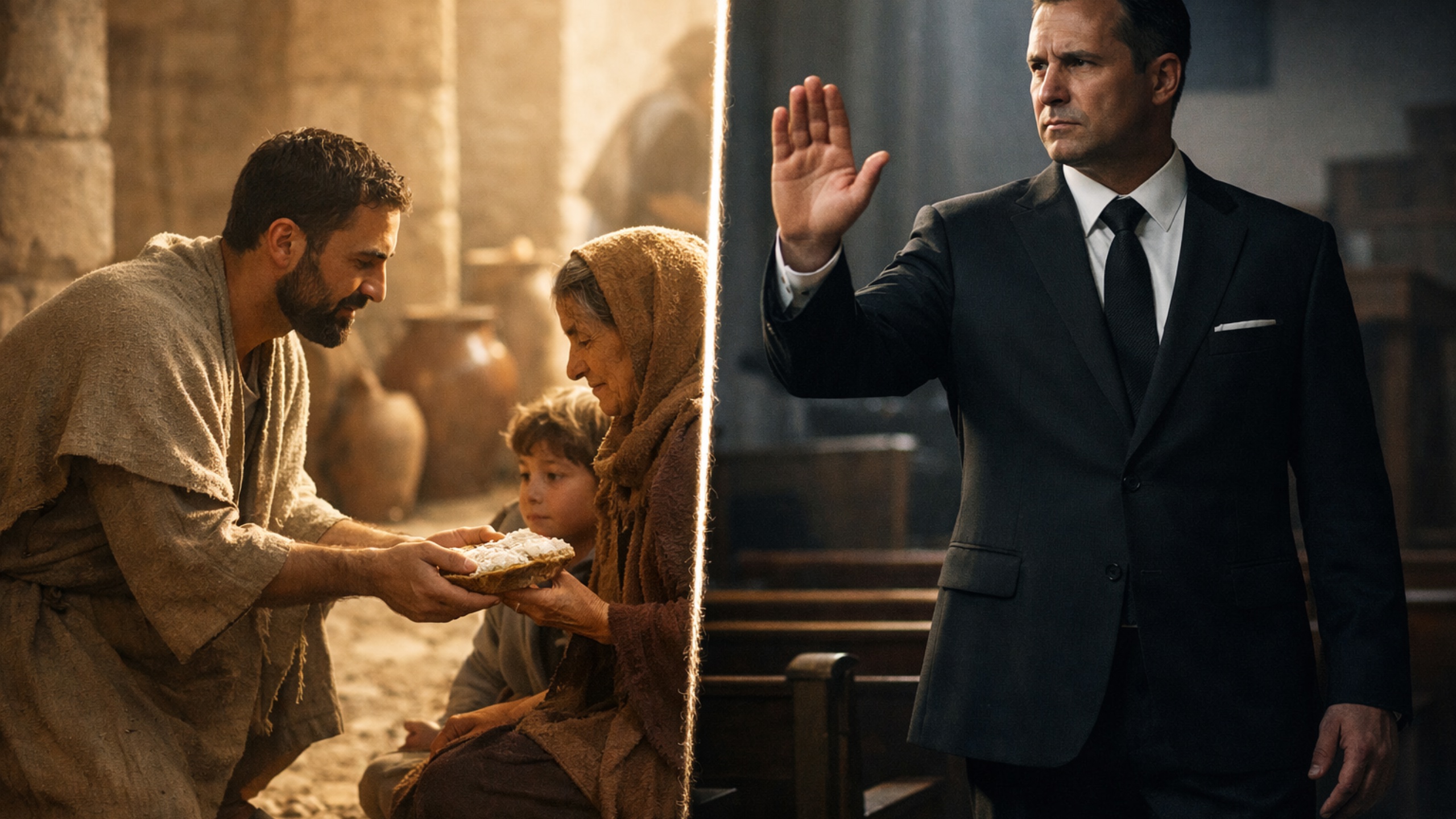
Deacons as Servants or Enforcers? Scripture Versus Branham’s Church Order
The New Testament presents deacons as servants entrusted with practical care and moral integrity, not as enforcers of authority or discipline. This study contrasts that biblical role with William Branham’s authoritarian redefinition of deacons as church “police,” exposing a fundamental shift from service-oriented ministry to control-based governance.
In the New Testament, the role commonly translated as "deacon" is rooted in the Greek term diakonos, a word that fundamentally denotes a servant, attendant, or one who renders assistance on behalf of others. Rather than indicating rank or governing authority, the term emphasizes function and posture, describing a person who carries out practical service for the benefit of the community (Mark 10:43-45).
The clearest narrative backdrop for the emergence of this role appears in the early Jerusalem church, where practical needs within the community required organized care. When disputes arose over the daily distribution of food to widows, the apostles appointed trusted individuals to oversee this service so that the apostles themselves could remain focused on prayer and teaching (Acts 6:1-4). Although the word diakonos is not explicitly used in this passage, the pattern established is one of delegated service, not delegated rule.
Later New Testament writings further clarify the character expected of those who serve in this capacity. Deacons are described in moral and relational terms—dignified, trustworthy, self-controlled, and faithful in family life—without any reference to disciplinary authority or enforcement power (1 Timothy 3:8-13). Their qualifications emphasize integrity and reliability rather than command or coercion.
The New Testament also applies the term diakonos broadly, including to individuals who serve the church in supportive roles without distinction of hierarchy. Phoebe, for example, is explicitly identified as a diakonos of the church at Cenchreae, demonstrating that the role was understood as one of recognized service rather than institutional authority (Romans 16:1-2). Across these texts, the biblical definition of a deacon consistently reflects service-oriented ministry aimed at meeting practical needs and supporting the spiritual mission of the church, rather than policing behavior or enforcing obedience.
What Branham meant by "deacon" in his church order teaching
Across multiple sermons and question-and-answer sessions, William Branham consistently framed the office of deacon not as a service role oriented toward care, assistance, or material support, but as an enforcement role centered on authority, order, and control. Although he occasionally retained the language of "servant," Branham repeatedly defined deacons using law-enforcement and military metaphors, establishing the office as an internal policing mechanism within the congregation [1].
A policeman (or the deacon) is a military police to the army, courtesy, but yet with authority. See? You know what a military police is, is actually, if he carries out his rights, I think he's just like a chaplain. You see? It's courtesy and everything, but yet he has an authority. See, you must mind him. See, he puts... These rookies get out there and get drunk, why, he puts them in their place. And so is the deacon to put them in their place. Now, remember, the deacon is a policeman, and a deacon's office is actually more strict than most any office in the church.
Branham, William. 1963, Dec 26. Church Order. (63-1226)
Branham explicitly taught that deacons function as “policemen” within the church, possessing authority that congregants were expected to obey without delay or debate. In this framework, deacons were not merely assistants to the pastor but agents empowered to correct behavior, restrain disorder, and impose compliance in the name of church order [2]. This framing sets the foundation for Branham’s broader redefinition of church governance, in which authority is maintained through surveillance and enforcement rather than voluntary service or mutual accountability.
Deacons as “policemen”: the core metaphor and repeated claims
One of the most persistent elements in William Branham’s teaching on church order is his repeated insistence that deacons are, by definition, “policemen” within the church. This language is not incidental or illustrative but foundational to how he understood the office. Across multiple years and venues, Branham consistently returned to this metaphor, reinforcing the idea that deacons exist to enforce compliance rather than to facilitate service [3].
Branham described deacons as occupying a clearly subordinate yet forceful role under pastoral or prophetic leadership, likening their function to civil or military law enforcement. In this construction, deacons are expected to intervene, correct, and restrain behavior deemed inappropriate, acting decisively rather than consultatively. The emphasis is not on mediation or pastoral care but on order maintenance, with deacons serving as the visible authority presence within congregational life [4]. This repeated framing establishes policing as the normative identity of the office rather than an occasional or emergency function.
Deacons as “military police”: courtesy paired with enforcement authority
William Branham extended the “policeman” metaphor by explicitly redefining deacons as a form of military police, borrowing imagery from armed forces discipline and chain-of-command structures. In this model, deacons were expected to combine surface-level politeness with unquestioned authority, creating a role that outwardly appeared hospitable while retaining the capacity for coercive intervention [5].
Branham emphasized that courtesy did not negate authority, repeatedly stressing that deacons must be obeyed simply because of their office. By comparing deacons to military police who discipline soldiers, he normalized corrective force as an intrinsic part of church life. Disorderly behavior, in his framing, justified immediate intervention, and deacons were tasked with “putting people in their place” when necessary [6]. This militarized understanding reinforced hierarchical obedience and reduced congregational participation to compliance under supervision.
Deacons as guards for the prophet/pastor: protection and perimeter control
In addition to enforcing general order, William Branham explicitly assigned deacons the role of personal guards for prophetic and pastoral authority. Rather than serving as facilitators of congregational participation, deacons were positioned as a protective barrier around the platform, responsible for shielding the speaker from disruption and managing access to authority .
Branham described this guarding function in terms that closely resemble security detail rather than church service. Deacons were instructed to remain quiet, watchful, and strategically positioned, acting as sentries rather than participants. Their loyalty was oriented upward toward the prophet or pastor rather than outward toward the congregation, reinforcing a structure in which authority is insulated and dissent is intercepted before it can be voiced .
Deacons as supervisors of sanctuary behavior: silence, movement, and “sanctuary” rules
William Branham further expanded the enforcement role of deacons by assigning them responsibility for controlling behavior within the physical space of the church. He taught that the sanctuary was not a place for conversation, movement, or informal interaction, and that deacons were obligated to regulate silence, seating, and conduct before, during, and after services [7].
In Branham’s instructions, deacons were empowered to confront individuals who talked, moved about, or disrupted the atmosphere he defined as appropriate for worship. This authority extended beyond gentle reminders and included decisive intervention to halt perceived disorder. The role of the deacon thus shifted from assisting worship to policing the environment, with congregants expected to submit to surveillance and correction as a normal feature of church life [8].
Deacons as moral enforcers: youth control, dating surveillance, and intervention threats
William Branham extended the authority of deacons beyond maintaining order during services into the realm of personal and moral behavior, particularly involving young people. He taught that deacons were responsible for monitoring interactions between youths, intervening when behavior was deemed inappropriate, and exercising authority that reached beyond the church building itself .
In these instructions, Branham explicitly authorized deacons to confront, remove, or transport individuals in order to correct behavior. Moral oversight was not framed as pastoral guidance or familial responsibility but as an enforcement duty of the deacon’s office. This approach positioned deacons as agents of surveillance over private conduct, reinforcing a culture in which compliance was maintained through the threat of intervention rather than voluntary accountability [9].
Deacons handling “out of order” tongues and prophecy: control mechanisms and discretion
William Branham assigned deacons a critical role in regulating charismatic expressions such as tongues and prophecy, particularly when these manifestations were judged to be “out of order.” Rather than encouraging discernment through communal or pastoral processes, Branham instructed deacons to function as enforcement agents whose primary duty was to preserve the authority and flow of the platform ministry .
In this framework, deacons were told to act as silent guards rather than active participants, intervening only when necessary to protect the prophet or pastor. Authority over spiritual expression was centralized, with deacons serving as the physical means by which that authority was maintained. This arrangement reduced congregational agency in spiritual matters and reinforced a top-down control structure in which deviation from approved expression was managed through surveillance and restraint rather than instruction or correction [10].
Deacons versus trustees: separating “spiritual” enforcement from finances and property
William Branham repeatedly emphasized a rigid separation between deacons and trustees, assigning each group narrowly defined domains while elevating the deacon’s role as the primary enforcement mechanism within church life. Trustees, in his teaching, were limited to property maintenance and financial matters, whereas deacons were entrusted with authority over behavior, order, and discipline, reinforcing their status as the church’s internal police force [11].
This division functioned to consolidate control over congregational life while minimizing checks and balances. By restricting trustees to material concerns and empowering deacons to regulate spiritual and moral conduct, Branham created a system in which enforcement authority operated independently of financial accountability. The result was a structure where deacons could exercise coercive power without oversight from other offices, further entrenching authoritarian control within the local assembly [12].