
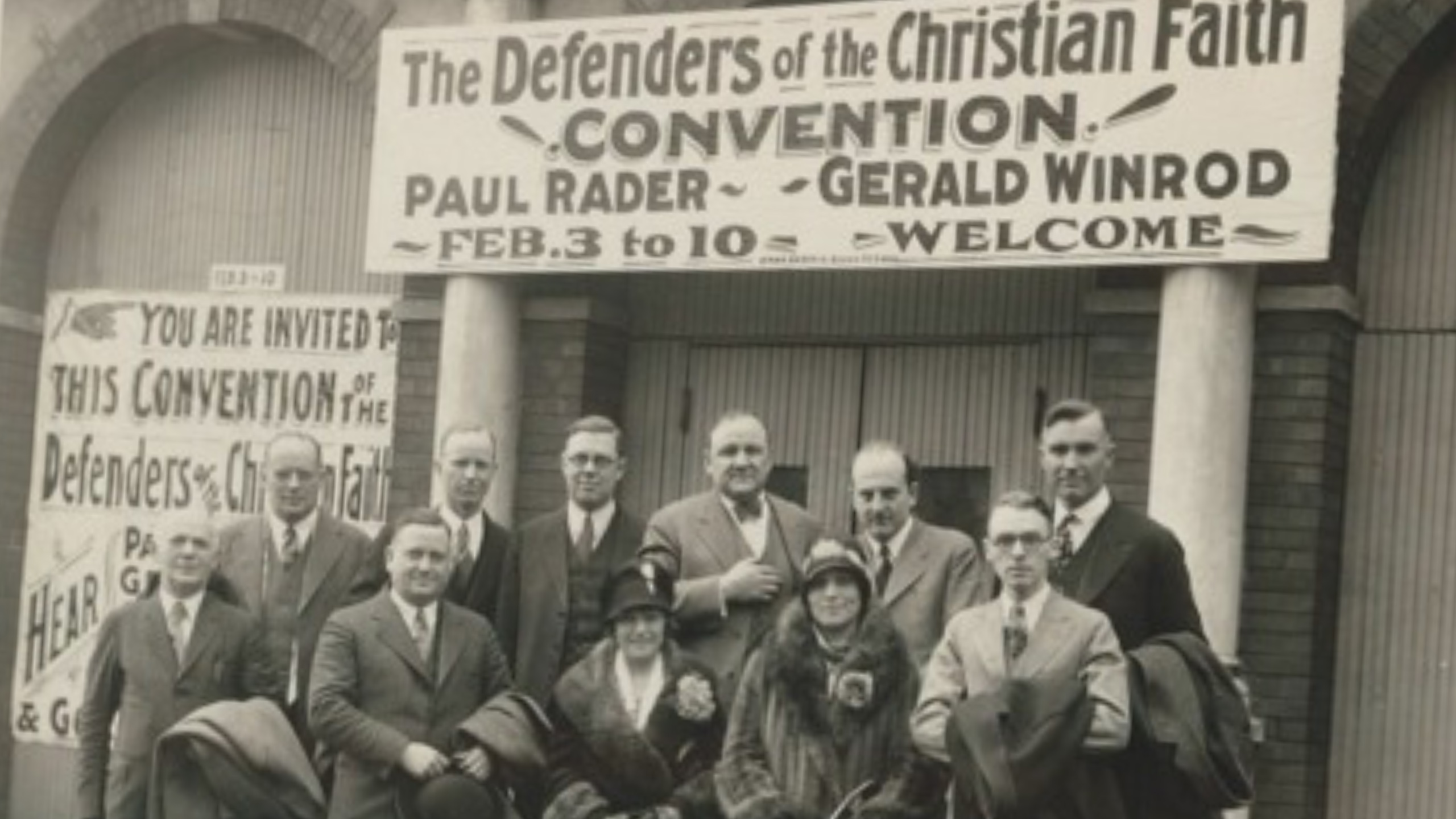
Defenders of the Christian Faith: How Fundamentalism Fueled Fascism in America
The Defenders of the Christian Faith emerged in the 1920s as a fundamentalist movement that fused biblical literalism with political radicalism, eventually aligning itself with fascist and antisemitic ideology. Under the leadership of Gerald Burton Winrod, the organization played a significant role in spreading Nazi propaganda in the United States and was ultimately named as a co-conspirator in the Great Sedition Trial of 1944.
Defenders of the Faith was a fringe political pseudo-religious Fascist movement named in the Great Sedition Trial of 1944 as a co-conspirator accused of undermining the morale of United States troops through the dissemination and sale of Nazi propaganda.[1][2] The movement was founded by Gerald Burton Winrod, who served on the board of directors of the Fundamentalists of the World[3] alongside Roy E. Davis,[4] and who was connected to several prominent figures in American Christian Fundamentalism, including F. F. Bosworth,[5] John Roach Straton,[6] Paul Rader,[7] and Charles Fuller.[8] The organization and its propaganda earned Winrod the sobriquets “Kansas Hitler”[9] and “Jayhawk Nazi.”[10]
While the rest of America slept, the Nazis had crept quietly into the fold and gained the ears and minds of a gullible religious following. The main apostle of the hate creed was this same Rev. Gerald B. Winrod, with a large and militant following in the Midwest. In Wichita, Kansas, Winrod directed a quasi-religious propaganda group known as the Defenders of the Christian Faith and was pastor of the Defender Tabernacle. He published The Defender with a peak circulation of 125,000 (“A prophetic voice crying in the wilderness”), The Constitutionalist, The Revealer, and was one of the most prolific publishers of Nazi party-line literature in the country. One of Winrod's closest collaborators was Colonal Sanctuary. Others included Joseph P. Kamp, Jung True, Pelley, Edmondson, Mrs. Dilling, Henry D. Allen, Mrs. Fry, several Nazi consuls, and Herman Max Schwinn, notorious Bund leader of the West Coast. Winrod sold The Protocols. The columns of The Defender promoted practically every major anti-Semitic, anti-Democracy, anti-British book published in the past eight years.[11]
— Tampa Bay Times
In 1925, former Secretary of State and three-time presidential nominee William Jennings Bryan took a public stand against the theory of evolution, describing it as a “duel to the death.”[12] His rhetoric earned him the reputation of a “prophet” and the informal title “defender of the Christian faith.” The phrase soon became a political slogan, and Bryan toured the South declaring that the entire Southern United States was now “the defender of the Christian Faith.”[13] Contemporary newspapers responded with pointed irony, noting Bryan’s associations with white supremacy by remarking that “a specific proof of Mr. Bryan’s claim would be an ending of southern lynchings and feuds and a reversal of the traditional southern attitude toward the humble black brother.”[14]
After Bryan’s death in July 1925, several religious leaders attempted to assume his mantle. None proved more successful than Gerald Burton Winrod. Drawing directly on Bryan’s slogan,[15] Winrod organized a Kansas-based group that would soon extend its influence beyond state lines. He first gained attention by challenging Kansas laws against cigarettes and alcohol at the annual convention of the World’s Christian Fundamentalists, arguing that existing restrictions were inadequate and “not working very successfully.” With institutional backing from the Fundamentalists, Winrod rapidly transformed the organization into a national movement and launched The Defender as its official publication.[16] The journal became known for aggressively “lambasting” modernism in what contemporaries described as “fine fashion.”
The rapid growth of the movement earned it the nickname “The Flying Defenders,” echoing former Congressman William D. Upshaw’s anti-saloon “Flying Squadron.”[17] Within a single year, the organization claimed members in eighty-five cities and towns across Kansas, representing approximately fifty counties, with additional members “scattered over fifteen other states.” The movement reported 10,000 subscribers to The Defender, and Winrod himself claimed to have addressed more than 200,000 people in Kansas alone, mobilizing opposition to evolution, alcohol, and tobacco.[18] By July 1927, he was popularly dubbed the “Bryan of Kansas” and the “Kansas Cyclone,” references to both William Jennings Bryan and William D. Upshaw.[19]
Despite its growth, the organization was mired in controversy. It was widely identified as a Christian-fascist movement due to Winrod’s overt alignment with fascist ideology and persistent anti-Jewish propaganda.[20] Alongside anti-evolution activism, Winrod promoted anti-prohibition, anti-cigarette, anti-feminist, and anti-homosexual rhetoric, while openly supporting racial segregation. He described the mission of the movement as the “teaching and dissemination of historic Christianity, including an organized defense of the same against the encroachments of modernism.” In December 1927, the organization was formally incorporated in Topeka, Kansas.[21]
By 1928, Defenders of the Christian Faith had become a substantial national presence. Local chapters operated in twenty-two states, and conventions routinely filled auditoriums and hotels, with private homes opened to accommodate visitors. Well-known evangelists and revivalists were regularly featured speakers.
With the city auditorium packed to capacity, the third annual convention of the Defenders of the Christian Faith opened here tonight with Rev. Paul Rader, founder of the Chicago Tabernacle, speaking on “Youth and the Handwriting on the Wall.” Delegates from more than a dozen states are already here for the meetings, which will close Sunday night, and more are expected tomorrow. Hotels are crowded, and more than a hundred homes in the city have opened their doors to visitors. The convention is the largest in the history of the city.[22]
— Wichita Eagle
In 1929, Chicago evangelist Paul Rader advanced a coordinated national campaign against what he termed “the teachings of evolution and modernism.” He recruited “the most prominent fundamentalists in the country,” including Gerald Burton Winrod and Paul W. Rood, president of the Bryan Bible League, itself named in honor of William Jennings Bryan.[23] Central to Rader’s strategy was a national convention of the Defenders of the Christian Faith, scheduled for the Cadle Tabernacle in Indianapolis, a former headquarters of the Indiana Ku Klux Klan. The stated goal was to persuade participants to “carry the fundamentalist campaign into every State.”[24] Charles E. Fuller, later founder of Fuller Theological Seminary and a representative of the Los Angeles Bible Institute, played a prominent role by leading daily morning Bible studies.[25][26]
The Defenders argued that a strictly literal interpretation of every passage of Scripture was the sole path “to find spiritual satisfaction,” regardless of literary genre and without allowance for metaphor, symbolism, or allegory. In a widely publicized gesture, Rader announced a $1,000 reward, offered by Winrod, for proof that Adam did not eat an apple.[27]
Scientists have not been able to prove anything that detracts one iota from the authenticity of the Holy Book. Modernists have cast the Bible overboard in their search for reality and truth. Fundamentalists, because of their explicit faith in the Bible, are able to believe the truths of religion, which their religious opponents cannot understand. Materialists, who seek to catalogue and analyze the verities of the Christian faith, are at a loss to find spiritual satisfaction because they lack faith in the literal Bible.[28]
— Gerald Winrod, Defenders Convention at Cadle Tabernacle
By 1936, the movement had become overtly politicized, waging a religious-political campaign against Communism framed through explicitly anti-Jewish rhetoric.[29] Dr. L. M. Burkhead of Kansas City identified the Defenders as part of a broader conspiracy[30] aimed at spreading Fascism and Nazism within the United States.[31] Burkhead warned that Winrod was exploiting connections within Christian Fundamentalism to embed antisemitic ideology into American religious life, noting that Winrod’s publications reached an estimated circulation of 150,000.
Activities of Winrod: The Defenders of the Christian Faith. This is one of the important anti-Semitic movements because it teaches the fundamentalist Christians of the country with unscrupulous attacks on the Jews written by the Rev. Gerald Winrod of Wichita, Kansas. The same attacks are first printed in the Defender and the Revealer, both edited by Winrod in Wichita and having a combined circulation of something like 150,000. Winrod’s thesis is that Communism is a Jewish conspiracy to destroy Christianity. Ever since the coming of Jesus the Jews have sought the destruction of his message.[32]
— Dr. L. M. Burkhead
Subsequent developments confirmed Burkhead’s concerns. Winrod and other American collaborators publicly aligned themselves with antisemitic rhetoric attributed to Adolf Hitler, including the claim, “I believe I am acting in the spirit of the Almighty Creator; by opposing the Jew I am fighting for the Lord’s work.”[33] On January 3, 1944, the Defenders of the Christian Faith and twenty-nine additional defendants were brought to trial for conspiracy to undermine troop morale and promote Fascism in the United States.[34] Winrod was named for his outspoken hostility toward Jews and for distributing the Nazi-favored text The Protocols of the Elders of Zion.[35] He was identified as “one of the most prolific publishers of Nazi party-line literature in the country.”[36]
Even after charges in the Great Sedition Trial were dropped, Winrod intensified his activities. In January 1947, he organized the Defenders Theological Seminary and a printing operation to continue publishing the same materials cited during the trial.[37] He allied with Klan leader Gerald L. K. Smith and supported Senator Joseph McCarthy in advancing anti-Communist campaigns.[38] Seminaries and “Defender Missions” were established domestically and abroad, including operations in Puerto Rico and the distribution of Spanish-language editions of The Defender under the title El Defensor Hispano.[39]
In 1966, the organization rebranded itself as a charitable entity, opening Townhouse Retirement Homes for senior citizens in Kansas City and in Rogers and Harrison, Arkansas.[40] By 1971, additional facilities were constructed in Beatrice and McCook, Nebraska.[41] The Secretary-Treasurer, Myrtle Flowers, traveled with Winrod and “fiercely defended him.”[42]
The legacy of the movement extended beyond Winrod’s death. His son, Gordon Winrod, continued to propagate extremist ideology. In 2000, Gordon was sentenced to thirty years in prison for kidnapping six of his grandchildren from North Dakota and indoctrinating them at his farm in Ozark County near Mountain Home, Arkansas.[43] He distributed propaganda asserting that “Jews are the Satanists, who lust to murder,” prompting more than four hundred complaints to the Springfield post office.[44]