
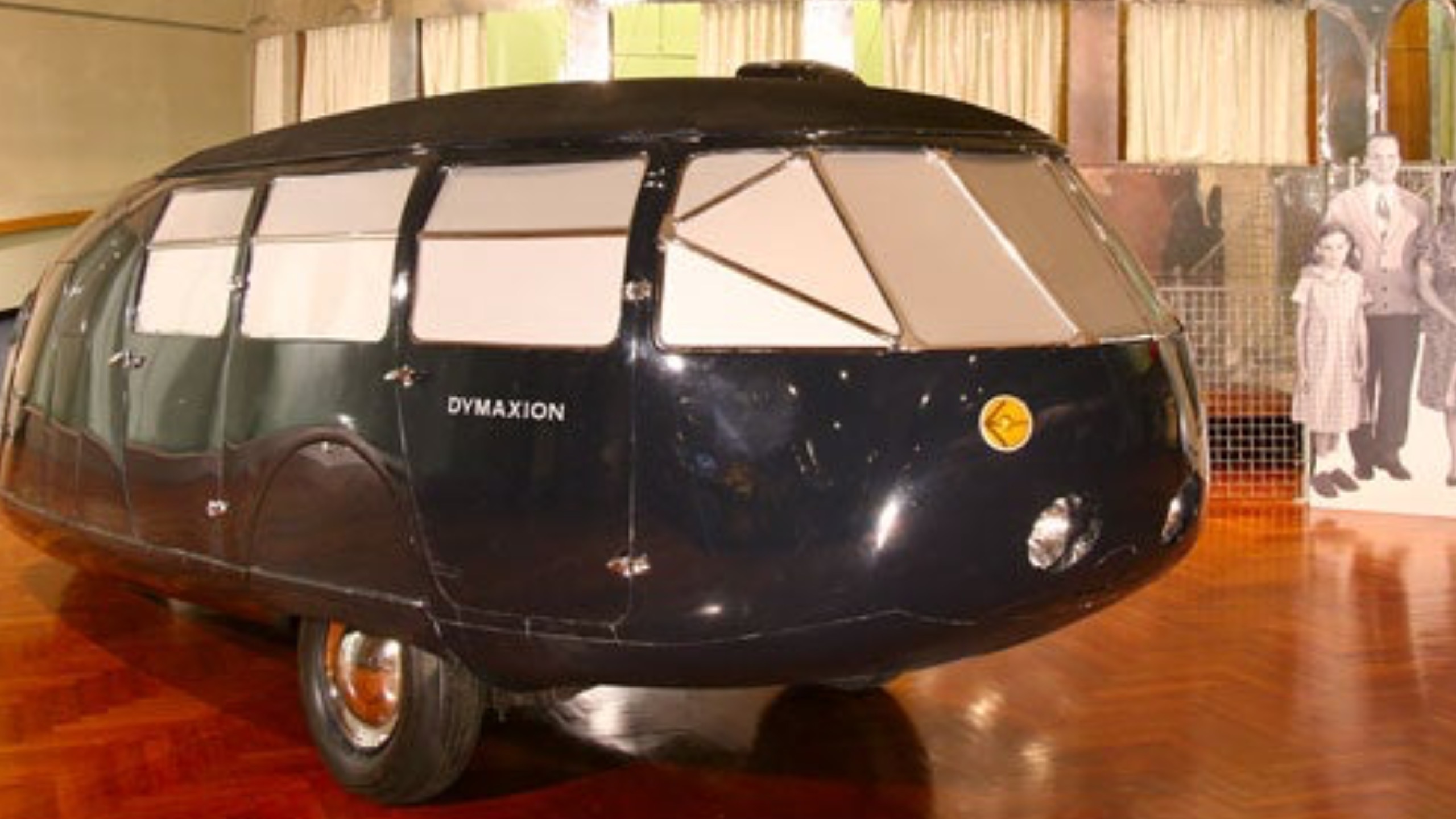
The Egg-Shaped Car Prophecy That Was Already in the Newspapers
Claims about a 1933 prophecy predicting egg-shaped automobiles emerged publicly decades after engineers, scientists, and newspapers were already discussing and displaying aerodynamic vehicle designs. Extensive coverage, World’s Fair prototypes, and published predictions demonstrate that the “vision” closely followed widely known technological trends rather than anticipating them.
As late as 1953,[1] William Branham introduced a prophetic claim for his stage persona, asserting that he had received a prophecy in 1933 concerning the physical shape of future automobiles. In his earliest accounts, descriptions of the alleged “vision” claimed that immediately before the End of Days, automobiles would become shaped “like an egg.” At the time this claim was introduced in 1953, it may have appeared prophetic; vehicle designs were clearly becoming more aerodynamic, and many people would have forgotten the earlier timeline of design experimentation. In 1933, however, no prophet was required to anticipate forthcoming changes in the automobile industry.
In 1902, the Brooklyn Daily Eagle published an article describing a new automobile design that was breaking speed records. Mr. Serpollet won a contest in Nice, France, using a brand-new 12-horsepower egg-shaped automobile.[2] In 1921, the Brooklyn Daily Eagle published another article describing German innovation. An article entitled Sensation Created By Egg-Shaped Car With Rear Motor described a streamlined automobile that was making world headlines. By 1930, newspapers across the United States[3] were preparing Americans for the changes coming to the automobile industry based on engineering innovations in several countries. Scientists recognized that aerodynamics were critical to automobile design and had determined through wind-tunnel testing that egg-shaped designs performed better than the block-body styles of the past.[4] The automotive industry began producing prototypes of egg-shaped automobiles, while newspapers intrigued readers with headlines such as Freak Car Like This May Be Common In Future![5] and Future Autos May Be Shaped Like Egg and Run on Air![6]
The Louisville Courier-Journal, a newspaper sold in Branham’s hometown of Jeffersonville, Indiana, published an article on August 9, 1931, describing the “egg-shaped car of the future,”[7] making it likely that the future of automobile design was already a topic of local discussion. Reporters in Louisville had effectively anticipated Branham’s later claim. Multiple cities in multiple countries were discussing the emerging “egg design.” The Ottawa Journal, for example, published an article on April 25, 1931, entitled Egg-Shaped Automobile Body Predicted For Future, describing the body changes required to achieve greater speed.[8]
Knowledge of impending changes to the automotive industry became even more widespread through the 1933 World’s Fair, the Century of Progress International Exposition in Chicago, Illinois. Visitors to the fair were given a clearer glimpse into the future through prototype vehicles displayed by leading manufacturers, many of which soon transitioned from concept to production. The Lincoln Zephyr, for example, was based on the 1933 Briggs Dream Car[9] and bore a strong resemblance to the egg-shaped Volkswagen Beetle. The Lincoln Zephyr prototype was produced in honor of the fair’s most celebrated attraction, the Pioneer Zephyr, an early model in what would later become the California Zephyr passenger train.[10]
The Pioneer Zephyr was prominently displayed as a symbol of how aerodynamics would shape the future of transportation. Its front was rounded and angled forward to allow air to flow freely as it cut through resistance.[11] The Ford Motor Company appears to have drawn inspiration from this train when designing the grille and midsection of the Lincoln Zephyr, while further advancing aerodynamics through rounded fenders, a curved roofline, and an overall egg-like form.
Many automobile manufacturers were already presenting aerodynamic concepts at the 1933 World’s Fair. The first prototype of the Dymaxion, for instance, was tested at the fair.[12] The Dymaxion was even more egg-shaped, resembling an egg mounted on wheels.[13] The design ultimately proved flawed; the Dymaxion was involved in a serious accident that killed the driver and critically injured two passengers. Investigators concluded that the vehicle was top-heavy and that its single rear wheel provided insufficient stability. The crash occurred at the entrance to the World’s Fair, drawing nationwide attention to both the design and its shortcomings.[14]
Given the widespread publicity surrounding aerodynamic automobiles, it would have been difficult for William Branham or his early followers to have been unaware of these developments. It would have been even more unlikely for Branham not to have seen the prototypes firsthand, as he later stated that he attended the 1933 World’s Fair in Chicago.
I remember when I stood by the side of the seashore the first time… It wasn’t the sea; it was Lake Michigan. I was just a boy preacher, went up to hear Paul Rader preach at the World’s Fair, about 1933, I believe it was, when it was at Chicago.[15]
Manufacturers appeared to be competing to create the future as envisioned by Norman Bel Geddes, who was rapidly becoming a recognized figure not only in the automotive industry but across multiple fields[16] due to what were widely regarded as his prophetic designs.[17] In 1932, Bel Geddes published a book outlining scientific and technological advancements that he believed were soon to become reality. In Horizons, he described the automobile of the future:
This form is approximately that of an egg, though the small end of the drop tapers more sharply to a conical point. In falling, the larger and blunt end of the drop is foremost. This is the shape that creates the least turbulence… It is my prediction that within the next two or three years some farseeing manufacturer will again turn his attention to making his machine go, that this time his design will be the result of what has been learned in this motorized-buggy era. This means that he will start afresh and that his objective will be the ultimate form of the future motor car. This car will look very different from those you see on the road today, but not very different from Car Number 8 as illustrated here.[18]
While egg-shaped designs with rounded roofs, fenders, and oval profiles were popular in the 1940s and 1950s, the automotive industry eventually shifted toward flatter profiles to accommodate higher speeds and changing engineering requirements. Modern vehicles appear significantly flatter when compared to automobiles from the 1950s, when Branham claimed to have made his 1933 prediction. Automobile design continued to evolve throughout Branham’s lifetime. It is therefore unsurprising that additional details were later added to the “egg-shaped prophecy,” with attention shifting from exterior form to interior features. After Central Power and Light Company began advertising future automobiles in Power Companies Build For Your New Electric Living[19], Branham’s account was revised to include descriptions of passengers seated around a table in a driverless vehicle. His description closely mirrored the illustration in the advertisement, from the rounded glass dome to the family playing a board game while the car operated without a steering wheel.
And now, it also said, “And it shall come to pass, that before the end time shall come, that automobiles will take on the shape of an egg, become more like an egg.” And I saw an American family driving down a highway in a car that… They were setting facing one another, and had a table, and were, look like, playing checkers or cards. And they didn’t have any steering wheel in the car. And it was controlled by some power without a steering wheel. How many remembers me prophesying that (see?), that’s been here? Now, at the World’s Fair they’ve already got the car on the market. Here is the… It’s sold now; some big company has taken many of them. And this car, here it is. Paul Boyd remembered the prophecy, looked into his book what I’d said, and took the picture in there. And there it is, exactly in the form of an egg, with two seats setting that way, and two seats setting this way, and a table setting in the middle to play the cards and things on, just exactly.[20]
