
Born Liars? How Scripture Was Rewritten in Branham’s Teaching
William Branham publicly rejected creeds while elevating select composite phrases to doctrinal authority, reframing disagreement as resistance to Scripture itself. By adding, removing, or merging words across passages, these teachings subtly but decisively altered biblical meaning and centralized interpretive control.
William Branham frequently framed his ministry as a restorationist effort rather than a sectarian movement. He presented his message as a rejection of denominational creeds, human traditions, and formal theological systems, insisting that Scripture alone should govern faith and practice. Phrases such as no creed but Christ and no Book but the Bible functioned rhetorically to distance his teaching from established doctrinal statements while simultaneously portraying his movement as a return to apostolic simplicity.
The Bible said, "We're borned in sin, shaped in iniquity, come to the world speaking lies."
- William Branham, 1955. The Seal Of The Antichrist
In practice, this posture created an implicit contrast between Branham and historic Christian institutions. By positioning himself as standing outside creeds, disagreement with his interpretations could be reframed as resistance to Scripture itself rather than as a difference in theological judgment. This approach laid the groundwork for an interpretive hierarchy in which authority was measured not by historical exegesis or communal discernment, but by conformity to Branham's spoken explanations of selected biblical phrases.
Warnings Against Altering Scripture
Branham frequently warned of divine punishment for adding to or taking away from Scripture. Revelation 22 was often cited within the following of William Branham as a condemnation of ministers who twist biblical texts to serve personal agendas:
For I testify unto every man that heareth the words of the prophecy of this book, If any man shall add unto these things, God shall add unto him the plagues that are written in this book: And if any man shall take away from the words of the book of this prophecy, God shall take away his part out of the book of life, and out of the holy city, and from the things which are written in this book.
Revelation 22:18-19
However, when examining the passages most frequently quoted in Branham's preaching, repeated patterns of added, removed, or rearranged wording emerge. Entire verses were combined with phrases from other biblical books, producing hybrid statements that functioned as new verses within the following of William Branham. These altered forms were repeated, memorized, and treated as authoritative.
Frequently Altered Composite Statements
The three most prominent examples include:
- I will be with you even in you until the end of the world.[1]
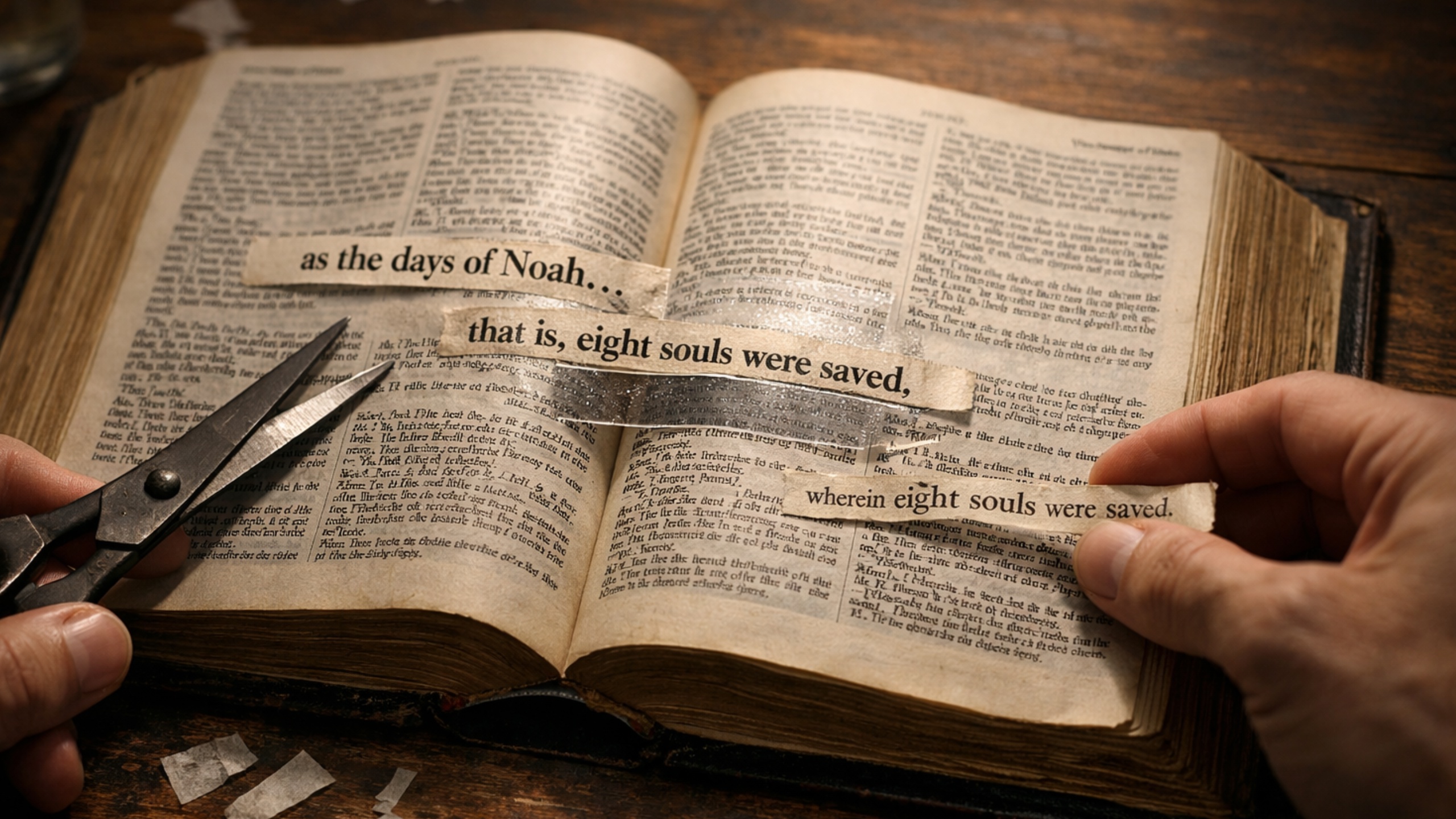
- As it was in the days of Noah wherein eight souls were saved, so shall it be at the coming of the son of man.[2]
- This is my beloved son in whom I am well pleased to dwell in.[3]
These composite statements formed the foundation for three major teachings promoted by William Branham. Although the alterations involved only a few words, the cumulative effect significantly changed the meaning and theological intent of the original biblical texts.
I Will Be With You -- Even In You
William Branham promoted a Christological view closely resembling the Jehovah's Witness understanding of Jesus Christ, teaching that Jesus was merely a man until His baptism. According to Branham, God fully entered Jesus at baptism to create the so-called God-man, asserting that the Jesus of the New Testament was Jehovah of the Old Testament. This teaching reflects modalism, a doctrine that denies the triune nature of God and was condemned as heretical by the early church.
To support this view, Branham claimed that the original biblical text contained three additional words: even in you. Although these words do not appear in the King James Version studied by his followers, many were taught to believe they existed in the original manuscripts. Those who later examine the source texts often discover that no such wording exists and that this interpretation does not align with the biblical record.
Only Eight Souls
Branham advanced the idea that he had been sent to prepare a little bride for the return of Jesus Christ. In this framework, Christians outside his following were identified as the foolish virgins of Matthew 25. His apocalyptic vision portrayed a world condemned for rejecting his ministry, with himself cast as the final messenger through whom God would close the door to the ark.
To reinforce the imagery of scarcity and exclusivity, Branham merged two passages with distinct contexts. The first, from Matthew 24, describes the sudden and unexpected coming of Christ:
Verily I say unto you, This generation shall not pass, till all these things be fulfilled. Heaven and earth shall pass away, but my words shall not pass away. But of that day and hour knoweth no man, no, not the angels of heaven, but my Father only. But as the days of Noah were, so shall also the coming of the Son of man be. For as in the days that were before the flood they were eating and drinking, marrying and giving in marriage, until the day that Noe entered into the ark, And knew not until the flood came, and took them all away; so shall also the coming of the Son of man be. Then shall two be in the field; the one shall be taken, and the other left. Two women shall be grinding at the mill; the one shall be taken, and the other left. Watch therefore: for ye know not what hour your Lord doth come.
The second passage comes from 1 Peter 3, where Peter emphasizes God's patience and faithfulness rather than numerical exclusivity:
For Christ also hath once suffered for sins, the just for the unjust, that he might bring us to God, being put to death in the flesh, but quickened by the Spirit: By which also he went and preached unto the spirits in prison; Which sometime were disobedient, when once the longsuffering of God waited in the days of Noah, while the ark was a preparing, wherein few, that is, eight souls were saved by water. The like figure whereunto even baptism doth also now save us (not the putting away of the filth of the flesh, but the answer of a good conscience toward God,) by the resurrection of Jesus Christ: Who is gone into heaven, and is on the right hand of God; angels and authorities and powers being made subject unto him.
By combining the phrase as the days of Noah were with eight souls were saved by water, Branham produced a new composite statement that was treated as Scripture: As it was in the days of Noah wherein eight souls were saved, so also shall the coming of the Son of Man be.
Born Liars
Branham also merged passages from the Psalms to teach that all people are born liars. He frequently described humanity as born in sin, shaped in iniquity, coming into the world speaking lies. While the source phrases do appear in Scripture, the combined usage conflates texts addressing two distinct groups: the righteous and the wicked.
Psalm 51:5 describes the fallen condition of humanity and the need for redemption, followed immediately by an emphasis on God's desire for truth:
Behold, I was brought forth in iniquity, And in sin my mother conceived me. Behold, thou desirest truth in the inward parts: and in the hidden part thou shalt make me to know wisdom.
Psalm 51:5-6
By contrast, Psalm 58:3 applies explicitly to the wicked rather than to all humanity:
The wicked are estranged from the womb: they go astray as soon as they be born, speaking lies.
Psalm 58:3
In Scripture, the righteous are characterized by a pursuit of truth, while deceit is attributed to the wicked. By blending these passages, Branham reversed the biblical distinction and universalized a description that Scripture applies selectively.
Stated Principle and Practical Outcome
Branham's oft-repeated principle, No Creed but Christ; No Book but the Bible, functioned as a rhetorical safeguard against external critique. Yet in practice, this principle coincided with the repeated reshaping of biblical language, resulting in composite phrases that carried doctrinal weight while remaining detached from their original textual contexts.