William Branham’s Woman President Prophecy: The Myth of a 1933 Prophecy
William Branham claimed that a 1933 vision foretold a woman becoming President of the United States, yet the prediction only appeared in his preaching decades later, after the idea was already common in American culture. As political events unfolded, the claim was repeatedly reinterpreted and reassigned, revealing a pattern of retrospective adjustment rather than a stable prophetic forecast.
William Branham's claim that he foresaw a woman becoming President of the United States did not appear in his public preaching until the mid-1950s, more than two decades after the date to which he later retroactively assigned it. Prior to that point, the idea of a woman president was already part of American political discussion, journalism, and popular culture, appearing in newspapers, books, and theatrical productions well before 1933. These cultural references demonstrate that the concept itself was neither novel nor obscure at the time Branham later claimed to have received his vision.
A—a woman…I—I better leave it alone. But just remember this. I predict this: that a woman will be president before we’re annihilated. That’s right. I said that in 1933 by a vision.
Branham, William. 1956, April 28. God's Covenant With Abraham (56-0428)
The timing of Branham's introduction of the prophecy is therefore central to evaluating its credibility. The claim surfaced only after years of social debate over women's political power and was subsequently reshaped multiple times in response to changing political circumstances. As events unfolded—particularly the 1960 presidential election—the prophecy was repeatedly reinterpreted, reassigned, and reframed, revealing a pattern of retrospective adjustment rather than a stable, forward-looking prediction.
Timeline of Evolving Claims: From 1933 Retrospection to Post-Kennedy Revisions
The female-president prophecy did not enter William Branham's public preaching as a dated prediction until 1955, when he first asserted that a vision allegedly received in 1933 foretold a woman rising to national power. This retrospective dating immediately framed the claim as already fulfilled in outline, shielding it from prior verification and placing its authority entirely in Branham's memory rather than in contemporaneous documentation. Yet the alleged misogynistic prophecy continued to evolve over time:
- 1955: A woman will rise to power in America as the president.[1]
- 1960: Women will vote for the wrong person (Kennedy), and a great woman, beautiful and great, would rise in the U.S. (perhaps the Catholic Church).[2]
- 1960: A great woman, beautiful and cruel, will stand up in the United States as a president (perhaps the Catholic church)[3]
- 1960: The vision showed Kennedy being elected. A great woman, beautiful and cruel, rising in the USA (perhaps the Catholic Church), would be caused by the women's vote. Followed immediately by the destruction of America.[4]
- 1961: The women's vote will elect the wrong man, causing a great, beautiful, and cruel woman to rise to power (a church)[5]
- 1961: Voting women would elect the wrong man (Kennedy). A great woman would rise in the US dressed in purple clothes (perhaps a ruler or the Catholic Church).[6]
- 1964: A great queen rising in the US, beautiful and wicked.[7]
- Church Age Book: Voting is connected with the decline in morals and the rise of a beautiful, cruel woman in America, possibly the Catholic Church.[8]
Pre-1933 Cultural Context: Women, Suffrage, and the Idea of a Woman President
Long before William Branham later claimed that a 1933 vision revealed a woman rising to national power, the possibility of a female president was already openly discussed in American public life. Newspapers, books, and entertainment media treated the concept as speculative, cultural, and even theatrical, rather than prophetic. These discussions demonstrate that the idea itself was part of the public imagination and did not originate with Branham or require supernatural insight.
By 1919, women's suffrage was a dominant national issue, widely covered in major newspapers as Congress moved toward granting women the right to vote. This expansion of political participation naturally produced discussion about women's future roles in government, including the presidency. By the early 1930s, such conversations were common enough to appear in mainstream journalism and cultural commentary.
In 1931, a Courier-Journal feature described actress Ethel Barrymore portraying a woman president on stage, presenting the idea as a dramatic role rather than a shocking novelty. Two years later, Eleanor Roosevelt publicly addressed the subject, writing that the sex of a president was ultimately unimportant and that a woman president would emerge when a qualified woman appeared. These sources confirm that the notion of a woman president was neither rare nor extraordinary by the early 1930s.
This broader cultural backdrop is critical for evaluating Branham's later retrospective claim. Rather than anticipating an unthinkable future development, his alleged 1933 "vision" aligned with ideas already circulating in American political and cultural discourse.
1955 Introduction of the Claim and Retrospective Dating to 1933
The first documented instance in which William Branham publicly asserted that a woman would become President of the United States appeared in 1955, more than twenty years after the date to which he later assigned the prophecy. Rather than presenting the claim as a new prediction, Branham framed it as a recollection of a vision allegedly received in 1933, a move that placed the prophecy beyond contemporary verification and insulated it from any documentary scrutiny.
How many remembers that vision, here in the church? Sure. Said that, how that even Kennedy would be elected in this last election. How that women would be permitted to vote. ... Now, and it said in there, "At that time, there'd be a great woman stand up in the United States. " And she was dressed and beautiful, but she was cruel in heart.And I got in parenthesis on the vision, even yellow paper, said, "perhaps the Catholic church. "And the women being permitted to vote would help elect the wrong person for this nation. And that's what they done. Exactly. [...] I got in parenthesis: "(perhaps the Catholic church). " See? "That'll take rulership over the power, overpower the others in the United States. She'll be beautiful to look at, but she'll be cruel-hearted as she can be. "
Branham, William. 1960, Dec 5. The Ephesian Church Age.
In this initial formulation, Branham stated plainly that a woman would rise to presidential power before the destruction of the nation. No symbolic explanation was offered at this stage, nor was the claim connected to Catholicism, voting patterns, or ecclesiastical power. The prophecy was presented as literal, political, and imminent, with its authority grounded solely in Branham's retrospective testimony.
The method of introduction is significant. By asserting a decades-old origin without producing contemporaneous notes, sermons, or published accounts from the 1930s or 1940s, Branham relied entirely on personal recollection. This stands in contrast to other elements of his ministry that were documented in print or on tape at the time they were introduced. The absence of any earlier record of the female-president claim strongly suggests that the prophecy itself emerged in the mid-1950s rather than in 1933, and was only later anchored to that earlier date to enhance its prophetic weight.
1960 Election Crisis and Reinterpretation Toward Kennedy and Catholicism
The 1960 presidential election marked a decisive turning point in the presentation of the female-president prophecy. As John F. Kennedy's candidacy advanced and concerns over Catholic influence dominated public discourse, William Branham began to modify the meaning of his earlier claim. Rather than focusing solely on a literal female president, he increasingly tied the prophecy to women's suffrage, asserting that women's votes would elect "the wrong person" and thereby unleash a destructive national outcome.
Several years ago, It predicted exactly the Maginot Line, exactly what would take place, exactly Kennedy would take the place, and of this, and there would be a Catholic President ruling here, and what it would be. And there's just two more things left, from seven things that He told me to happen perfectly. That's right. It's on old yellow paper. We're at the end time.
- Branham, William. 1962, Jul 8. A Super Sign(62-0708)
During this period, Branham introduced a crucial interpretive shift. He claimed that the vision of a great woman rising in the United States might not refer to a literal female president at all, but instead to the Catholic Church, which he described as beautiful in appearance yet cruel in power. This symbolic reading was hedged with uncertainty, repeatedly qualified with parenthetical language such as "perhaps the Catholic church," allowing the prophecy to flex as events unfolded.
After Kennedy's victory was confirmed, Branham pressed the reinterpretation further. He asserted that the same 1933 vision had actually shown Kennedy being elected and that a Catholic president was now ruling the nation. By reframing the prophecy in this way, the originally literal claim of a future female president was temporarily replaced with a male fulfillment aligned with anti-Catholic anxieties prevalent within Branham's religious and political milieu.
This revisionary phase reveals a reactive pattern. The meaning of the prophecy was adjusted to accommodate Kennedy's election rather than standing as a fixed prediction made in advance. The shift from female ruler to Catholic symbolism—and then to a Catholic male president—demonstrates how the prophecy's content was reshaped in response to contemporary political developments rather than guiding expectations beforehand.
Post-1960 Revisions: Oscillation Between Female Ruler and Catholic Church
The assassination of President John F. Kennedy in November 1963 created a serious problem for William Branham's revised interpretation of the prophecy. The claim that a Catholic male president fulfilled the 1933 vision could no longer be sustained as a continuing or culminating event. In response, Branham reverted to earlier elements of the prophecy, once again emphasizing the rise of a powerful woman in the United States rather than a completed fulfillment in Kennedy himself.
From 1961 through 1964, Branham's descriptions oscillated between literal and symbolic meanings. At times, the woman was presented as a political ruler—possibly a president—while at other times she was explicitly framed as a church exercising national control. The same vision was repeatedly re-described as showing a beautiful but cruel woman, dressed in royal or purple attire, rising to dominance through women's voting. The ambiguity was preserved through qualifying language, allowing the prophecy to remain unfalsified despite its changing applications.
These revisions reveal a pattern of doctrinal flexibility driven by external events. Rather than clarifying or stabilizing the meaning of the prophecy, Branham repeatedly adjusted its interpretation to maintain relevance after political developments undermined prior claims. The continual shifting between a literal female leader and an abstract ecclesiastical power underscores the absence of a fixed prophetic referent and highlights the retrospective nature of the narrative construction.
Voting Claims and the Historical Record of Women's Electoral Behavior
A central pillar of William Branham's revised prophecy was the assertion that women's suffrage directly enabled the election of "the wrong person," specifically John F. Kennedy, and thereby triggered the rise of a destructive female or Catholic power in the United States. This claim framed women's political participation as both morally corrupting and prophetically catastrophic, elevating voting behavior into a causal mechanism for national judgment.
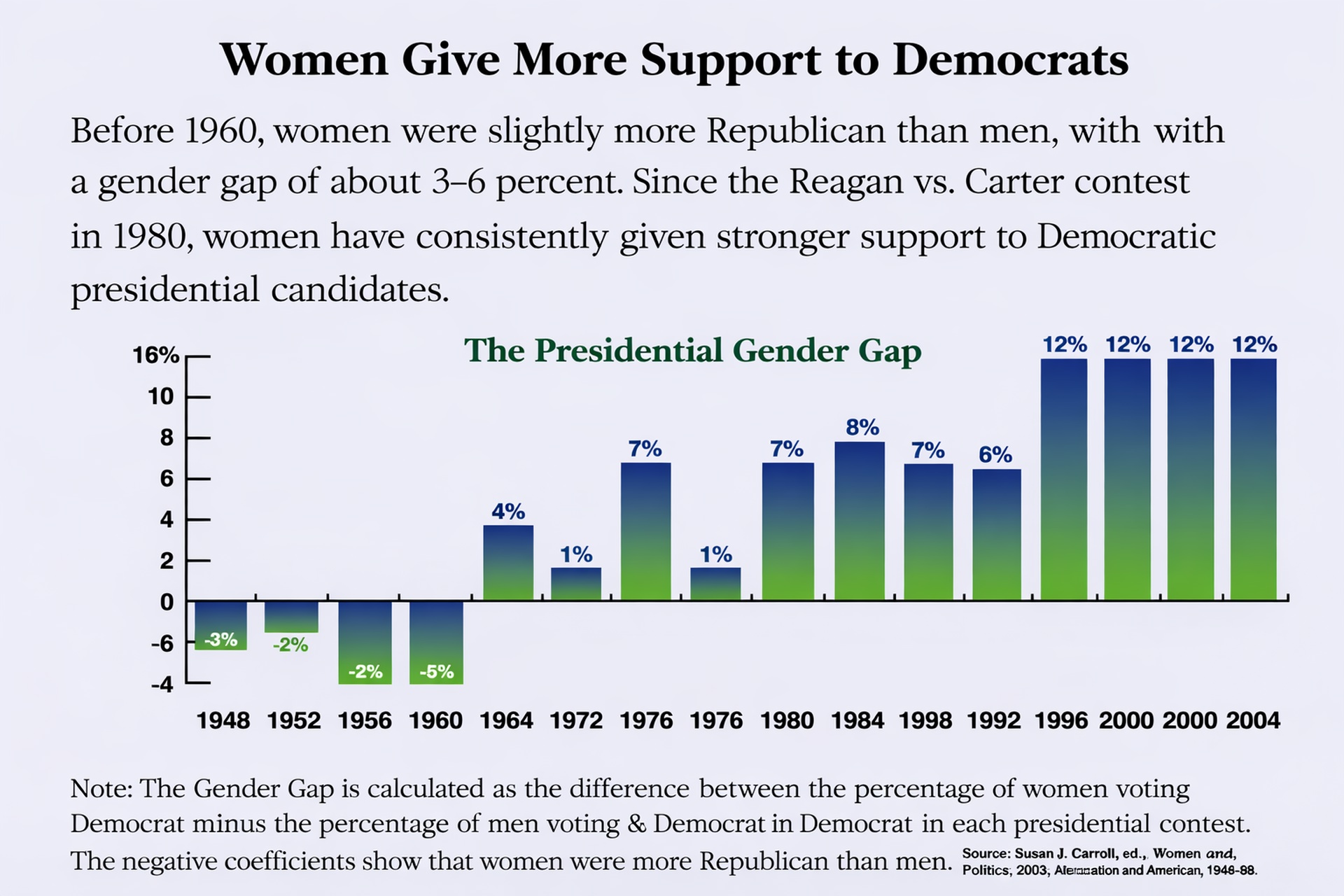
The historical record does not support this narrative. Kennedy was elected by the Electoral College rather than by a decisive popular-vote mandate, and his margin of victory in the national popular vote was exceptionally narrow. More importantly, voting data from the period show that women, as a demographic group, did not disproportionately support Kennedy. In fact, women voters in 1960 leaned slightly more Republican than men, continuing a pattern that had existed for decades.
These facts undermine the internal logic of Branham's claim. Even if Kennedy's election were treated as prophetically significant, it cannot plausibly be attributed to women's votes in the way Branham asserted. The prophecy therefore depends not only on retrospective reinterpretation but also on a demonstrably false account of electoral behavior. This disconnect between claim and evidence further reinforces the conclusion that the prophecy functioned rhetorically—as a vehicle for anti-Catholicism and opposition to women's suffrage—rather than as an accurate prediction grounded in observable reality.
Interestingly, Branham's newly added prediction and its application for President Kennedy was incorrect. President Kennedy was elected by the Electoral College of the United States, not by the popular vote.[9] Had he been elected by the popular vote, it would have also been incorrect; a majority of women voted against President Kennedy. In fact, more women voted for the Republican party than the Democratic until after Kennedy's assassination.[10]