
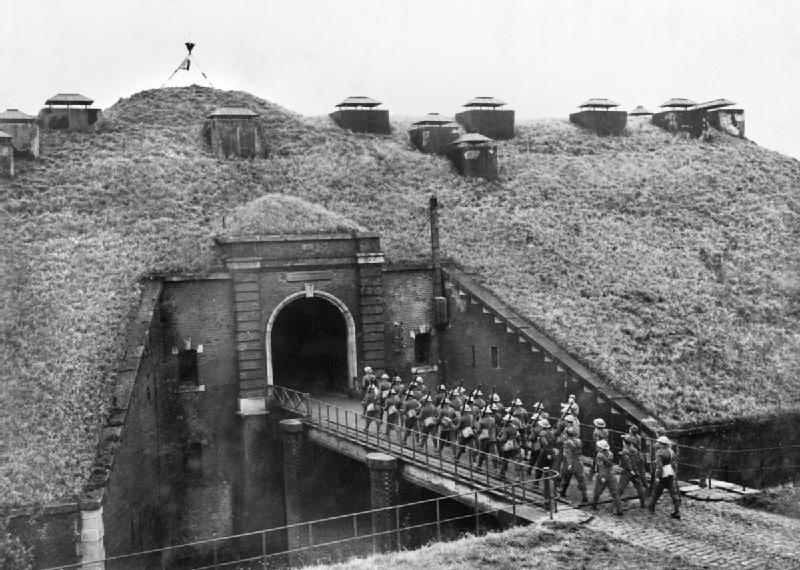
Maginot Line
In September of 1958, William Branham began claiming to have seen a vision, in his already established "1933 prophecies",[1] of the "German" building of the Maginot line. Branham often described this vision as being "a wall",[2] which is one of the primary reasons that researchers believe this prophecy to be faked rather than false. Not only did William Branham introduce this alleged prophecy over two decades after his alleged vision, many of the details of the Maginot Line for which it was "prophesied" are incorrect including its timeline and description.
In September of 1958, William Branham began claiming to have seen a vision, in his already established "1933 prophecies",[1] of the "German" building of the Maginot line. Branham often described this vision as being "a wall",[2] which is one of the primary reasons that researchers believe this prophecy to be faked rather than false. Not only did William Branham introduce this alleged prophecy over two decades after his alleged vision, many of the details of the Maginot Line for which it was "prophesied" are incorrect including its timeline and description.
And in 1933, when the Lord…When we was having meetings over here where that church of Christ is standing now, the old Masonic home, the vision of the Lord came to me up here and predicted that 'Germany would rise up and put that Maginot Line there.' Many of you remember it. And how they'd be all fortified in there, and the Americans would take a great beating right there at that line[3]
The Maginot line was an interesting topic of William Branham's era. Due to its concrete fortification, it could not be moved. The German military simply went around the Maginot Line and entered France unopposed.[4] This left everything beyond the line vulnerable to attack once breached. When General George S. Patton was asked about a similar fortification line in Germany, the Siegfried Line, he reportedly joked, saying, "Fixed fortifications are monuments to man's stupidity."[5]
While William Branham used the name "Maginot" when describing his alleged vision, however, he gave some details that were confused with the "Siegfried Line". His alleged vision described Germany "rising up and putting" the defensive fortification. The Maginot Line was built by France, not by Germany,[6] which is why it has a French name. The Siegfried Line was built by the Germans and given a German name. Someone apparently informed Branham of his mistake, and he began correcting himself in sermons describing the Maginot Line.[7] He struggled to remember the name, however and used them almost interchangeably for the rest of his ministry.[8]
Both these resounding names refer to a national defense system. They are, respectively, German and French. The principal difference between the two is that the former was erected in France by the Germans in World War I; the latter by the French between 1929 and 1934 on their own eastern frontier.
- The Siegfried and Maginot Lines: similarities and differences[9]
Researchers have noted that William Branham also called the fortification a "wall" suggesting that he based his prophecy on the news reports rather than a vision of the actual fortification. The Siegfried Line was referred to as the "West Wall" simply due to its location, [10] but was not actually a wall. The Germans extended and enhanced the "West Wall" during the 1930s by adding a series of bunkers which the Allied soldiers referred to as "pill boxes" due to the germans being packed into them so tightly.[11] The Siegfried Line also consisted of a series of foundations for FlaK turrets,[12] dugouts,[13] and a series of concrete blocks referred to as "dragons teeth" or "pimples" to block tanks from crossing.[14]
William Branham's sermons that describe this "wall" used themes of a false sense of security, however, leading one to believe that he fully intended to claim prophecy on the Maginot Line but associated it with the wrong country. While the German fortification of the Siegfried Line was somewhat successful for defense, it was the Maginot Line that became synonymous with a false sense of security.
Because of its place in history, the Maginot line has come to mean "a defensive barrier or strategy that inspires a false sense of security," according to Merriam-Webster.
- Business Insider[15]
As William Branham began to correct himself on the name of the defensive line for the alleged vision, using "Siegfried" instead of "Maginot", he also began to transfer the theme of false security to the Siegfried Line. He claimed (falsely) that Hitler "moved his headquarters" to the Siegfried Line due to this false sense of security. Hitler did move his headquarters temporarily, but it was to Poland and then back to his Berlin bunker.[16]
It was the late Adolf Hitler who give to the German people a sign that he was a genius, he knowed all about military life. And, without discrediting him, he did know much about it. But he assured the German people, by building what we call the Maginot Line, or the Siegfried Line, that he poured billions of tons of concrete and steel together. Showed his confidence in it, that he moved his headquarters up to the front line, where restaurants and business places operated beneath the ground, where they had billions of tons of steel and cement. No matter how it ever went, Germany was fortified. It was a sign of safety. But the modern blockbuster blowed it into Eternity, and Hitler with it.
- William Branham[17]