
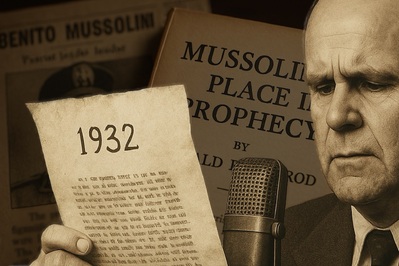
1933 Prophecies: A Self-Proclaimed Prophet
William Branham’s alleged 1933 prophecies show every sign of being constructed backwards: there is no contemporaneous 1933 documentation, his own references to the list are inconsistent (including a slip reading “1932” while admitting the prophecies were being revised), and several early items were borrowed from other writers like Gerald Winrod. Over the following decades the list expanded from “seven major events” to as many as eighteen wildly varied predictions—ranging from Mussolini’s fate to egg-shaped cars, a female U.S. ruler, “don’t eat eggs,” and “don’t live in a valley”—revealing a flexible, evolving narrative shaped by postwar fears and theological needs rather than a single, fixed prophetic vision.

1932: The Paper Trail Behind a Manufactured Prophecy
William Branham’s claim to a set of "1933 prophecies" is undermined by a 1960 sermon in which he theatrically reads from a paper he himself dates to 1932, exposing how the timeline of the alleged vision was flexible and retrospectively standardized. The later exhumation of his church’s cornerstone—where he claimed the original written prophecy was entombed—revealed no document at all, leaving only an empty cavity that some spiritualized as a miracle but which in practice underscores the lack of verifiable evidence behind his prophetic narrative.

Franklin D. Roosevelt and William Branham’s Failed World War Prophecy
William Branham later claimed that a vision from 1932 or 1933 foretold Franklin D. Roosevelt leading the world into war, but his own recorded statements reveal shifting dates, expanding details, and retrospective framing. By comparing Branham’s evolving claims with the actual chronology of World War II, the narrative shows why the Roosevelt prophecy fails historical scrutiny.
No records found.