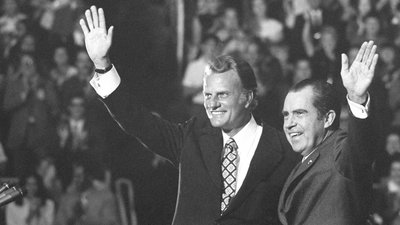
Billy Graham: From Youth for Christ to National Power
Billy Graham’s city-wide crusade model—built on interdenominational cooperation, centralized planning, and campaign-style evangelism—helped normalize a scalable parachurch ecosystem while also becoming a symbolic benchmark that adjacent revival networks (including figures like Branham and environments like Peoples Temple promotions) could invoke for legitimacy. Your excerpt then traces Graham’s visible proximity to Cold War political power through declassified references and public civic spectacle, and concludes by contrasting his public reputation on race with later-documented private antisemitic remarks and their fallout.
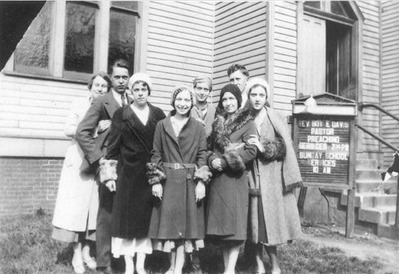
Pentecostal Baptist Church of God Sect
Roy E. Davis was the general overseer of the "Pentecostal Baptist Church of God",[1] a Pentecostal sect[2] that practiced "divine healing" and recruited members by allegedly drinking poison.[3] The national headquarters of the sect was at Jeffersonville, Indiana.[4] It was a Pentecostal assembly.[5] William Branham appears to have tried to conceal his involvement with the cult by being dishonest about the affiliation of the church led by Davis. According to the timeline given,[6] Branham claimed that Davis' Pentecostal church was "Missionary Baptist" (missionaries from the Southern Baptist Convention),[7] and that he was ordained into the Southern Baptist Convention. According to newspaper advertisements and testimony given by Roy Davis in Branham's The Voice of Healing publication, however, the sect was Pentecostal in 1933, the year Branham used. Roy E. Davis was banished from the Baptist Church by the Missionary Board on August 12, 1926,[8] placing Branham's ordination long before 1933.
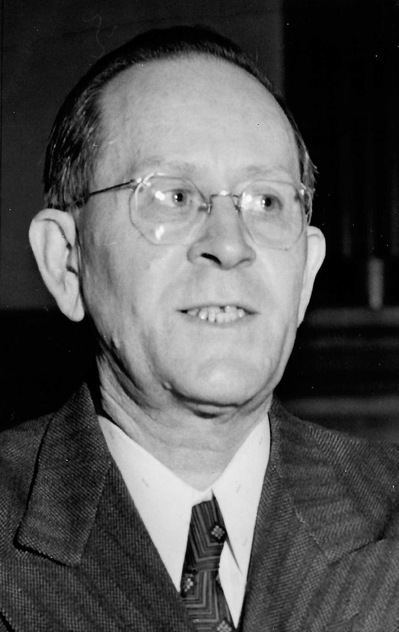
Roy E. Davis
Rev. Roy Elonza. Davis, Sr. was a lifelong leader of multiple white supremacy groups. He worked directly under William Joseph Simmons as the second-in-command of the Ku Klux Klan after it was rebirthed in Atlanta.[1] Davis helped write the constitution and by-laws of the Klan [2] and was an ambassador in Washington for the Klan.[3] When Simmons was ousted from the Klan, Davis joined him to form the Knights of the Flaming Sword and recruited the largest number of people into the white supremacy group.[4] Davis was the man who baptized William Branham,[5] ordained Branham in the Pentecostal faith,[6] mentored him,[7] and toured with Branham in the snake-handling, poison-drinking sects of Pentecostalism in the South.[8]
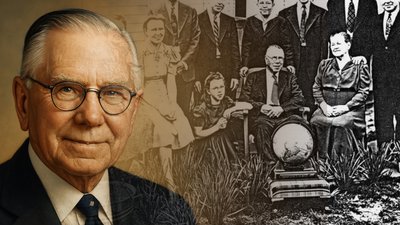
A. J. Tomlinson: Architect of a Theocratic Pentecostal Empire
Here is a clear, tight two-sentence summary of the entire passage: A. J. Tomlinson, a former Quaker turned Pentecostal leader, transformed the Church of God (Cleveland, TN) into a major Pentecostal denomination, but his authoritarian governance and financial controversies led to his 1923 removal and a lasting schism that reshaped the movement. The fallout opened the door for white supremacist influence through figures like Roy E. Davis, while Tomlinson’s son Homer later extended his father’s theocratic ambitions into politics—founding the Theocratic Party, declaring himself “King of the World,” and blending Pentecostalism with British Israelism and dominionist aspirations.
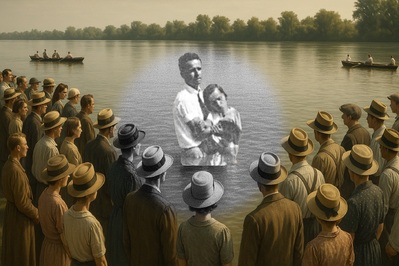
1933 Baptism: The Voice No One Heard
Dismantling William Branham’s famed 1933 Ohio River baptism story—showing that claims of a visible light, an audible commissioning voice, massive crowds, and nationwide newspaper coverage are contradicted by eyewitnesses, contemporary press records, and the documented history of his church and mentor, Roy E. Davis. It argues that the baptism narrative and the so-called 1933 prophecies were retrofitted into Branham’s biography as tools of authority, illustrating how myth-making and repetition, rather than verifiable evidence, became the foundation for prophetic belief in the Message movement.
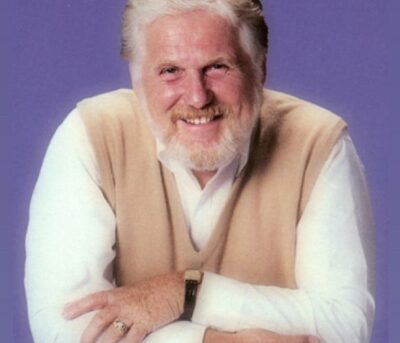
John Wimber
John Richard Wimber was a Christian minister, author, and musician of significant influence within charismatic Christianity, particularly through the Vineyard Movement. As a leader deeply involved in what has become known as the New Apostolic Reformation (NAR), Wimber promoted a theology that emphasized supernatural experiences, such as miraculous healings and prophetic utterances, which he referred to as "Signs and Wonders." His approach, termed "Power Evangelism,"[1] integrated charismatic experiences with traditional evangelicalism, drawing on themes from earlier Pentecostal movements like the Latter Rain. Wimber's work at Fuller Theological Seminary and his association with figures like C. Peter Wagner connected him with theological streams that ultimately contributed to the development of the NAR. His ideas, particularly those aligned with the views of others in the "Kingdom Now" movement,[2] continue to shape contemporary evangelicalism, influencing leaders like Bill Johnson of Bethel Church and Mike Bickle of the International House of Prayer in Kansas City IHOPKC.

1932: The Paper Trail Behind a Manufactured Prophecy
William Branham’s claim to a set of "1933 prophecies" is undermined by a 1960 sermon in which he theatrically reads from a paper he himself dates to 1932, exposing how the timeline of the alleged vision was flexible and retrospectively standardized. The later exhumation of his church’s cornerstone—where he claimed the original written prophecy was entombed—revealed no document at all, leaving only an empty cavity that some spiritualized as a miracle but which in practice underscores the lack of verifiable evidence behind his prophetic narrative.

1907: Branham's Actual Birth Year
William Branham’s widely repeated 1909 birth year is a historically inaccurate date that emerged from his later sermons and theological self-mythologizing rather than from any legal documentation. Contemporary records—including multiple census entries, newspaper accounts, and early public documents—consistently demonstrate that he was born in 1907, a fact overshadowed over time by the prophetic significance Branham attached to the later date.
How William Branham and Latter Rain Rewrote the Five-Fold Ministry
This work examines the biblical foundation of the so-called five-fold ministry and traces how restorationist movements transformed ministry gifts into hierarchical authority structures. By following the doctrine from Ephesians 4 through Latter Rain theology, William Branham, and modern charismatic networks, it demonstrates how authoritarian control and spiritual abuse emerged as consistent fruit.
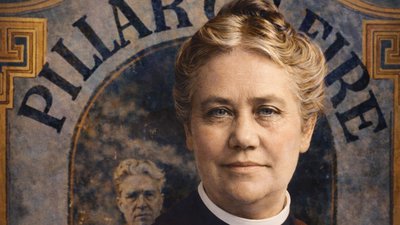
Alma White, the Holy Jumpers, and the Racial Politics Behind Early Holiness Rituals
The Pillar of Fire gained increasing public scrutiny in 1926 when newspapers labeled the “Holy Jumpers” a cult after 22-year-old Ruth Marshall joined the sect and refused to return to her family. Reporters emphasized her intense devotion, noting that her “eyes burn[ed] with a religious zeal,” which reinforced concerns about the group’s influence and controversial practices.
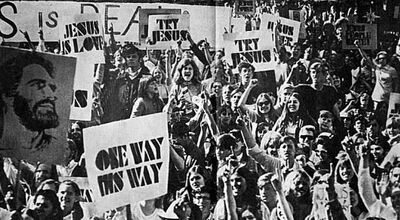
Jesus Movement
In the decades following World War II, American society was gripped by a rising sense of dread over the so-called “youth crisis.” Many people feared that juvenile delinquency, cultural rebellion, and political radicalism would threaten not only family structures but also national survival. With the Cold War escalating, the fear that young people could be captured ideologically[1] —by communism,[2] foreign religion,[3] fascism,[4] or secular humanism —became central to both government propaganda and evangelical strategy.[5] The social upheaval of the 1960s, characterized by the civil rights movement, student protests, and the sexual revolution, only amplified this anxiety, with many conservatives perceiving these shifts as a form of ideological contagion that threatened American values.

Chanting Mathematics: William Branham’s Trance Method and the Bible’s Warning
William Branham taught that chanting basic mathematical equations could draw believers into a trance and produce spiritual experiences he attributed to the Holy Spirit. Examined alongside biblical commands for sobriety, understanding, and discernment, this practice reflects trance-inducing mysticism rather than Christian prayer grounded in Scripture.
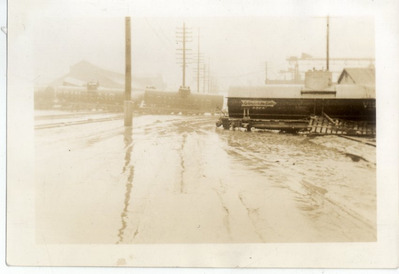
1937 Flood: The Myth of Branham's Pentecostal Conversion
The catastrophic Ohio River flood of January 1937 later became a centerpiece of William Branham’s “Life Story,” in which he claimed that God punished him for resisting Pentecostalism by taking the lives of his wife Hope and daughter Sharon during the disaster. However, historical records show that Branham had already been ordained into Pentecostal ministry and founded a Pentecostal church before the flood, and that Hope’s death from tuberculosis occurred months after the waters receded—exposing serious contradictions in his popular conversion narrative.
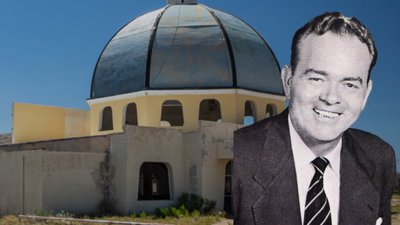
A. A. Allen: Miracle Valley Cult
Rev. Asa Alonso (A. A.) Allen emerged from the Latter Rain and Voice of Healing revivals as a controversial evangelist whose ministry became marked by racial tensions with William Branham, accusations of fraudulent healings, and escalating personal struggles with alcoholism. FBI investigations, Klan attacks, internal revivalist disputes, and Allen’s eventual death from acute alcoholism reveal a turbulent career that exposed deep fractures within mid-century Pentecostal healing movements.
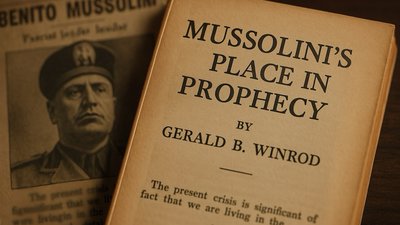
Benito Mussolini in Prophecy: How Fascism Fueled Identity Apocalypticism and Branham's 1933 Visions
William Branham’s later retellings of “1933 visions” about Mussolini, the “three isms,” and the Vatican’s destruction closely track themes already published and promoted within Christian Identity circles—especially Gerald B. Winrod’s 1933 prophetic framing of Mussolini. It then traces how those borrowed apocalyptic motifs were repackaged through Branham’s authority and carried forward into postwar revivalism, Latter Rain theology, and later Charismatic/NAR prophetic culture.
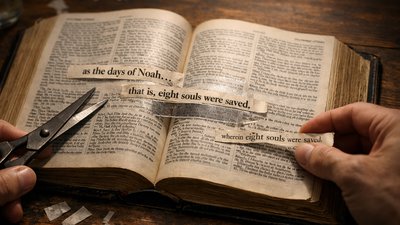
Born Liars? How Scripture Was Rewritten in Branham’s Teaching
William Branham publicly rejected creeds while elevating select composite phrases to doctrinal authority, reframing disagreement as resistance to Scripture itself. By adding, removing, or merging words across passages, these teachings subtly but decisively altered biblical meaning and centralized interpretive control.
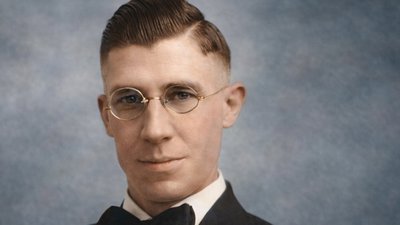
Clyde E. Green: The Minister Who Married William Branham & Hope Brumbach
Clyde E. Green was a Midwestern minister whose career moved from early Church of the Nazarene pastorates into interdenominational revival leadership and ultimately Pentecostal and Primitive Evangelistic authority. His role as the officiant in the 1934 marriage of William Branham and Hope Brumbach places Branham squarely within Roy E. Davis–aligned Pentecostal networks during his formative ministerial years.
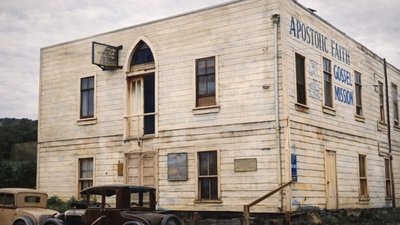
Azusa Street in Flames: Earthquake, Ecstasy, and the Birth of Pentecostal Chaos
In the aftermath of the 1906 San Francisco earthquake, the Azusa Street Revival in Los Angeles emerges as a racially charged, chaotic experiment in Holiness ecstasy that even contemporary newspapers depicted as fanatical, irreverent, and socially destabilizing. Drawing on reports from the Los Angeles Times, critics like Nettie Harwood, and Charles Fox Parham’s own disgust at interracial worship, the narrative traces how a confused mixture of Holiness practices, occult phenomena, and apocalyptic fervor produced “pilgrims” who carried this volatile spirituality into early Pentecostal denominations and later healing revivalists such as F. F. Bosworth.
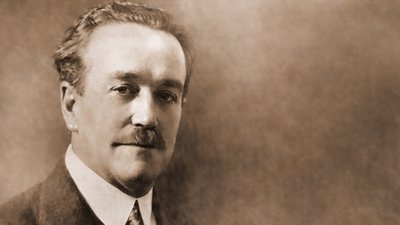
Charles Fox Parham: Fraud, Racism, and the Dark Origins of Pentecostalism
Charles Fox Parham, often credited as a founding figure of Pentecostalism, was deeply entangled with fraud schemes, racial ideology, and extremist theology that shaped both his ministry and his legacy. His promotion of British Israelism, segregation, and apocalyptic communal experiments reveals a movement rooted not only in revivalism but also in white supremacy and exploitation.
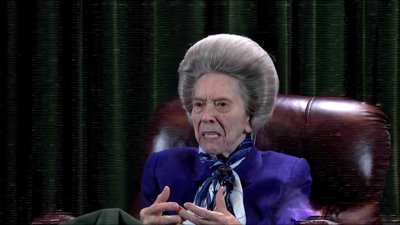
Berniece Hicks: Branham’s Sunday School “Messenger” and the Rise of Christ Gospel Church International
Berniece Hicks emerged from William Branham’s inner circle—teaching in his tabernacle, participating in early revival networks, and adopting the same “Message”-adjacent doctrines and source-material claims—before building Christ Gospel Church International into an isolationist movement centered on her own prophetic authority. Over time, her teachings expanded into militant Manifest Sons/“Joel’s Army” themes, increasingly extraordinary supernatural claims, and accusations from former members that drew public scrutiny, including a 1979 Louisville Courier-Journal investigation.
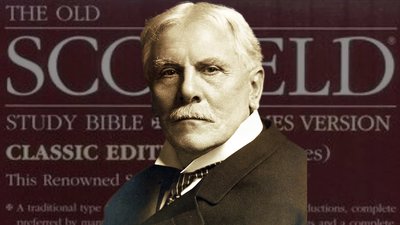
C. I. Scofield: From Forgery Charges to the Scofield Reference Bible
C. I. Scofield, best known for the influential Scofield Reference Bible, rose to prominence after a career marked by political corruption, financial fraud, and criminal convictions for forgery. His later theological authority, heavily indebted to John Nelson Darby’s dispensationalism, profoundly shaped Fundamentalist, Pentecostal, and Latter Rain movements, including ideas used to legitimize modern prophetic and angelic claims.
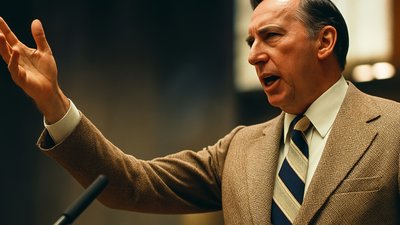
Derek Prince and the Roots of Deliverance Theology
Derek Prince played a formative role in shaping modern Charismatic theology through his teachings on deliverance, spiritual warfare, and prayer, while maintaining close ties to influential networks surrounding William Branham and the Full Gospel Business Men’s Fellowship. His legacy—cemented through the Shepherding Movement and overlapping with Latter Rain and prosperity teachings—helped lay the groundwork for the authoritarian apostolic structures later embraced by the New Apostolic Reformation.
No records found.